Archoseum

Museum Exhibition

Preparing the exhibition

0%
← Museum Home

Research Library

Ancient Migrations & Lost Connections

Movement, Dispersal, and Connection

A special museum study of ancient migration traditions, dispersal, geographic connections, and proposed contact between distant peoples.

Research Room · Chronology & Dispersal

When did the movements begin?

The biblical record presents more than one movement of peoples. First comes the post-Flood spread of Noah's descendants and the division associated with Peleg. Later, Scripture records regional displacements involving peoples remembered as Rephaim, Emim, Zamzummim and Anakim. Centuries after that, the campaigns of Moses and Joshua remove or confine additional giant-associated populations.

The museum therefore treats migration as a sequence, not a single event. Scripture, ancient interpretation, historical commentary and modern hypotheses are kept visibly separate.

✦ Canonical Record ◇ Ancient Source ▣ Historical Commentary △ Research Hypothesis
The chronological hinge

Peleg: “for in his days was the earth divided”

“And unto Eber were born two sons: the name of one was Peleg; for in his days was the earth divided...”Genesis 10:25, KJV

In the Masoretic chronology represented by the KJV genealogies, Peleg's birth falls about 1757 AM, roughly 101 years after the Flood. The wording does not itself explain the mechanism of the division. Because Genesis 10 is immediately followed by the Babel account in Genesis 11, many traditional commentators connect Peleg's “division” with the division of peoples and languages rather than with a physical splitting of continents.

Ancient witnesses preserve the same basic association. Josephus says Peleg received his name because he was born at the dispersion of the nations to their several countries. Jubilees likewise connects Peleg's birth with the descendants of Noah beginning to divide the earth among themselves, although Jubilees uses a chronology different from the Masoretic text.

Flood1656 AM
Genesis 7
Pelegc. 1757 AM
Genesis 10:25
BabelPost-Flood era
Genesis 11:1-9
AbrahamRephaim, Zuzim, Emim
Genesis 14:5
Earlier DisplacementsMoab, Ammon, Edom
Deuteronomy 2
MosesSihon & Og defeated
Numbers 21; Deut. 3
JoshuaAnakim driven out
Joshua 11:21-22
Genealogical bridge

From Peleg to David

Peleg stands near the opening of the post-Flood dispersal story, while David belongs to the later kingdom period when Israel still remembered and confronted surviving giant-associated peoples. The line below follows the biblical ancestry from Peleg to David through Abraham, Isaac, Jacob, Judah and the house of Jesse.

How to read this line: this is a genealogical sequence, not a proportional time scale. Genesis supplies age-based chronology through the patriarchal generations, but the later links from Judah to David are preserved as ancestry rather than a continuous series of father-at-birth ages.
PelegGenesis 10:25
Genesis 11:18
ReuGenesis 11:18-19
SerugGenesis 11:20-21
NahorGenesis 11:22-24
TerahGenesis 11:24-26
AbrahamGenesis 11:26
17:5
IsaacGenesis 21:3
Jacob / IsraelGenesis 25:26
32:28
JudahGenesis 29:35
49:8-10
Pharez / PerezGenesis 38:29
Ruth 4:18
HezronRuth 4:18
RamRuth 4:19
AmminadabRuth 4:19
NahshonRuth 4:20
SalmonRuth 4:20
BoazRuth 4:21
ObedRuth 4:21
JesseRuth 4:22
DavidRuth 4:22
1 Samuel 16

Why this matters here: the migration story and the giant-clan story eventually intersect again. Joshua records surviving Anakim in Gaza, Gath and Ashdod, and later David's generation confronts Goliath of Gath and other giant champions. The genealogy therefore links the era of Peleg's division to the later biblical world in which those surviving traditions and populations are still visible.

From the Flood and Peleg to David and Solomon

This comparison places the museum's biblical chronology beside broadly dated ancient-world developments. The colored civilization bars use conventional historical date ranges and are included as context, not as proof of contact with the biblical peoples shown on the same line.

✦ Biblical record● Giant-clan encounter◇ Dispersal / migration▣ Wider world
Shang China · c. 1600-1046 BC
Egyptian Middle Kingdom and Second Intermediate Period · c. 2055-1550 BC
Egyptian New Kingdom · c. 1550-1070 BC
Old Babylonian period · c. 1894-1595 BC
Minoan civilization · c. 2000-1450 BC
Mycenaean civilization · c. 1600-1100 BC
Hittite kingdom and empire · c. 1650-1200 BC
Middle Assyrian period · c. 1365-934 BC
Olmec horizon begins · c. 1500 BC onward
2350 BC
2150 BC
1950 BC
1750 BC
1550 BC
1350 BC
1150 BC
970 BC
The Floodc. 2348 BC · Genesis 7
Peleg bornc. 2247 BC · Genesis 10:25
Babel and dispersalPost-Flood era · Genesis 11
Ur III worldMesopotamian city-state networks
Middle Kingdom EgyptStrong centralized Nile state
AbrahamPatriarchal period
Rephaim, Zuzim, EmimGenesis 14:5
Indus urban declinec. 1900 BC
IsaacPatriarchal generation
Jacob / IsraelGenesis 32:28
Joseph in EgyptGenesis 37-50
HammurabiBabylon · c. 18th century BC
Hyksos ascendancyEgypt · c. 17th century BC
Mycenaean centers riseGreek mainland · c. 1600 BC
Hittite power expandsAnatolia · Late Bronze Age
Shang dynastyChina · c. 1600 BC onward
Egyptian New KingdomBegins c. 1550 BC
Moses bornTraditional conservative chronology
Thutmose IIIEgyptian imperial campaigns
Exodus1446 BC · conservative chronology
Sihon defeatedNumbers 21
Og of Bashan defeatedDeuteronomy 3
Wilderness generationForty years
Joshua enters Canaanc. 1406 BC · conservative chronology
Anakim driven outJoshua 11:21-22
Amarna age14th century BC
Early JudgesIsrael's tribal period
Ramesses IIEgypt · 13th century BC
Late Bronze collapsec. 1200 BC
Sea Peoples movementsEastern Mediterranean upheaval
Phoenician expansionLevantine maritime networks
Philistine strongholdsGaza, Gath, Ashdod region
Iron Age transitionLevant and eastern Mediterranean
SamuelProphet and judge
Saul becomes king1 Samuel 10
David and Goliath1 Samuel 17
Later giant champions2 Samuel 21
David's reignc. 1010-970 BC
Shang gives way to Zhouc. 1046 BC
Solomon succeeds Davidc. 970 BC
Chronology note: dates for the biblical events follow the museum's conservative KJV-oriented framework where a conventional date is shown. Wider-world civilization bars use standard approximate historical ranges. The purpose is to compare overlap in time, not to account contact or common origin.

The Great Dispersion

Follow the biblical sequence from one post-Flood family to clans, languages, territories and nations.

Museum chronology is limited to the last 6,000 years. Biblical dates follow the museum’s KJV/Masoretic chronology where calculable. For sites or migration models conventionally dated earlier than that limit, the older numerical date is intentionally omitted. Colored bands provide approximate civilization context, including the Americas, and are not evidence of contact by themselves.

Civilization context · approximate date ranges
Old Kingdom Egypt · c. 2686–2181 BC
Sumerian city-states / Akkadian horizon · c. 2900–2154 BC
Indus civilization · c. 2600–1900 BC
Norte Chico / Caral · c. 3000–1800 BC
Minoan civilization · c. 2000–1450 BC
Middle Kingdom / Second Intermediate Egypt · c. 2055–1550 BC
Old Babylonian period · c. 1894–1595 BC
Noah and three sons1656 AM / c. 2348 BCPost-Flood family nucleus
Shem, Ham, JaphethAfter 1656 AMThree principal family branches
Grandsons of Noahc. 1657–1757 AMGenesis 10 national names multiply
Nimrod and early citiesEarly post-Flood eraBabel, Erech, Accad · Gen. 10:8-12
Pelegc. 1757 AM / c. 2247 BC“in his days was the earth divided” · Gen. 10:25
BabelTraditionally near Peleg’s eraLanguage confused and mankind scattered · Gen. 11
Joktanite dwellingPost-Babel eraMesha toward Sephar, mountain of the east
Canaanite bordersPost-Babel eraSidon toward Gaza and inland cities
Maritime peoplesPost-Babel eraGenesis 10:5 describes isles/coasts
Josephus geography1st century AD interpretationAncient Jewish identifications across regions
Shemite eastward associationsPost-Babel distributionMesopotamia, Elam and adjoining regions
Japhethite northern/western traditionsPost-Babel distributionLater historical identifications vary
Hamite southern associationsPost-Babel distributionCanaan, Egypt and African regions
Nations spread abroadGenesis 10 summaryGenesis 10:32 summary
Arphaxad linec. 1658 AMShemite genealogy continues after the Flood
Cush and MizraimEarly post-Flood eraHamite branches associated with southern regions
Canaan and his sonsEarly post-Flood eraSidon, Heth, Jebusite, Amorite and related names
Elam and AsshurEarly post-Flood eraEastern and Mesopotamian names in Genesis 10
Eberc. 1723 AMAncestor in the line leading to Peleg and Abraham
Language families separateAfter BabelGenesis 11 describes confused speech and scattering
Mesha to SepharPost-Babel eraGenesis 10:30 gives a directional Joktanite boundary
Sidon to GazaPost-Babel eraGenesis 10:19 gives a Canaanite territorial description
Isles of the GentilesPost-Babel eraGenesis 10:5 associates Japhethite families with coastlands
Territories become nationsPost-Babel generationsFamilies, tongues, lands and nations become distinct
Trade corridors emerge2nd millennium BCRoutes connect Mesopotamia, Levant, Egypt and Anatolia
Regional identities harden2nd millennium BCKingdoms and city-states become increasingly distinct
Genesis 10 presents families becoming nations in lands and languages. Genesis 11 supplies the scattering account. Later geographical identifications are displayed as interpretation rather than as inspired labels.

Nations Rising

Compare long-lived civilizations with the biblical sequence without implying common origin or contact.

Museum chronology is limited to the last 6,000 years. Biblical dates follow the museum’s KJV/Masoretic chronology where calculable. For sites or migration models conventionally dated earlier than that limit, the older numerical date is intentionally omitted. Colored bands provide approximate civilization context, including the Americas, and are not evidence of contact by themselves.

Civilization context · approximate date ranges
Akkadian legacy and Ur III · c. 2334–2004 BC
Middle Kingdom / Second Intermediate Egypt · c. 2055–1550 BC
Minoan civilization · c. 2000–1450 BC
Hittite kingdom and empire · c. 1650–1200 BC
Shang China · c. 1600–1046 BC
Mycenaean civilization · c. 1600–1100 BC
Olmec horizon · c. 1500–400 BC
Early Dynastic / Akkadian legacyc. 2900–2150 BCMesopotamia
Ur IIIc. 2112–2004 BCSouthern Mesopotamia
Old Kingdom Egypt endsc. 2181 BCTransition into First Intermediate Period
Middle Kingdom Egyptc. 2055–1650 BCRenewed centralized state
Old Babylonian worldc. 2000–1595 BCHammurabi belongs here
Minoan palatial Cretec. 1900–1450 BCAegean maritime civilization
Hyksos in Egyptc. 1650–1550 BCSecond Intermediate Period
Mycenaean Greecec. 1600–1100 BCPalatial centers expand
Hittite Empirec. 1400–1200 BCAnatolian great power
Egyptian New Kingdomc. 1550–1070 BCImperial Egypt
Shang Chinac. 1600–1046 BCBronze Age state tradition
Late Bronze collapsec. 1200 BCMultiple eastern Mediterranean systems fail
Phoenician city networksc. 1200–800 BCMaritime expansion
Iron Age kingdomsc. 1200–900 BCRegional states consolidate
Israelite monarchyc. 1050–930 BCSaul → David → Solomon
Neo-Assyrian ascentc. 900–700 BCLater imperial expansion begins
Sumerian city-statesc. 3500–2000 BCUruk, Ur, Lagash and other southern Mesopotamian centers
Egyptian unificationc. 3100 BCEarly dynastic state along the Nile
Akkadian Empirec. 2334–2154 BCMesopotamian imperial consolidation
Indus urban civilizationc. 2600–1900 BCHarappa and Mohenjo-daro flourish
Amorite dynastiesc. 2000–1600 BCWest Semitic rulers appear across Mesopotamia
Old Assyrian tradec. 2000–1750 BCMerchant colonies link Assur with Anatolia
Hammurabic. 1792–1750 BCBabylon becomes a major regional power
Mitannic. 1500–1300 BCHurrian kingdom between Anatolia and Mesopotamia
Egypt at Amarnac. 1350 BCDiplomatic network links Near Eastern great powers
Ramesses IIc. 1279–1213 BCEgypt contests Hittite influence in the Levant
Sea Peoples upheavalc. 1200 BCEastern Mediterranean populations and states shift
Early Aramean statesc. 1100–900 BCNew polities appear across inland Syria
Zhou Chinafrom c. 1046 BCWestern Zhou replaces Shang rule
Davidic kingdomc. 1010–970 BCJerusalem becomes the center of Israel’s monarchy
These broad bands are comparative chronology. Dates for ancient civilizations are approximate and should not be used to force synchronisms where the evidence is under study.

Giant Clans & Displacement

Trace only what the biblical record actually says, then show where the documented trail becomes under study.

Museum chronology is limited to the last 6,000 years. Biblical dates follow the museum’s KJV/Masoretic chronology where calculable. For sites or migration models conventionally dated earlier than that limit, the older numerical date is intentionally omitted. Colored bands provide approximate civilization context, including the Americas, and are not evidence of contact by themselves.

Civilization context · approximate date ranges
Egyptian Middle Kingdom and Second Intermediate Period · c. 2055–1550 BC
Old Babylonian period · c. 1894–1595 BC
Minoan civilization · c. 2000–1450 BC
Hittite kingdom and empire · c. 1650–1200 BC
Shang China · c. 1600–1046 BC
Poverty Point · c. 1700–1100 BC
Olmec horizon · c. 1500–400 BC
RephaimPatriarchal era · Genesis 14Named in Genesis 14:5
ZuzimPatriarchal era · Genesis 14Genesis 14:5
EmimPatriarchal era · Genesis 14Genesis 14:5; later remembered in Moab
AnakimBefore Israel enters CanaanAssociated with Hebron and hill country
Emim displacedBefore c. 1406 BCMoab possessed their land · Deut. 2
Zamzummim displacedBefore c. 1406 BCAmmon possessed their land · Deut. 2
Og of Bashanc. 1407 BCRemnant of giants · Deut. 3:11
Sihon defeatedc. 1407 BCIsrael takes Amorite territory
Og defeatedc. 1407 BCBashan taken by Israel
Joshua attacks Anakimc. 1406–1399 BCHill country campaigns · Josh. 11
Anakim remnantsAfter c. 1400 BCGaza, Gath, Ashdod remain
Goliath of Gathc. 1020 BC1 Samuel 17
Other giant championsc. 1010–1000 BC2 Samuel 21
Biblical trail narrowsAfter Davidic eraNo scriptural migration route beyond these populations
Migration questionUndated hypothesisCaucasus / Asia / farther east?
New World account boundaryUndated hypothesisRequires independent archaeology, chronology and population evidence
Rephaim at Ashteroth Karnaimc. 2000 BCGenesis 14:5 places Rephaim east of the Jordan
Zuzim in Hamc. 2000 BCGenesis 14:5 names another large-warrior population
Emim at Shaveh Kiriathaimc. 2000 BCGenesis 14:5 places Emim in Moabite territory
Horim in Mount SeirPatriarchal eraGenesis 14 and Deuteronomy 2 preserve territorial memory
Moab replaces EmimBefore MosesDeuteronomy 2:10-11 recalls an earlier displacement
Ammon replaces ZamzummimBefore MosesDeuteronomy 2:20-21 recalls another displacement
Og rules BashanBefore c. 1406 BCKing of Bashan, identified with the remnant of giants
Sihon defeatedc. 1407 BCIsrael takes Amorite territory east of Jordan
Og defeatedc. 1407 BCBashan falls to Israel under Moses
Anakim in Hebronc. 1406 BCJoshua’s campaigns reach the hill country
Caleb takes Hebronc. 1400 BCAnakite stronghold passes to Caleb
Gaza, Gath, Ashdod remainc. 1400 BC onwardJoshua 11:22 preserves three survivor centers
Goliath of Gathc. 1020 BCDavid confronts the Philistine champion
Later champions defeatedc. 1000 BCDavid’s warriors defeat additional giant-associated fighters
The solid biblical sequence ends with named peoples and surviving Philistine-area champions. Any proposed movement beyond the biblical map belongs in a separate hypothesis layer.

Population Expansion After the Flood

Show growth using textual anchors while refusing to turn genealogy into a false census.

Museum chronology is limited to the last 6,000 years. Biblical dates follow the museum’s KJV/Masoretic chronology where calculable. For sites or migration models conventionally dated earlier than that limit, the older numerical date is intentionally omitted. Colored bands provide approximate civilization context, including the Americas, and are not evidence of contact by themselves.

Civilization context · approximate date ranges
Old Kingdom to Middle Kingdom Egypt · c. 2686–1650 BC
Sumer, Akkad and Ur III · c. 2900–2004 BC
Indus civilization · c. 2600–1900 BC
Norte Chico / Caral · c. 3000–1800 BC
Minoan civilization · c. 2000–1450 BC
Shang China · c. 1600–1046 BC
Olmec horizon · c. 1500–400 BC
8 aboard the Ark1656 AM / c. 2348 BCGenesis 7:13
Three sons establish familiesAfter 1656 AMGenesis 9-10
Named descendants multiplyc. 17th–18th centuries AMTable of Nations
Peleg generationc. 1757 AM / c. 2247 BCDivision associated with his days
Cities and organized peoplesEarly post-Flood eraBabel and early kingdoms
Abrahamic householdc. 2000 BCLarge mobile household and retainers
Jacob enters Egyptc. 1876 BCSeventy persons in KJV count · Gen. 46:27
Israel grows in Egyptc. 1876–1446 BCExodus 1 emphasizes multiplication
Exodus census traditionc. 1446 BCNumbers records tribal musters
Settlement in Canaanc. 1406 BC onwardTribal territories and towns
Judges erac. 14th–11th centuries BCDistributed tribal population
United monarchyc. 1050–930 BCCentralized kingdom under Saul and David
Urban and administrative growthc. 1000–930 BCJerusalem and kingdom institutions
Eight survivors1656 AM / c. 2348 BCGenesis begins the post-Flood world with Noah’s household
Three family branchesImmediately after FloodShem, Ham and Japheth become heads of expanding lines
Genesis 10 clans multiply1st century after FloodNamed sons and grandsons form larger kinship groups
Peleg generationc. 1757 AM / c. 2247 BCDivision and dispersal occur within a growing population
Abram’s householdc. 2000 BCA patriarchal household includes servants and armed retainers
Isaac and Jacob householdsc. 1900 BCFamily lines expand into multiple tribal households
Jacob enters Egyptc. 1876 BCGenesis 46 counts seventy persons of Jacob’s house
Israel multiplies in Egypt1876–1446 BCExodus 1 repeatedly emphasizes rapid increase
Exodus hostc. 1446 BCExodus 12:37 reports about 600,000 men besides children
Wilderness censusc. 1446 BCNumbers records a large tribal military census
Second wilderness censusc. 1407 BCA new generation is counted before entry into Canaan
Settlement spreadsc. 1400–1100 BCTribal populations occupy multiple regions of Canaan
Urban centers consolidatec. 1100–1000 BCPopulation gathers around fortified towns and royal centers
United monarchyc. 1050–930 BCIsrael’s population is organized under a centralized kingdom
Scripture gives named descendants, households and some later population figures, but it does not provide a continuous world census. The widening bands therefore show increasing social scale, not exact global population totals.

Migration Highways

Follow the geographic routes that made large-scale movement possible across the ancient world.

Museum chronology is limited to the last 6,000 years. Biblical dates follow the museum’s KJV/Masoretic chronology where calculable. For sites or migration models conventionally dated earlier than that limit, the older numerical date is intentionally omitted. Colored bands provide approximate civilization context, including the Americas, and are not evidence of contact by themselves.

Civilization context · approximate date ranges
Mesopotamian city-state and kingdom networks · 3rd–2nd millennium BC
Egyptian kingdoms and Nile corridor · 3rd–2nd millennium BC
Minoan and Mycenaean Aegean · c. 2000–1100 BC
Hittite Anatolia · c. 1650–1200 BC
Shang China · c. 1600–1046 BC
Poverty Point exchange sphere · c. 1700–1100 BC
Olmec interaction sphere · c. 1500–400 BC
Fertile CrescentActive throughout ancient Near Eastern historyMesopotamia ↔ upper Euphrates ↔ Levant
Levantine land bridgePrehistory through antiquityAfrica ↔ Asia
Nile corridorPredynastic era through antiquityDelta ↔ Upper Egypt ↔ Nubia
Anatolian routesBronze Age and earlierLevant ↔ Taurus ↔ Anatolia
Caucasus gatewaysBronze Age and earlierAnatolia / Mesopotamia ↔ steppe
Eurasian steppe3rd–1st millennia BC and beyondLong east-west mobility corridor
Iranian plateau3rd–1st millennia BCMesopotamia ↔ Central / South Asia
Central Asian corridors2nd–1st millennia BC and beyondOases and mountain passes
Inner Asian routes2nd–1st millennia BC and beyondSteppe and basin networks
Northeast AsiaPrehistoric through historic periodsSiberian and Pacific-facing routes
BeringiaEarlier conventional chronology · numerical date omittedPleistocene connection to Alaska
American dispersal corridorsEarlier conventional chronology · numerical date omittedCoastal and interior movements
Maritime routesBronze Age onwardMediterranean / Indian Ocean / Pacific possibilities
Upper Euphrates corridor2nd millennium BCMovement between Mesopotamia, Syria and Anatolia
Fertile Crescent arc2nd millennium BCA broad land route links river valleys and the Levant
Via Maris2nd millennium BCCoastal road connects Egypt with Canaan and Syria
King’s Highway2nd millennium BCTransjordan route links Bashan, Ammon, Moab and Edom
Nile corridor2nd millennium BCNorth-south movement through Egypt and Nubia
Red Sea routes2nd millennium BCMaritime links toward Arabia and northeast Africa
Persian Gulf routes2nd millennium BCSea traffic connects southern Mesopotamia with eastern trade
Caucasus gateways2nd millennium BCMountain passes connect Anatolia, steppe and Near East
Central Asian steppe2nd–1st millennium BCPastoral routes permit long-distance east-west movement
Arabian caravan routes2nd–1st millennium BCOasis chains channel movement across Arabia
Mediterranean sea lanes2nd–1st millennium BCIsland and coastal networks connect the Levant and Aegean
Phoenician maritime expansionc. 1100–800 BCWestern Mediterranean colonies extend seaborne networks
Silk Road precursors1st millennium BCEarlier Eurasian exchange networks precede formal Silk Roads
These are geographic corridors, not accounts that a particular biblical clan traveled their entire length. A corridor demonstrates possibility of movement, not identity of the people moving through it.

Megaliths Across Time & Geography

Compare monumental building horizons without assuming a single migrating builder population.

Museum chronology is limited to the last 6,000 years. Biblical dates follow the museum’s KJV/Masoretic chronology where calculable. For sites or migration models conventionally dated earlier than that limit, the older numerical date is intentionally omitted. Colored bands provide approximate civilization context, including the Americas, and are not evidence of contact by themselves.

Civilization context · approximate date ranges
Dynastic Egypt and monumental stone building · c. 3100 BC onward
Minoan / Mycenaean Aegean · c. 2000–1100 BC
Hittite Anatolia · c. 1650–1200 BC
Late Bronze / Iron Age Levant · c. 1550–586 BC
Norte Chico monumental centers · c. 3000–1800 BC
Olmec monumental tradition · c. 1500–400 BC
Adena / Hopewell mound traditions · c. 1000 BC–500 AD
Göbekli TepeDate omitted · outside museum 6,000-year chronologyAnatolia · early monumental ritual architecture
JerichoDate omitted · outside museum 6,000-year chronologyLevant · early tower and settlement
European dolmen traditionsLater phases c. 4000–2500 BCMultiple Neolithic regions and dates
Malta templesc. 3600–2500 BCCentral Mediterranean
Stonehenge landscapec. 3000–1600 BCBritain · multi-phase monument
Egyptian pyramidsc. 2700–2200 BCOld Kingdom monumental masonry
Aegean monumental buildingc. 2000–1100 BCMinoan / Mycenaean traditions
Cyclopean masonryc. 1400–1200 BCMycenaean citadels
Nuragic Sardiniac. 1800–500 BCBronze Age tower tradition
Levantine megalithic landscapesBroad Bronze Age and earlier rangesDolmens and large-stone traditions
Baalbek later monumental phases1st century BC–3rd century ADRoman-period platform and temples
North American earthworksc. 3500 BC–1500 ADDifferent technology, monumental landscape tradition
Comparative questionSpans multiple periodsDiffusion, convergence, or many local traditions?
Early Anatolian monumental sitesDate omitted · outside museum 6,000-year chronologyOlder conventional dates are not displayed here
Early Jericho settlement phasesDate omitted · outside museum 6,000-year chronologyOlder conventional dates are not displayed here
Ggantija, Maltac. 3600–3200 BCMassive freestanding temple complex
Newgrangec. 3200 BCIreland · passage tomb aligned to winter sunrise
Avebury complexc. 2850–2200 BCBritain · large stone circle and ceremonial landscape
Great Pyramid of Gizac. 2560 BCEgypt · monumental limestone construction
Stonehenge stone phasesc. 2500–1600 BCBritain · major sarsen and bluestone construction phases
Levant dolmen fieldsc. 3000–2000 BCLarge-stone tomb traditions east of the Jordan
Nuraghi of Sardiniac. 1800–500 BCTower-building tradition across Sardinia
Mycenae fortificationsc. 1350 BCCyclopean masonry at the Lion Gate and citadel walls
Tirynsc. 1300 BCMassive Cyclopean defensive walls
Jerusalem monumental building10th century BC and laterLarge public works belong to a later architectural horizon
Baalbek Roman complex1st century BC–3rd century ADHuge stone blocks incorporated into Roman-period construction
This museum timeline does not print numerical dates older than 6,000 years. Sites conventionally assigned earlier dates remain visible as comparative subjects, but their older numerical dates are omitted. Similar stone construction is not by itself evidence of contact.

The Road to the Americas

End the research sequence where the strongest migration evidence and the museum’s most exploratory questions must be visibly separated.

Museum chronology is limited to the last 6,000 years. Biblical dates follow the museum’s KJV/Masoretic chronology where calculable. For sites or migration models conventionally dated earlier than that limit, the older numerical date is intentionally omitted. Colored bands provide approximate civilization context, including the Americas, and are not evidence of contact by themselves.

Civilization context · approximate date ranges
Norte Chico / Caral · c. 3000–1800 BC
Poverty Point · c. 1700–1100 BC
Olmec horizon · c. 1500–400 BC
Maya Preclassic · c. 2000 BC–250 AD
Adena tradition · c. 1000 BC–200 AD
Hopewell tradition · c. 100 BC–500 AD
Cahokia / Mississippian florescence · c. 1050–1350 AD
Northeast Asian populationsEarlier conventional chronology · numerical date omittedArchaeological and genetic background
BeringiaEarlier conventional chronology · numerical date omittedAncient land region connecting Asia and Alaska
Alaska / YukonEarlier conventional chronology · numerical date omittedEarly movement into northwestern North America
Pacific coastal route modelEarlier conventional chronology · numerical date omittedOne major scholarly migration model
Interior corridorEarlier conventional chronology · numerical date omittedAnother route discussed in peopling research
North American dispersalEarlier conventional chronology · numerical date omittedRapid occupation of diverse environments
Central AmericaEarlier conventional chronology · numerical date omittedPopulation movement continues south
South AmericaEarlier conventional chronology · numerical date omittedEarly archaeological occupations
Later regional civilizationsAfter c. 3000 BCIndependent cultural histories develop
Trans-Pacific contact accountsVarious proposed datesCase-by-case evaluation required
Atlantic contact accountsVarious proposed datesCase-by-case evaluation required
Biblical-clan hypothesisNo established dateNo established archaeological chain
Research thresholdRequires independently dated evidenceDNA + dated artifacts + secure context + route continuity
Northeast Asia backgroundDate omitted · outside museum 6,000-year chronologyEarlier conventional population models are acknowledged without older dates
Bering land regionDate omitted · outside museum 6,000-year chronologyGeographic connection between Asia and Alaska
Early northwestern movementDate omitted · outside museum 6,000-year chronologyOlder conventional dates are intentionally not displayed
Coastal migration modelDate omitted · outside museum 6,000-year chronologyOne major route proposed by archaeologists
Interior corridor modelDate omitted · outside museum 6,000-year chronologyAnother proposed route into the continental interior
Regional population spreadWithin museum chronology, exact starting date under continued studyMultiple environments are occupied across the Americas
Norte Chico / Caralc. 3000–1800 BCEarly monumental centers on the Peruvian coast
Poverty Pointc. 1700–1100 BCLarge earthworks and exchange network in Louisiana
Olmec horizonc. 1500–400 BCMajor Mesoamerican cultural tradition
Adena traditionc. 1000 BC–200 ADEastern North American mound-building tradition
Hopewell traditionc. 100 BC–500 ADWide exchange networks and monumental earthworks
Cahokiac. 1050–1350 ADLarge Mississippian urban and mound center
This museum timeline does not print numerical dates older than 6,000 years. Earlier conventional migration models are acknowledged without displaying their older numerical dates. Proposed links between biblical peoples and the Americas remain research questions unless supported by direct evidence.
StagePeople / EventWhat the record saysDirection or resultEvidence level
1 · Post-Flood divisionPeleg and BabelGenesis 10:25 marks a division in Peleg's days. Genesis 11 describes language confusion and the scattering of mankind “upon the face of all the earth.”Broad dispersal from the Babel regionCanonical
2 · Patriarchal periodRephaim, Zuzim, EmimGenesis 14:5 places these named peoples in Transjordan before the later Israelite conquest.Established regional populations east of CanaanCanonical
3 · Pre-Israel displacementEmim, Zamzummim, HorimDeuteronomy 2 remembers earlier inhabitants being dispossessed by Moab, Ammon and the descendants of Esau. The Emim and Zamzummim are compared in stature to the Anakim.Replacement and contraction of older populationsCanonical
4 · MosesSihon and Og of BashanIsrael defeats the Amorite kingdoms east of Jordan. Og is explicitly described as a remnant of the giants.Loss of Bashan and Transjordan strongholdsCanonical
5 · JoshuaAnakimJoshua 11 says the Anakim were cut off from the mountains, with survivors remaining in Gaza, Gath and Ashdod.Survivors concentrated toward the Philistine coastCanonical
6 · Later memoryPhilistine championsGoliath and later giant warriors appear in the Philistine sphere, especially Gath.A surviving western enclave is documented in the biblical narrativeCanonical
7 · Wider eastward movementSurviving giant-associated clansNo biblical passage traces Anakim, Rephaim or related clans from Canaan across Asia.Possible migration eastward is a research question, not an established routeHypothesis

Migration Route Study

Possible Eastward Route Toward the Americas

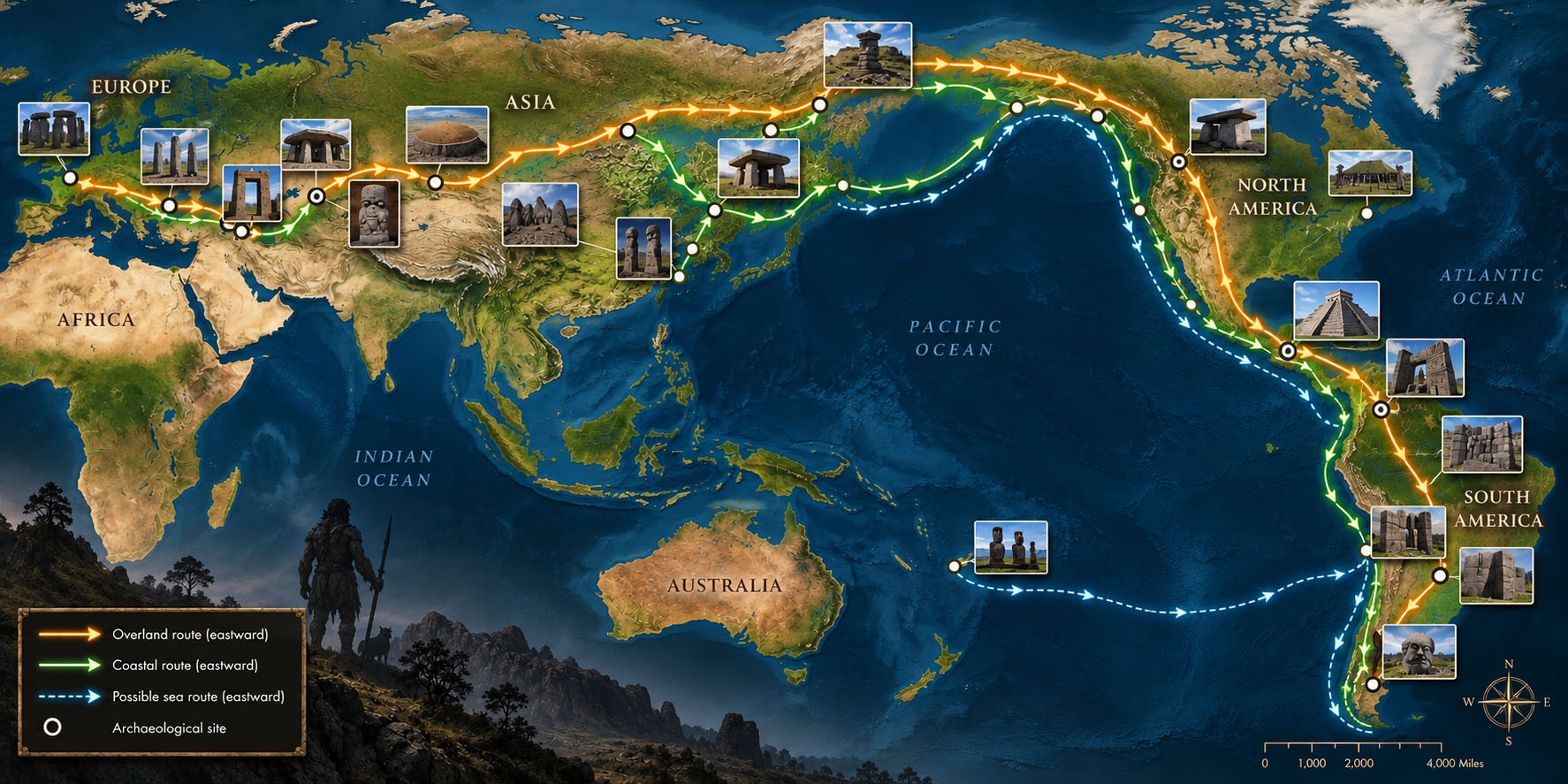
This illustrated research map compares a possible eastward route through Eurasia with dolmens, megalithic architecture and other monumental sites along the way. The route is presented as a museum research hypothesis, not as an established archaeological migration trail.

Research hypothesis. Architectural resemblance or geographic sequence alone does not establish that the same people built the sites shown or traveled the proposed route.

Ancient & Historical Witnesses

How has the division been understood?

Several interpreters connect Peleg with a real dispersal of peoples, but they do not all describe the event in precisely the same way. Their testimony is useful as interpretation, not as a substitute for the biblical text.

1st century AD · Josephus

Dispersion into separate countries

Josephus states that Peleg was named because he was born at the time the nations were dispersed to their several countries. He also assigns descendants of Noah across broad regions of Asia, Europe and Africa. This is an ancient Jewish geographical interpretation of Genesis 10.

Traditional Genesis commentators

Division connected with Babel

Commentators represented in the Pulpit Commentary, including references to Keil, Lange and Murphy, commonly connect Genesis 10:25 with the confusion of languages and dispersal at Babel. A minority of older proposals understood “division” differently, so the museum should not present one interpretation as a verse-level certainty.

Ancient non-canonical tradition · Jubilees

Earth allotted among Noah's descendants

Jubilees 8 connects Peleg's birth with Noah's descendants beginning to divide the earth and then describes territorial allotments to Shem, Ham and Japheth. Its dates differ from the KJV genealogical chronology and should remain separately labeled.

The question beyond the biblical map

Scripture clearly records dispersal, territorial replacement and the survival of some giant-associated populations. What Scripture does not provide is a continuous itinerary carrying those clans east across Asia and into the Americas.

That possibility can still be investigated, but it belongs in the museum as a hypothesis. A serious case would need a chain of evidence that agrees in chronology, geography, archaeology, biological ancestry and securely provenanced historical records. Similar giant traditions by themselves are not enough to establish common descent.

Research question: After the documented contractions around Canaan and Transjordan, did any surviving population move beyond the biblical theater, and can any traceable evidence distinguish migration from independent traditions about unusually large people?

Research notes & source boundaries

  • KJV chronology: Genesis 5, 7, 10 and 11. The 1757 AM placement for Peleg is calculated from the Masoretic genealogical figures used by the KJV.
  • Giant-associated populations and displacements: Genesis 14:5; Deuteronomy 2:10-23; Deuteronomy 3:1-13; Joshua 11:21-22; 1 Samuel 17; 2 Samuel 21.
  • Josephus, Antiquities of the Jews, Book I, chapter 6, gives an ancient Jewish interpretation of post-Flood national settlement and Peleg's name.
  • Jubilees 8 gives a non-canonical territorial division account and a chronology distinct from the KJV/Masoretic line.
  • Modern accounts connecting biblical giant clans to the Americas are not established by mainstream archaeology and are treated here as research hypotheses only.
  • Genealogical line from Peleg to David: Genesis 10:25; 11:18-26; Genesis 21; 25; 29; 38; Ruth 4:18-22; 1 Chronicles 2:4-15.