Frontiers of Science & Architecture
The publicly known edge of human capability. Enter six escalating frontiers focused on technologies operating now, newly deployed systems, active prototypes, major systems in active construction, officially disclosed programs, and the most serious next-generation engineering proposals.
The Intelligence of Man
The biblical record does not introduce humanity as intellectually primitive. Adam is presented from the beginning as a reasoning, speaking man capable of naming the animals, understanding instruction, cultivating the ground, and passing knowledge to succeeding generations. Within only a few generations, Genesis records cities, livestock management, musical instruments, and the working of brass and iron. From Adam to the Flood, the genealogical chronology of Genesis records approximately 1,656 years of human development. That is an extraordinary span of time. In modern life we often wonder where technology may be only twenty years from now. The pre-Flood world, by comparison, had already experienced more than sixteen centuries of human life and accumulated knowledge. In that sense, those generations were not merely twenty years farther along a human timeline, but potentially hundreds upon hundreds of years farther into their own continuing course of discovery. If mankind possessed from the beginning the intellectual capacity implied by being created in the image of God, then the world before the Flood deserves to be considered not merely in terms of what was lost, but in terms of what human beings may have learned, built, discovered, and understood during more than sixteen centuries of civilization.
Imagine for a moment that the Flood had never occurred. Instead of civilization experiencing a catastrophic break, nearly six thousand years of accumulated human knowledge could have passed continuously from generation to generation. What would such a civilization have become? Would its people simply have constructed larger cities, greater monuments, and more ambitious works of stone, or would their knowledge eventually have moved into realms we associate with modern science: energy, flight, astronomy, advanced mathematics, materials, medicine, and the deeper laws governing the physical world? After the Flood, Noah and the seven others aboard the Ark carried human knowledge into a profoundly changed world, but civilization nevertheless had to be established again. What survived through memory, experience, skills, and inherited knowledge became the foundation upon which later societies built. The question is therefore fascinating: how different might the history of human advancement have been if that first world had never been interrupted?
Scripture also presents human experience as extending beyond architecture and mechanical invention. Prophets were shown events far beyond their own time. Men received visions of heaven. Enoch was taken by God. Elijah departed in a whirlwind. Ezekiel described extraordinary visions, and later John was shown events and places completely beyond his ordinary surroundings. Scripture tells us what they experienced, though it does not describe those experiences using the terminology of modern physics. Concepts such as dimensions, wormholes, nonlocal communication, or other mechanisms therefore remain modern possibilities rather than biblical explanations. Yet the larger question remains worth exploring: how far can human understanding reach? From the first generations to computers, aircraft, spacecraft, artificial intelligence, and our continuing attempt to reach beyond Earth, mankind has never stopped investigating the boundaries of what is possible. Perhaps the greater mystery is not whether ancient man was intelligent, but how much of humanity's original potential has been discovered, lost, rediscovered, or still remains ahead of us.
Human advancement is not necessarily a straight line. A civilization may master stone while another masters silicon; one may transform landscapes while another reaches into space. The exhibits ahead explore what human intelligence has accomplished, what it may yet accomplish, and whether the boundaries we accept today are truly the boundaries of tomorrow.
David Pinter - Curator
Frontiers presents the leading edge of publicly known technology as of September 2026. Retired technology appears only as a benchmark. Classified capabilities are never reconstructed from rumor. Future systems are identified by their actual development status.
Where Today Meets Tomorrow
Open a frontier below to explore the technologies, engineering challenges, scientific breakthroughs, and civilization-scale ideas shaping the edge of what humanity can build and understand.
01Frontier 01Engineering the EarthBridges · Architecture · Tunnels · Geographic Engineering

Humanity already builds at scales that would have seemed impossible to earlier engineers. This Frontier begins with the strongest public evidence of present capability: record spans, megatall towers, deep tunnels, immersed sea crossings, artificial land, and the digital systems used to keep them safe. Historical projects appear only when they remain a current benchmark.
Extreme BridgesSpans that seem to challenge gravity

The bridge frontier is no longer defined simply by making a bridge longer. The modern challenge is to combine extreme span, aerodynamic stability, seismic resistance, corrosion control, structural health monitoring, and construction logistics at scales that would have been nearly impossible a generation ago.
| Structure | What makes it frontier-level | Publicly documented scale | Status |
|---|---|---|---|
| 1915 Çanakkale Bridge | Longest main span of any suspension bridge and extremely tall towers. The 2,023 m central span demonstrates how far modern cable systems, aerodynamic deck design, fabrication tolerances, and erection methods can be pushed. | 2,023 m main span; 4,608 m bridge length | Operational |
| Hong Kong-Zhuhai-Macao Bridge | A bridge, artificial-island, and immersed-tunnel transportation system rather than a single structure. It solves marine navigation, foundation, typhoon, durability, and logistics problems across one integrated corridor. | 55 km total system | Operational |
| Next extreme-span concepts | Longer crossings are technically imaginable, but every additional increase magnifies wind response, cable forces, erection risk, maintenance, and cost. New materials and active monitoring may matter as much as raw span length. | Beyond 2 km main spans | Engineering frontier |
A suspension bridge works by converting the weight of the roadway into tension in the main cables, then into compression in the towers, and finally into enormous anchorage forces at each end. At record spans, wind and dynamic motion can become as important as gravity itself.
For Frontiers, the important question is not whether a bridge looks impossible. It is how engineers make a flexible structure several kilometers long behave predictably through decades of storms, temperature cycles, traffic, earthquakes, and maintenance.
Current public benchmark: 1915 Çanakkale remains the record main-span suspension bridge in 2026.
Engineering deep dive
What makes this frontier difficult
| Frontier variable | Why it matters | Evidence that would move the field |
|---|---|---|
| Wind engineering | Full-scale aerodynamic behavior, vortex shedding, flutter margins | Wind-tunnel correlation with real sensor data |
| Materials | Higher-strength wire, low-maintenance coatings, fatigue-resistant details | Long-term durability without excessive self-weight |
| Operations | Inspection, cable replacement strategy, seismic recovery | Lifecycle performance rather than opening-day records |
Architecture Beyond ImaginationBuilding higher, lighter and smarter
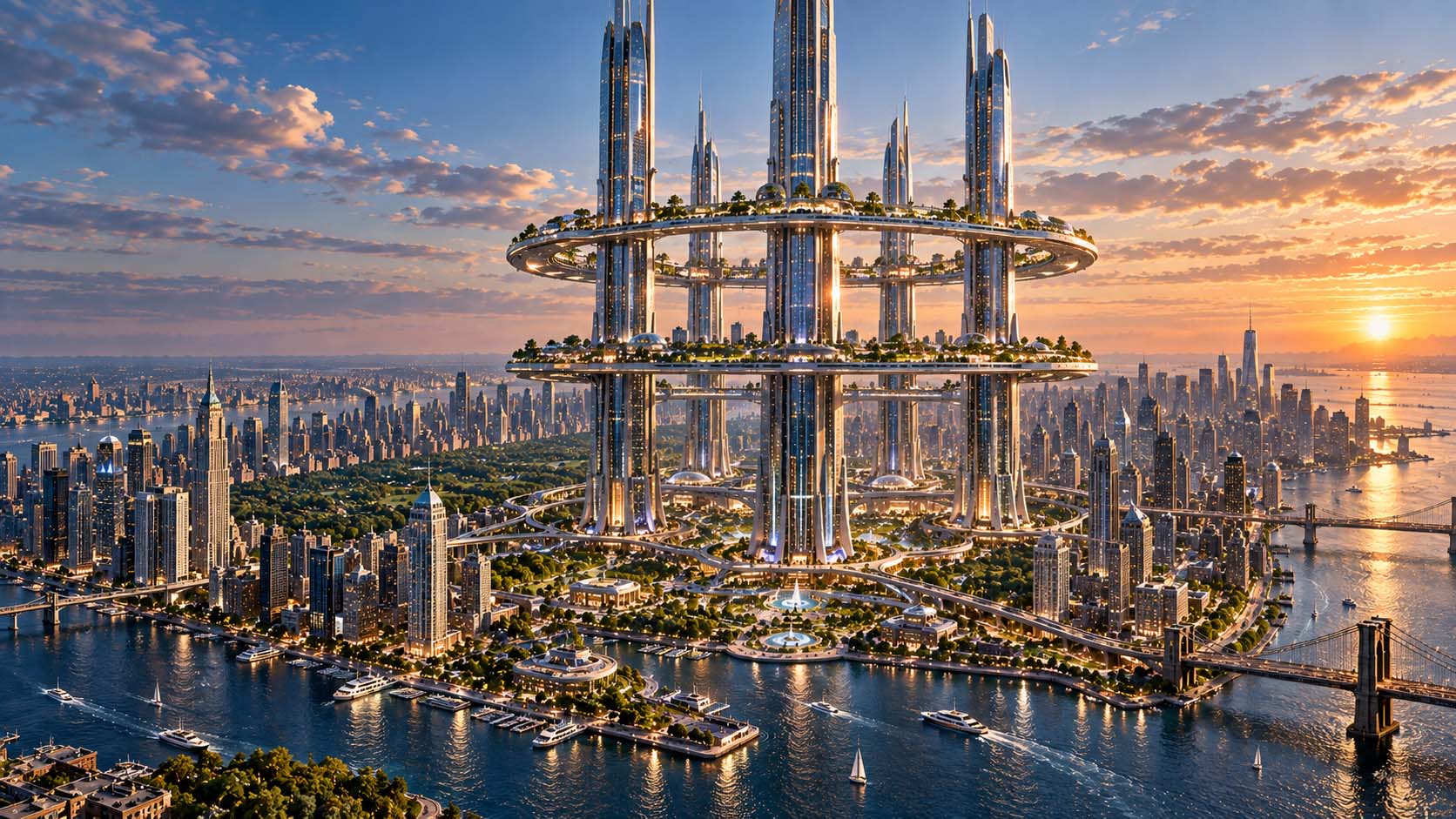
The vertical frontier combines structural systems, wind engineering, elevators, pumping, facade performance, fire safety, construction sequencing, and the human problem of moving thousands of people through a building that behaves almost like a small city.
In 1956, Frank Lloyd Wright unveiled The Illinois, an extraordinary unbuilt proposal for Chicago. Wright envisioned a skyscraper one mile high with 528 stories and more than 18 million square feet of floor space, large enough to accommodate more than 100,000 people. Access was conceived on the scale of a city, with highways, rail lines, a heliport, aircraft docking, extensive automobile parking, and 76 high-speed elevators. Wright called the project a “city in the sky.”
The two-mile vertical city imagined here begins with a similar question but develops it as a connected urban system rather than a single tower. Several supertall structures share the city's office demand while three immense inhabited rings tie the towers together. Those rings become horizontal neighborhoods in the sky, combining living quarters, gardens, recreation, services, shopping, dining, schools, and transportation while also providing additional structural connections between towers. Below, land once required for dense office development can be reconsidered as parks, cultural spaces, restaurants, pedestrian districts, and public landscape.
Historical precedent: Frank Lloyd Wright Foundation, The Illinois, Chicago proposal, 1956. Wright's project was never built. The two-mile towers and inhabited ring system shown above are a exploratory extension and are not part of Wright's design.
| Building / concept | Height or target | Frontier significance | Status |
|---|---|---|---|
| Burj Khalifa | 828 m | Still the tallest completed building. Its buttressed-core system, high-pressure concrete pumping, facade engineering, and vertical transportation remain a reference point for megatall design. | Operational benchmark |
| Jeddah Tower | More than 1,000 m planned | A serious attempt to cross the one-kilometer inhabited-building threshold. Wind, elevator travel, concrete placement, foundation behavior, and construction logistics become even more demanding. | Construction active |
| Vertical city concepts | Multi-use megastructures | The frontier is shifting toward towers that integrate housing, work, transit, food, energy, public space, and services rather than functioning as isolated office or residential buildings. | Proposal / research |
At extreme height, a tower does not stand perfectly still. It moves. Engineers shape the building, tune its stiffness, model vortex shedding, and may use dampers so movement remains safe and tolerable for occupants.
The Frontiers test is not whether a rendering is spectacular. The concept belongs here only when the structural system, material strategy, construction method, and operating systems are serious enough to be treated as engineering rather than fantasy.
Engineering deep dive
What makes this frontier difficult
| Frontier variable | Why it matters | Evidence that would move the field |
|---|---|---|
| Megatall structures | Kilometer-class occupied buildings | Construction progress, wind studies, vertical transport systems |
| Materials | Ultra-high-strength concrete, composite columns, high-strength steel | Pumpability, creep, shrinkage, fire behavior, embodied carbon |
| Building intelligence | Digital twins and continuous monitoring | Predictive maintenance and operational optimization |
Through Mountains & Beneath OceansCivil engineering where geography says no
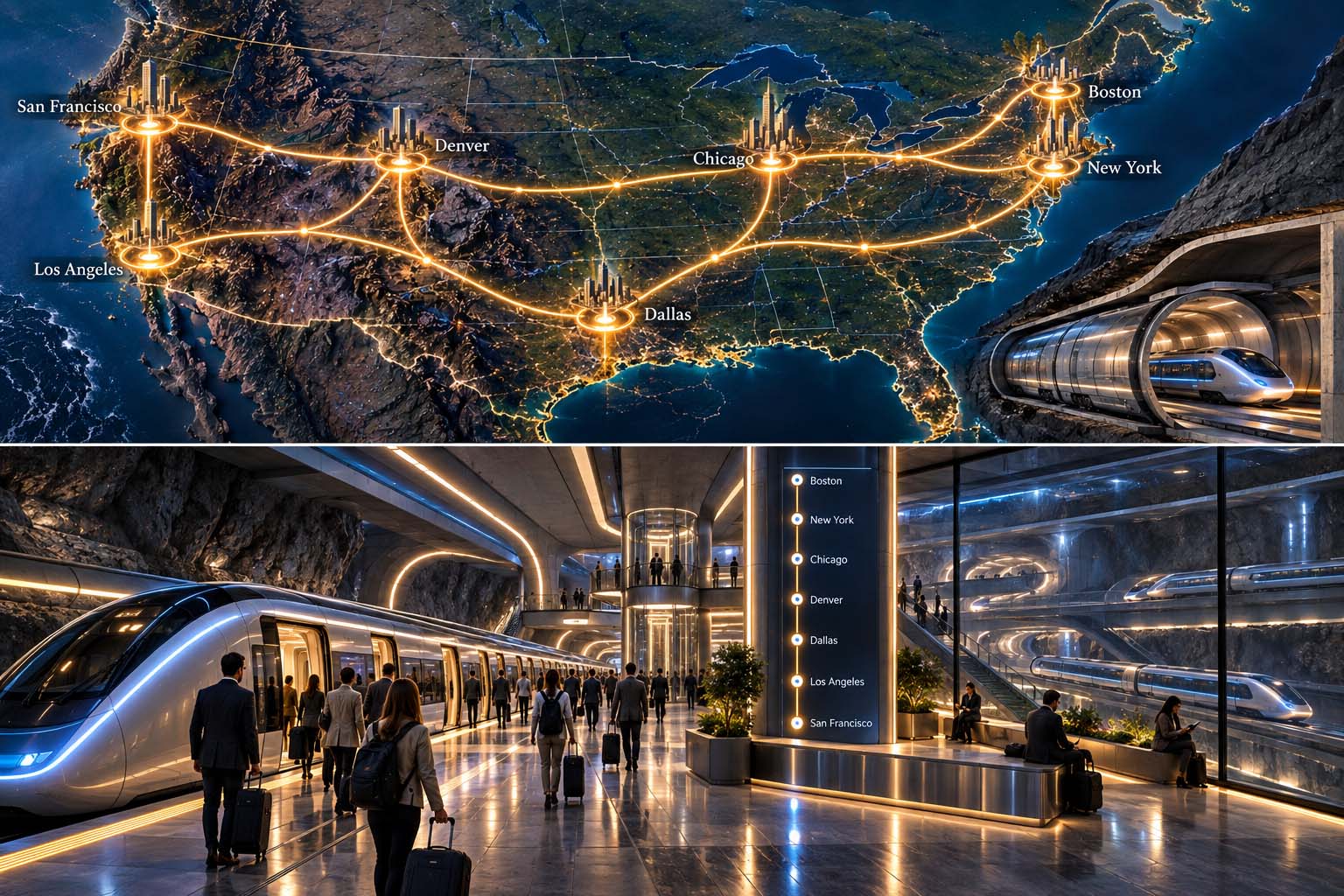
Tunneling technology now allows infrastructure to pass beneath seas, through mountain massifs, and under dense cities with extraordinary precision. Modern tunnel engineering is an orchestration of geology, pressure control, fire safety, ventilation, surveying, waterproofing, and automated excavation.
| Project | Engineering method | Scale | Why it matters |
|---|---|---|---|
| Gotthard Base Tunnel | Deep twin-bore hard-rock railway tunnel | 57.1 km | The longest railway tunnel in operation, cutting through the Swiss Alps with high-speed, low-gradient rail infrastructure. |
| Fehmarnbelt Tunnel | Immersed tube assembled from prefabricated elements | 18 km | Designed to become the world’s longest immersed tunnel. In 2026, installation of its giant seabed elements is underway. |
| Deep urban tunneling | Tunnel boring machines, ground freezing, slurry and earth-pressure balance methods | Project dependent | Makes it possible to add rail, utilities, flood control, and road systems beneath existing cities with reduced surface disruption. |
An immersed tunnel is fabricated in large watertight sections, floated into position, lowered into a prepared trench, joined, sealed, and buried. A bored tunnel is excavated through soil or rock by drilling, blasting, or a tunnel boring machine.
The spectacular part is often invisible. What looks like a simple line on a map may require years of geological investigation and an underground construction system operating continuously in an environment where access is constrained and mistakes are exceptionally expensive.
Engineering deep dive
What makes this frontier difficult
| Frontier variable | Why it matters | Evidence that would move the field |
|---|---|---|
| Excavation | Higher automation and real-time geology prediction | Faster adaptation to changing ground conditions |
| Immersed tubes | Large prefabricated seabed elements | Joint sealing, settlement control, marine logistics |
| Urban tunneling | Lower settlement beneath existing structures | Instrumentation and active compensation grouting |
Engineering GeographyChanging the physical map
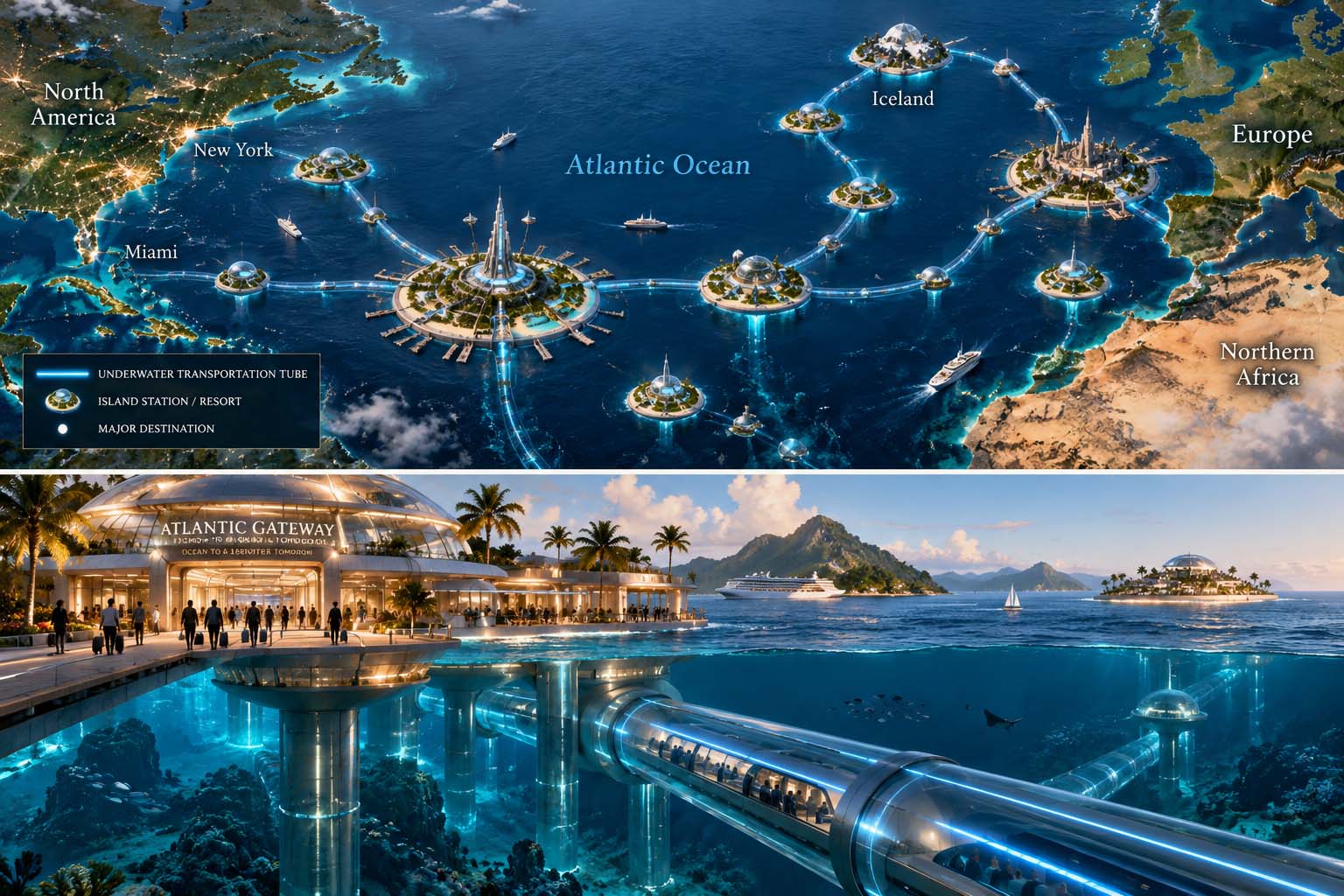
At the largest scale, civil engineering no longer adapts only to geography. It can deliberately reshape coastlines, create islands, redirect water, build new ports, stabilize shorelines, and assemble transportation corridors where land did not previously exist.
| Example | Engineering achievement | Frontier lesson | Status |
|---|---|---|---|
| Hong Kong-Zhuhai-Macao crossing | Artificial islands connect bridge approaches to a submerged tunnel beneath a major navigation channel. | Geography can be engineered as one integrated transportation machine. | Operational |
| Large coastal reclamation | Dredged and imported material creates airport, port, district, and industrial land. | The difficult problem is long-term settlement, drainage, liquefaction resistance, and coastal resilience. | Widely deployed |
| Floating urban systems | Modular platforms and protected-water concepts propose expansion without conventional reclamation. | Potential response to land scarcity and rising water, but utilities, anchoring, storms, law, and cost remain major constraints. | Pilot / proposal |
A project can be technically successful and still carry major ecological or social costs. Frontiers distinguishes the ability to build something from the question of whether it should be built in a particular place.
Engineering deep dive
What makes this frontier difficult
| Frontier variable | Why it matters | Evidence that would move the field |
|---|---|---|
| Coastal resilience | Storm surge barriers, managed retreat, elevated infrastructure | Performance under compound flooding and sea-level rise |
| Water megaprojects | Interbasin transfer, storage, desalination integration | Energy use, sediment, ecosystem and political constraints |
| Reaccounted land | Ground improvement and settlement control | Decades-long geotechnical behavior |
02Frontier 02The Edge of FlightQuiet Supersonic · Stealth · Autonomous Spaceplane · Hypersonic

This Frontier follows publicly known aerospace capability at the edge of the atmosphere and beyond it. Retired aircraft are used only as comparison points. The principal exhibits are machines flying now, programs in active test, and officially disclosed systems whose public capabilities can be documented without guessing at classified performance.
NASA X-59 QuesstFLIGHT TESTING · Quiet supersonic research
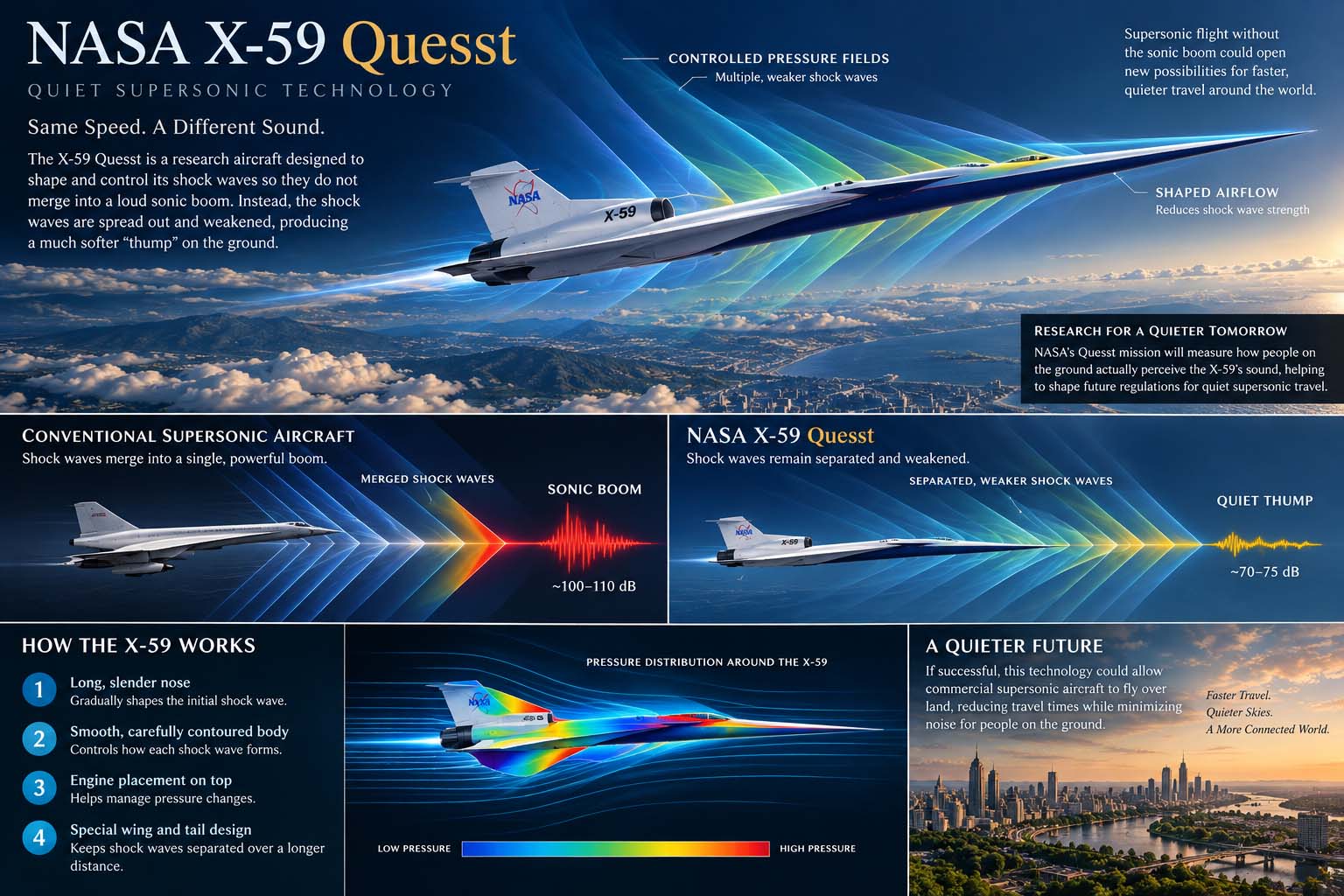
NASA’s X-59 is not a future airliner. It is a flying research instrument built to answer a regulatory and aerodynamic question that blocked civilian supersonic travel over land for decades: can an aircraft reshape its pressure waves so that the sonic boom becomes a much quieter thump?
| Aircraft / program | Approx. speed | Passenger role | What it represents |
|---|---|---|---|
| Modern long-haul airliner | Mach 0.85 class | In service now | Highly efficient subsonic travel remains the commercial standard. |
| Concorde | Mach 2.04 cruise | Retired 2003 | Historical benchmark only. Extremely fast passenger service, but loud sonic booms, fuel burn, economics, and airport noise limited the model. |
| NASA X-59 | Mach 1.4 mission condition; Mach 1.6 maximum test target | Research aircraft, not passenger transport | Current flight-tested technology aimed at changing the acoustic problem of supersonic flight over land. |
| Boom Overture | Mach 1.7 projected | Future passenger aircraft | A serious commercial development effort, but its passenger service performance remains a future account until the airliner itself flies and is certified. |
Concorde was faster. X-59 is frontier technology because it attacks a different obstacle: the shock-wave signature that made routine civilian supersonic flight over populated land unacceptable under existing rules.
By September 2026, X-59 had completed 25 flights and its real flight behavior was matching simulation closely. That is the kind of evidence Frontiers prioritizes: hardware flying now, measurements being collected now, and a clear technological question under test.
Engineering deep dive
What makes this frontier difficult
2026 public status: NASA reported 25 test flights by September 4. The aircraft had already reached its Mach 1.4 and 55,000-foot mission condition, with acoustic validation as the next major phase.
| Frontier variable | Why it matters | Evidence that would move the field |
|---|---|---|
| Acoustic validation | Measured ground signature during supersonic passes | Consistency between predicted and measured perceived loudness |
| Community testing | Public response to repeated low-boom exposure | Data quality sufficient for standards discussions |
| Civil transport impact | Whether low-boom design can change overland rules | Regulatory action, not just aircraft performance |
Earth in 90 MinutesRESEARCH CONCEPT · Suborbital point-to-point transportation
Beyond conventional hypersonic aircraft lies an even more radical transportation idea: use rocket propulsion to climb above most of the atmosphere, cross an intercontinental distance on a high-speed suborbital trajectory, then descend and glide to a runway near the destination. The vehicle would not enter a stable orbit around Earth. Instead, it would briefly operate at the boundary between aviation and spaceflight.
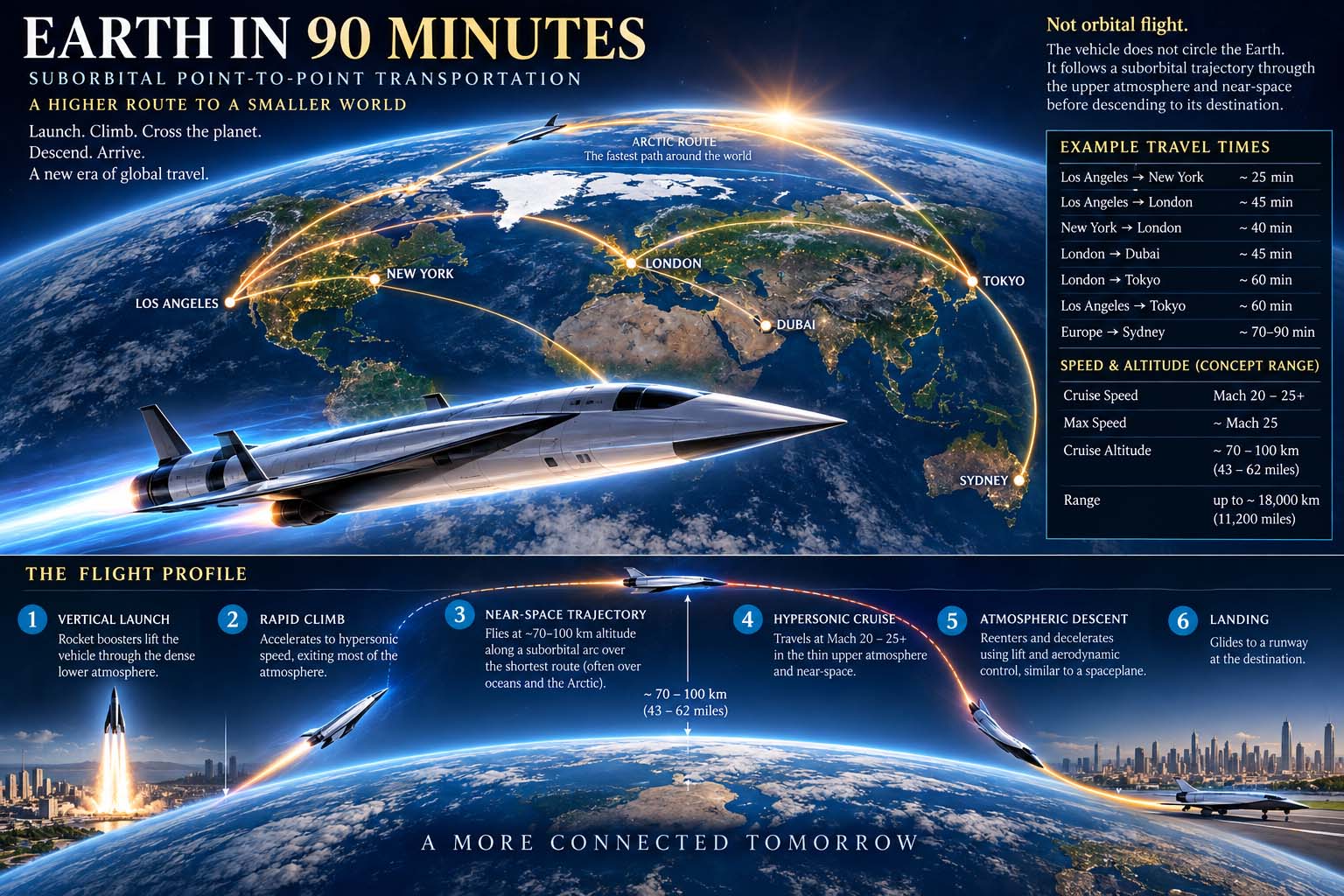
The shortest global passenger concepts do not need to circle Earth. A suborbital vehicle reaches enormous speed and altitude but follows an arc that intersects Earth again at the destination. This distinction matters: orbital velocity and a sustained orbit are not required for point-to-point transportation.
| Concept mission | Published flight time | Speed / altitude regime | What the trajectory does |
|---|---|---|---|
| Europe ↔ California | No more than about 60 minutes | Mach 20+ class; near-space trajectory | Rocket-powered climb followed by a long hypersonic glide across an intercontinental route. |
| Europe ↔ East Asia | About 60 minutes | Mach 20+ class | Uses altitude and extreme speed to compress a conventional long-haul journey to roughly an hour. |
| Europe ↔ Australia | About 90 minutes | Up to about 80 km altitude | The reference long-range passenger mission crosses a large fraction of the globe without entering sustained orbit. |
| Maximum SpaceLiner 7 design range | Mission dependent | Up to ~18,000 km (11,200 mi); ~7 km/s maximum | Represents the upper design envelope rather than a scheduled airline route. |
| Phase | What happens | Why it matters |
|---|---|---|
| 1 · Vertical launch | A reusable booster and passenger stage accelerate under rocket power. | The vehicle must gain enormous energy quickly while keeping passenger loads within acceptable limits. |
| 2 · Booster separation | The booster separates while the passenger stage continues its powered ascent. | Staging avoids carrying the entire launch system across the planet. |
| 3 · Near-space climb | The passenger stage reaches roughly 80 km on the reference concept. | At this altitude the atmosphere is extremely thin, greatly reducing aerodynamic drag. |
| 4 · Hypersonic glide | After engine cutoff, the passenger stage covers most of the intercontinental distance as a high-speed glider. | This is the heart of the concept: cross the planet at more than Mach 20 without maintaining a conventional atmospheric cruise. |
| 5 · Atmospheric descent | The vehicle loses speed while descending into denser air. | Thermal protection, stability, guidance, and energy management become critical. |
| 6 · Runway landing | The winged passenger stage approaches and lands horizontally. | The destination experience begins to resemble aviation again, despite the near-space portion of the journey. |
DLR's SpaceLiner remains a research concept, not an operational passenger system. NASA's High-Speed Flight research likewise studies technologies for future reusable hypersonic and commercial point-to-point missions. The extraordinary speeds and travel times shown here describe engineering studies and design targets, not passenger service available today.
B-21 RaiderOFFICIALLY DISCLOSED · Flight-test program
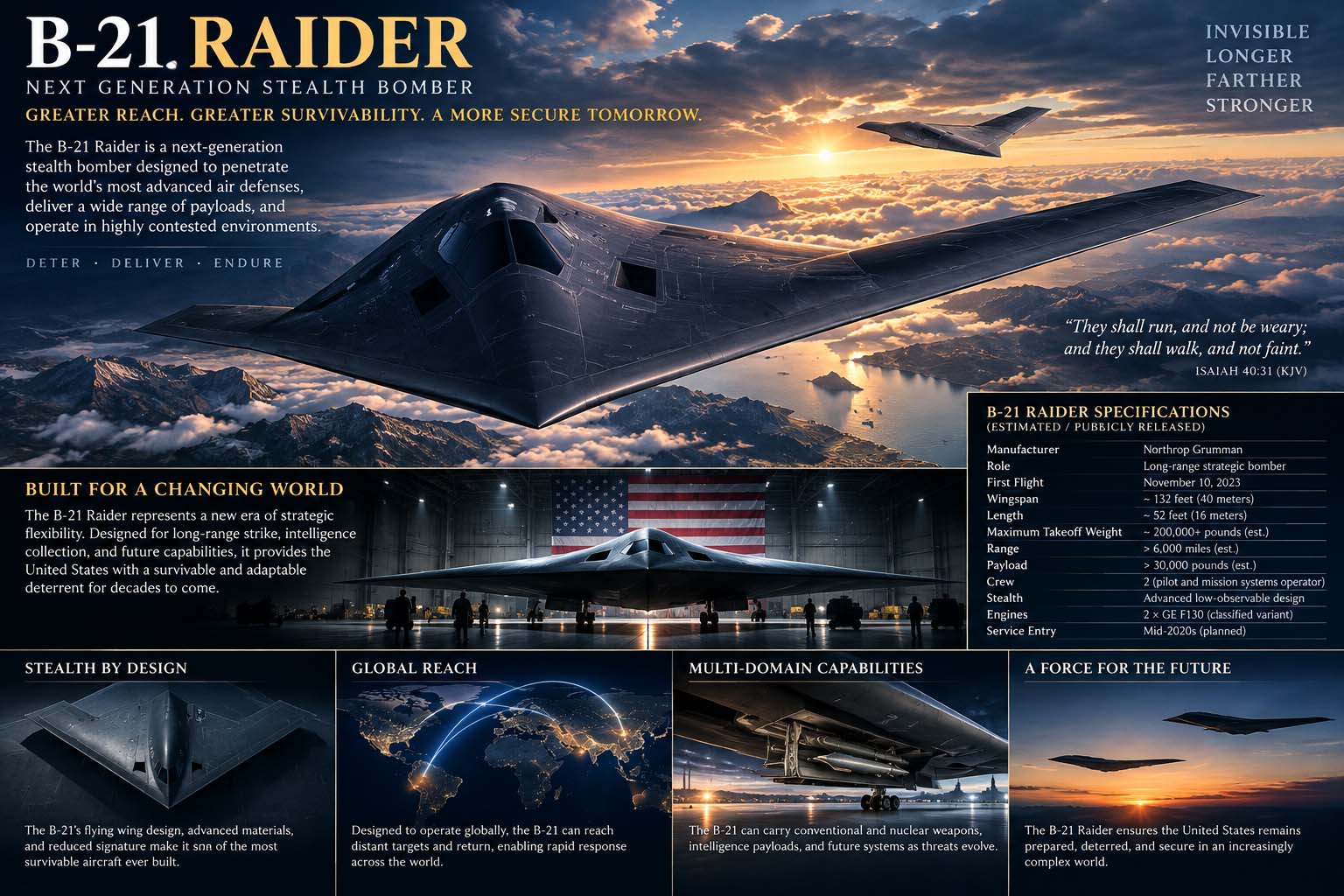
The B-21 Raider belongs in Frontiers for a different reason. It is one of the newest advanced aircraft whose existence and broad mission are officially public while many performance details remain classified. That makes it a useful example of how the museum handles declassified or publicly acknowledged frontier technology without pretending to know what has not been released.
| Publicly established | What remains outside the public record |
|---|---|
| Flying-wing low-observable design | Exact radar cross-section, signature-management methods, coatings, and classified sensor characteristics. |
| Long-range penetrating strike mission | Exact combat radius, maximum range, mission profiles, and operational tactics. |
| Open-system architecture and digital engineering | Specific software, electronic warfare, communications, and mission-system capabilities. |
| Flight-test and production program | Detailed performance envelope, top speed, ceiling, and many payload details. |
No numerical speed or range is shown here because reliable official figures are not public. Frontiers will not fill classified gaps with enthusiast estimates, anonymous accounts, or exploratory reconstructions.
The most important point is that the frontier is no longer one spectacular number such as Mach speed. Modern combat-aircraft capability emerges from a network of survivability, sensing, communications, computing, electronic warfare, weapons integration, and the ability to upgrade over decades.
Engineering deep dive
What makes this frontier difficult
| Frontier variable | Why it matters | Evidence that would move the field |
|---|---|---|
| Flight test | Expansion of the test envelope | Officially released milestones only |
| Production | Transition from development to repeatable manufacturing | Public Air Force production and basing announcements |
| Mission systems | Open-architecture integration | Confirmed upgrades without inferring classified capabilities |
X-37B Orbital Test VehicleOPERATIONAL / PUBLICLY ACKNOWLEDGED · Reusable autonomous spaceplane
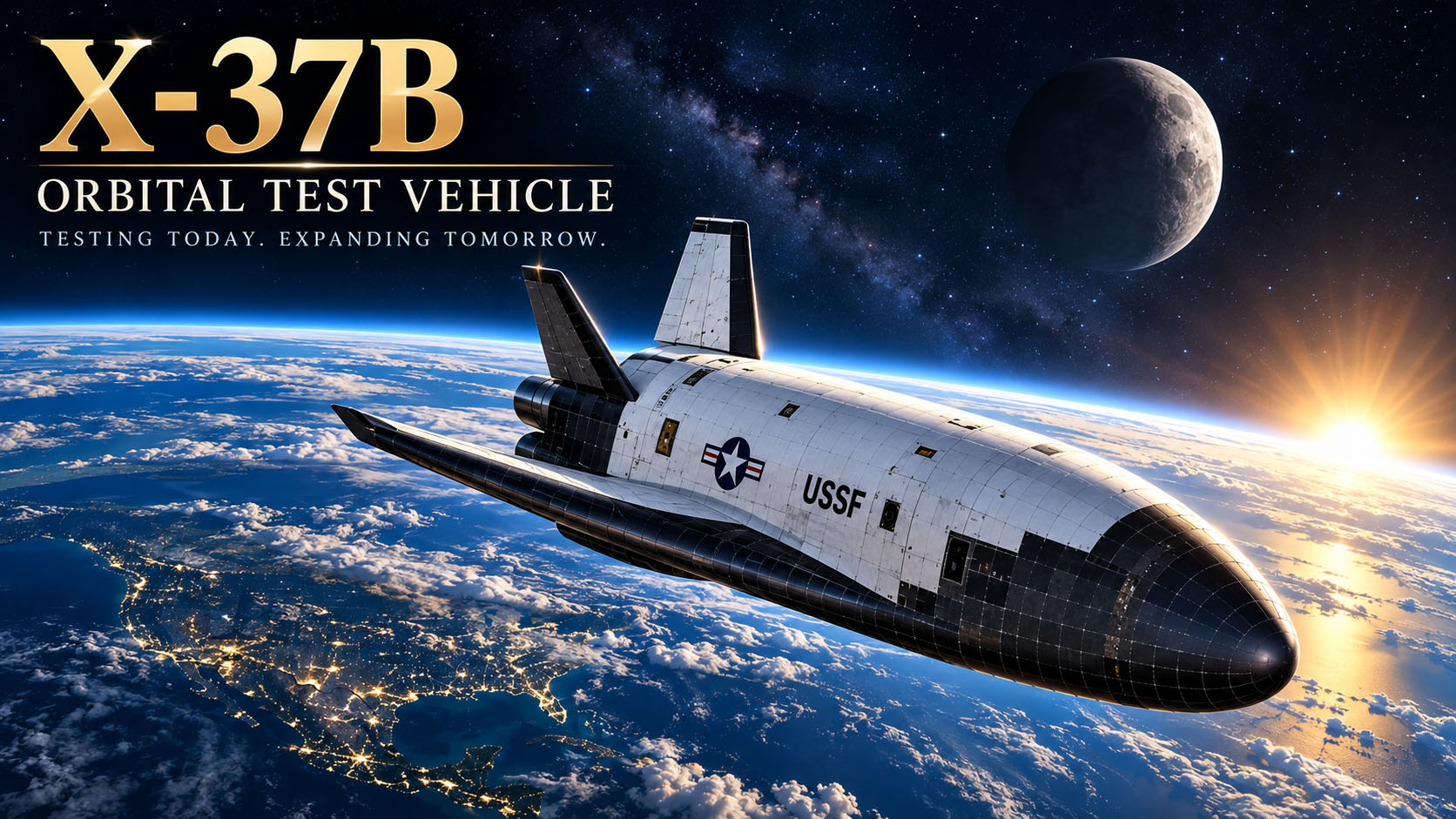
The X-37B is an uncrewed reusable orbital test vehicle that launches vertically, operates in space for long periods, reenters the atmosphere, and lands on a runway. Unlike a conventional satellite, it can carry experiments through launch, orbital operation, reentry, and recovery, then be prepared to fly again.
The Space Force publicly identified high-bandwidth inter-satellite laser communications and an enhanced space-navigation experiment using a high-performance quantum inertial sensor. Those are genuine frontier technologies being tested in orbit, not simply concepts on paper.
| Capability | Publicly acknowledged | Museum treatment |
|---|---|---|
| Mission duration | Past X-37B missions have demonstrated very long on-orbit endurance. | Discussed as an established capability. |
| Specific mission experiments | Some are publicly identified, as on Mission 8. | Included when officially released. |
| Operational mission details | Many are not released. | Not reconstructed or guessed. |
| Exact military utility | Broad technology-test role is public; detailed uses may not be. | Clearly marked as outside the public record. |
Engineering deep dive
What makes this frontier difficult
| Frontier variable | Why it matters | Evidence that would move the field |
|---|---|---|
| Reusability | Turnaround and repeated flight of the same vehicle class | Publicly announced mission cadence |
| Orbital experimentation | On-orbit technology demonstrations | Declassified payload and experiment disclosures |
| Autonomy | Navigation, guidance, reentry and landing | Public descriptions of flight-control advances |
The Hypersonic FrontierACTIVE DEVELOPMENT · Mach 5 and beyond

Hypersonic flight begins at Mach 5, but the number alone hides the real engineering problem. Sustained flight at these speeds requires surviving extreme heating, maintaining control in a highly compressed flow field, managing propulsion, navigating precisely, and communicating through conditions that can disrupt sensors and signals.
| Technology family | How it works | Current frontier question |
|---|---|---|
| Boost-glide vehicle | A rocket accelerates the vehicle to high speed, after which it glides and maneuvers through the upper atmosphere. | Can it maintain accuracy, controllability, and survivability across a demanding thermal trajectory? |
| Scramjet-powered vehicle | An air-breathing engine burns fuel in supersonic airflow. | Can sustained propulsion be achieved reliably across a useful flight envelope? |
| Hypersonic test aircraft | Reusable or recoverable platforms explore materials, guidance, propulsion, and aerodynamics. | Can research move from one-off demonstrations toward repeatable, economical operation? |
There is no operational Mach 5 passenger aircraft. Any account that routine hypersonic airline travel is available now belongs outside this museum category. Frontiers separates demonstrated hypersonic technology from commercial projections.
Engineering deep dive
What makes this frontier difficult
| Frontier variable | Why it matters | Evidence that would move the field |
|---|---|---|
| Materials | Reusable high-temperature structures and coatings | Flight hours and repeatability rather than one successful test |
| Propulsion | Sustained air-breathing hypersonic operation | Duration, throttle range and integration with vehicle |
| Civil relevance | Whether speed can coexist with cost, noise and safety | Operational economics, certification and maintenance burden |
Beyond the Public RecordCURATORIAL BOUNDARY · No exploration
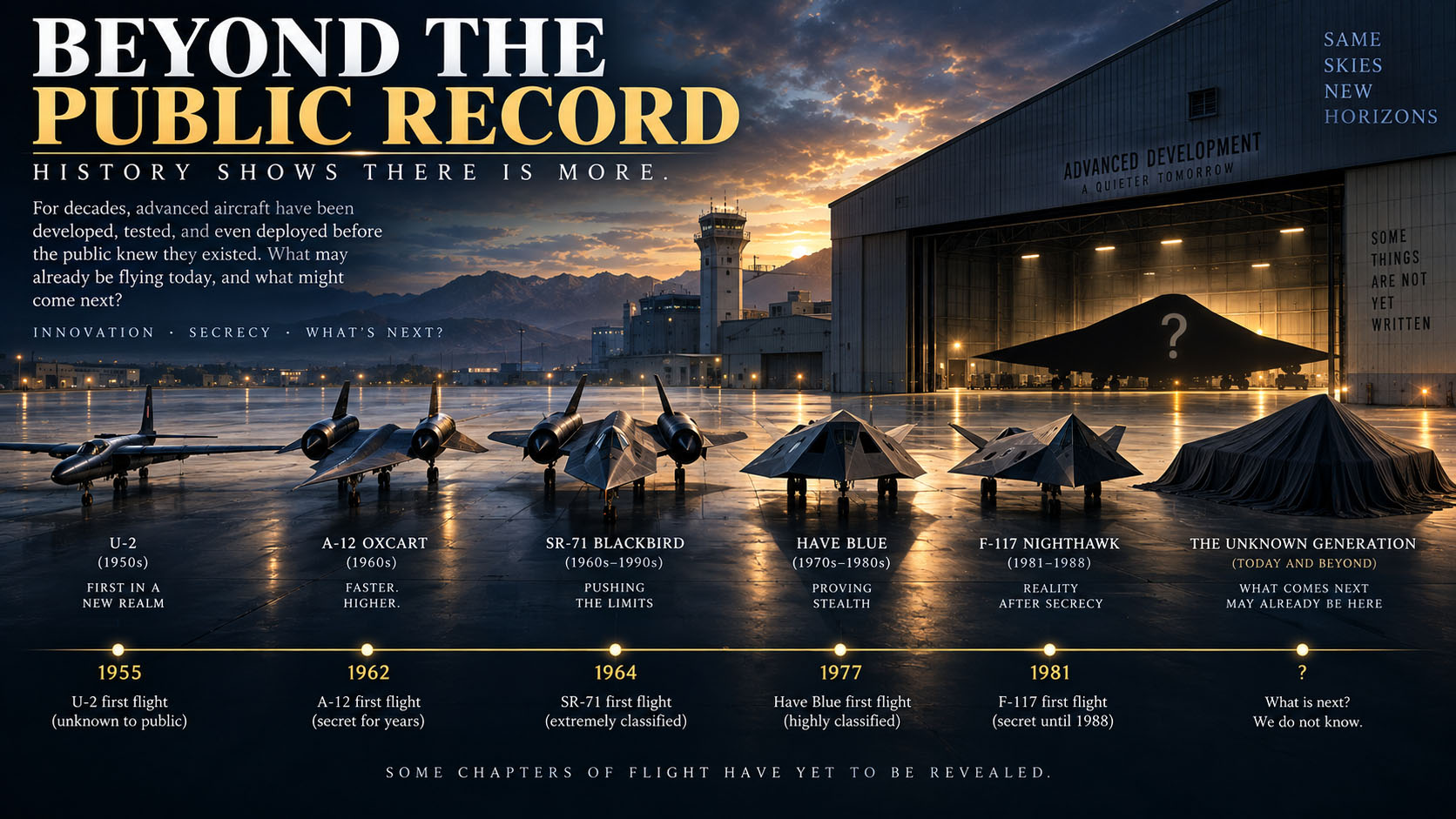
A museum of frontier technology must have a visible boundary around what it does not know. Aerospace is one of the clearest places to enforce that rule because classified programs, compartmented capabilities, and deliberately limited public descriptions are part of the real technological landscape.
A program may be included when its existence or capability has been officially acknowledged, declassified, or demonstrated in reliable public documentation. We describe only what that public record supports.
| Evidence level | Museum action | Example |
|---|---|---|
| Officially operational / demonstrated | Present as established capability. | X-59 flight data, publicly announced X-37B mission objectives. |
| Officially disclosed with classified details | Present the public architecture and explicitly mark unknown specifications. | B-21 Raider. |
| Serious prototype or test program | Present with current development status and no assumption of future success. | Hypersonic and commercial supersonic programs. |
| Rumor / anonymous account / “black project” reconstruction | Do not present as technology fact. | Unverified aircraft names, not established speed accounts, exploratory propulsion stories. |
This approach actually makes Frontiers more interesting. A blank space labeled not publicly known is more honest than a fabricated specification. It also lets the visitor see the difference between the technological frontier and the mythology that often grows around secret technology.
Engineering deep dive
What makes this frontier difficult
| Frontier variable | Why it matters | Evidence that would move the field |
|---|---|---|
| Disclosure | Official acknowledgment or declassification | Primary-source confirmation |
| Evidence quality | Independent imagery, budgets, contracts, hearings | Multiple converging public records |
| Museum standard | No reconstruction of secret performance | Explicit unknown markers where data stop |
03Frontier 03Machines at the Scientific FrontierHiLumi LHC · Fusion · Roman · Quantum · AI
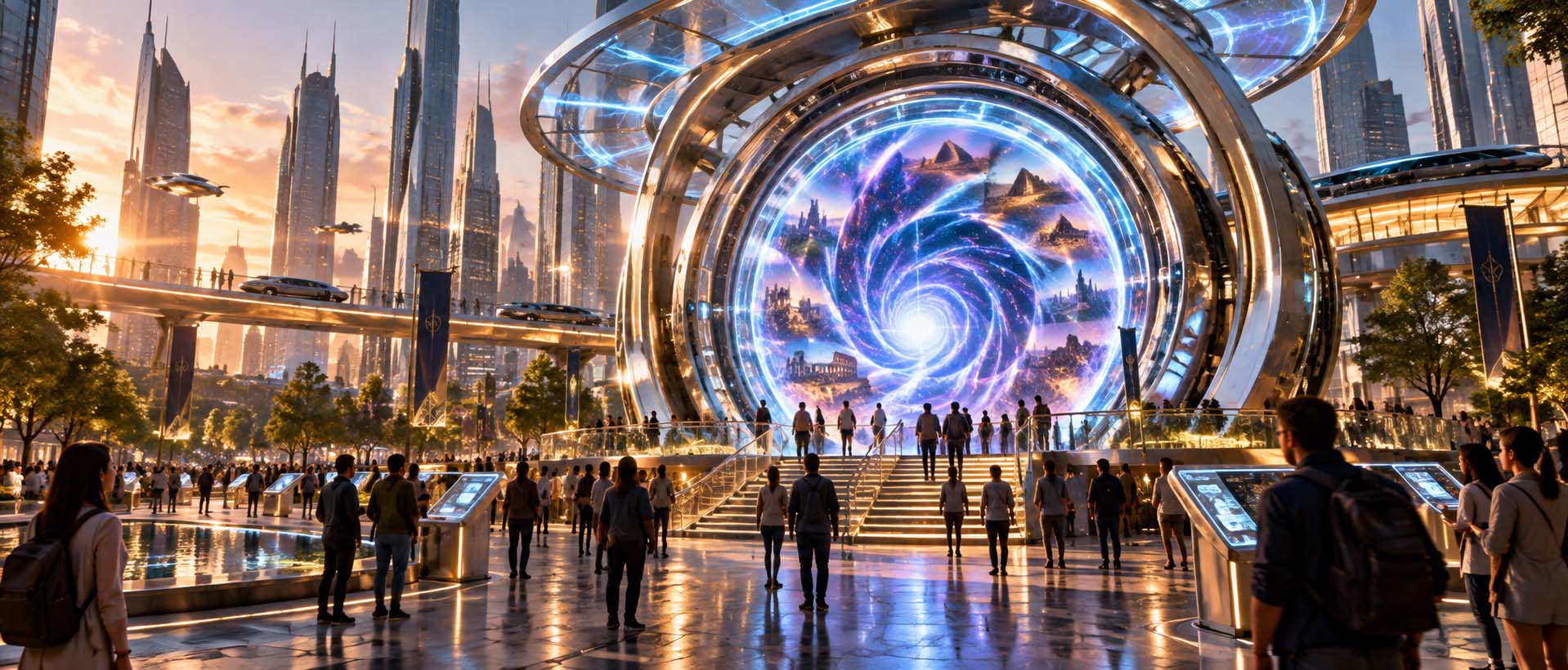
Some of the most advanced technologies ever built are not transportation systems at all. They are instruments for seeing, measuring, calculating, and reproducing conditions that ordinary human senses could never reach. In 2026, several of these systems are being upgraded, assembled, launched, or scaled in real time.
High-Luminosity LHCACTIVE CONSTRUCTION · Next-generation collider upgrade
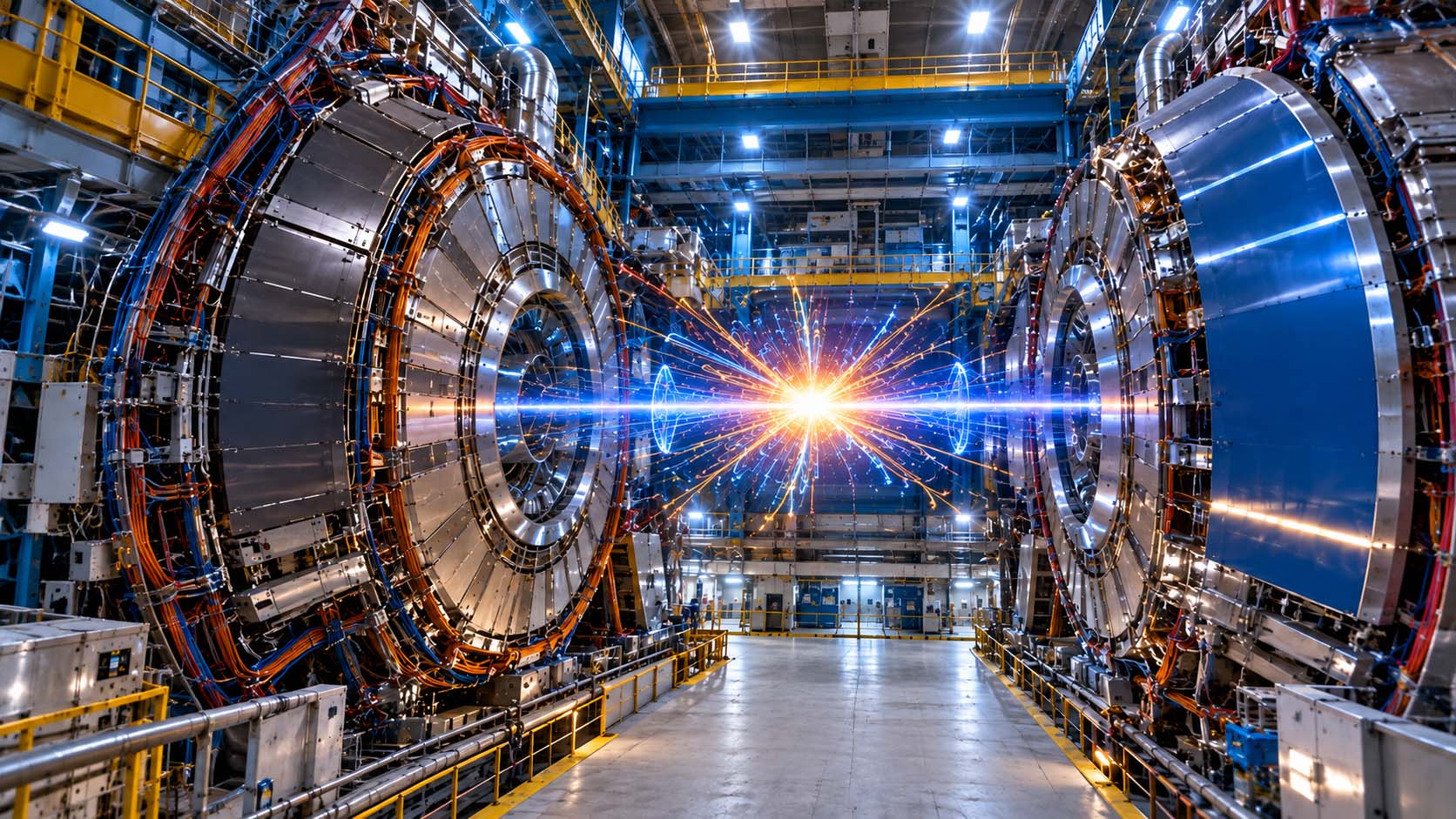
The High-Luminosity Large Hadron Collider is not a new circular tunnel. It is a transformation of the existing LHC into a much more powerful discovery instrument by increasing the number of particle collisions available to its experiments. The frontier is precision, beam control, radiation tolerance, magnets, cryogenics, and data at extraordinary scale.
A collider can discover rare events only if enough collisions occur. Higher luminosity does not simply mean particles move faster. It means the experiments receive a much larger statistical sample in which rare physics may appear.
| Scale | What happens |
|---|---|
| 27 km ring | Counter-rotating proton beams circulate around the underground accelerator complex. |
| Near light speed | Relativity means additional energy increasingly raises particle energy rather than producing ordinary intuitive increases in speed. |
| Collision points | Giant experiments such as ATLAS and CMS record debris from selected interactions. |
| Global computing | Massive distributed computing systems reconstruct, filter, store, and analyze data for thousands of researchers. |
In 2026, CERN is installing new High-Luminosity LHC systems including infrastructure for crab-cavity control electronics. This is a perfect Frontiers exhibit because the machine is physically being transformed right now.
Engineering deep dive
What makes this frontier difficult
2026 public status: CERN ended LHC Run 3 in June and entered Long Shutdown 3 for the transformation toward the High-Luminosity LHC, including new magnets, cryogenics, detector systems, and infrastructure.
“Clear evidence for the production of a neutral boson ... is presented.”ATLAS Collaboration, Physics Letters B, vol. 716, p. 1, 2012.
| Frontier variable | Why it matters | Evidence that would move the field |
|---|---|---|
| Machine upgrade | Installation and commissioning through Long Shutdown 3 | Cryogenics, magnets, collimation and beam systems |
| Detector upgrade | Higher-granularity and timing systems | Radiation tolerance and event reconstruction |
| Physics return | Precision Higgs studies and rare-process sensitivity | Integrated luminosity accumulated after restart |
Fusion Power: The Race to a Pilot PlantACTIVE DEVELOPMENT · Multiple approaches
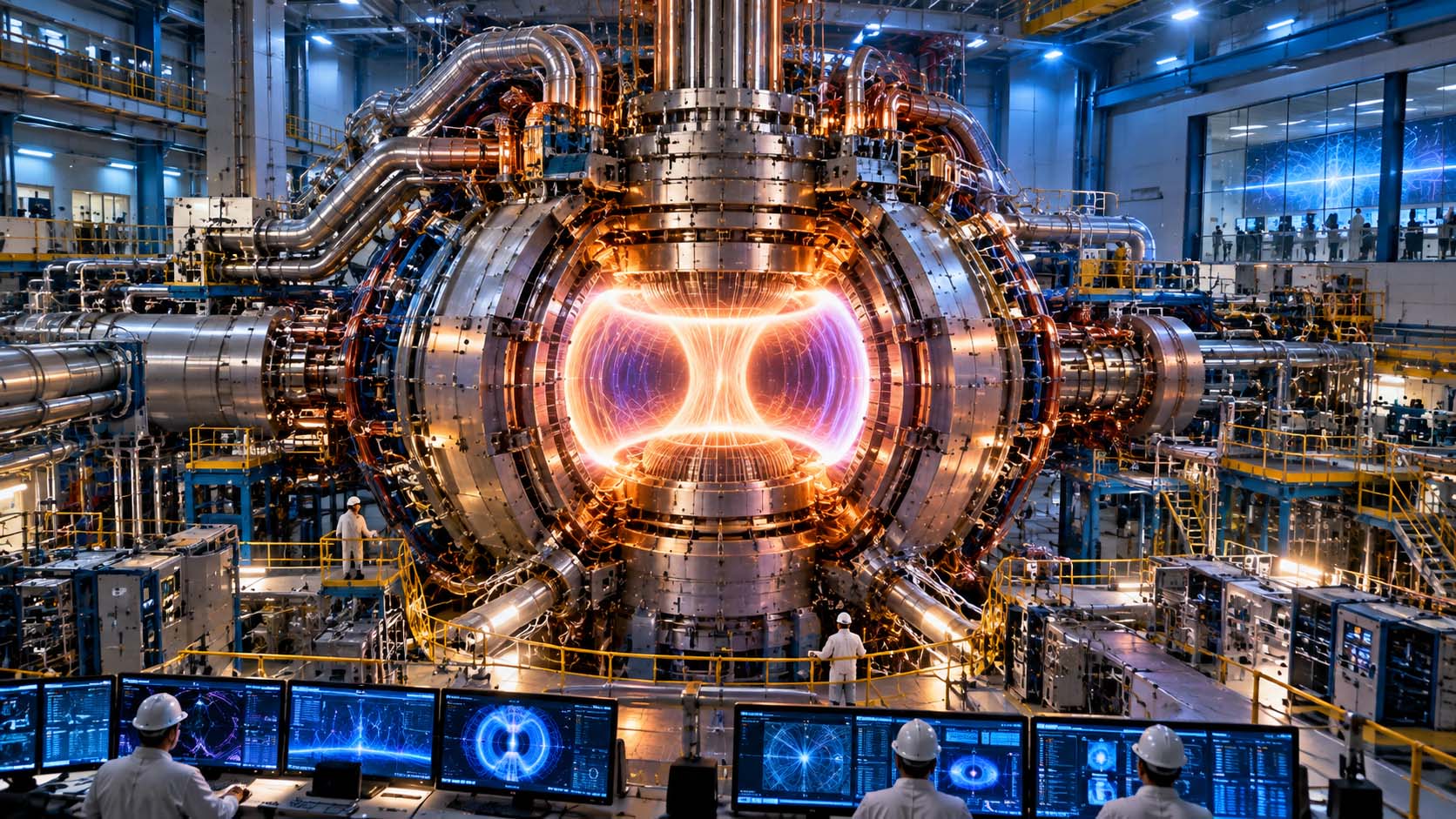
Fusion is moving from the question “can we create fusion reactions?” toward a much harder engineering question: can a machine repeatedly produce useful power while surviving the neutron, heat, materials, fuel-cycle, magnet, maintenance, and economic demands of a real power plant?
| Approach | How confinement is attempted | Frontier challenge |
|---|---|---|
| Tokamak | Powerful magnetic fields confine a ring-shaped plasma. | Steady high-performance plasma, materials survival, tritium breeding, maintainability, and net plant output. |
| Stellarator | Complex three-dimensional magnetic geometry aims for inherently steady confinement. | Manufacturing precision, optimization, size, and integrating a practical reactor blanket. |
| Inertial confinement | Lasers or other drivers rapidly compress tiny fuel targets. | High repetition rate, target manufacture, driver efficiency, chamber survival, and energy extraction. |
| Alternative private concepts | A wide range of magnetic, pulsed, and hybrid approaches. | Turning promising plasma physics into reliable, repeatable, maintainable power hardware. |
ITER is an experimental machine intended to demonstrate reactor-scale burning plasma physics and integrated technologies. It is not designed to sell electricity to the grid. Commercial power requires additional systems and a different plant mission.
Fusion belongs in Frontiers not because electricity is imminent, but because the transition from laboratory plasma to integrated power plant is now an active, heavily funded engineering race.
Engineering deep dive
What makes this frontier difficult
2026 public status: the U.S. Department of Energy finalized a fusion science and technology roadmap in June targeting pilot plants and commercial fusion in the mid-2030s. ITER reported two-thirds of its tokamak core installed in July.
| Frontier variable | Why it matters | Evidence that would move the field |
|---|---|---|
| ITER | Assembly of the large experimental tokamak | Sector installation, first-plasma schedule, integrated commissioning |
| Private fusion | High-field, inertial, pulsed and alternative concepts | Repeatable performance rather than single-shot records |
| Pilot plants | Grid-connected electricity and maintainability | Availability, component lifetime, fuel cycle, cost |
Nancy Grace Roman Space TelescopeNEWLY DEPLOYED · Launched August 30, 2026
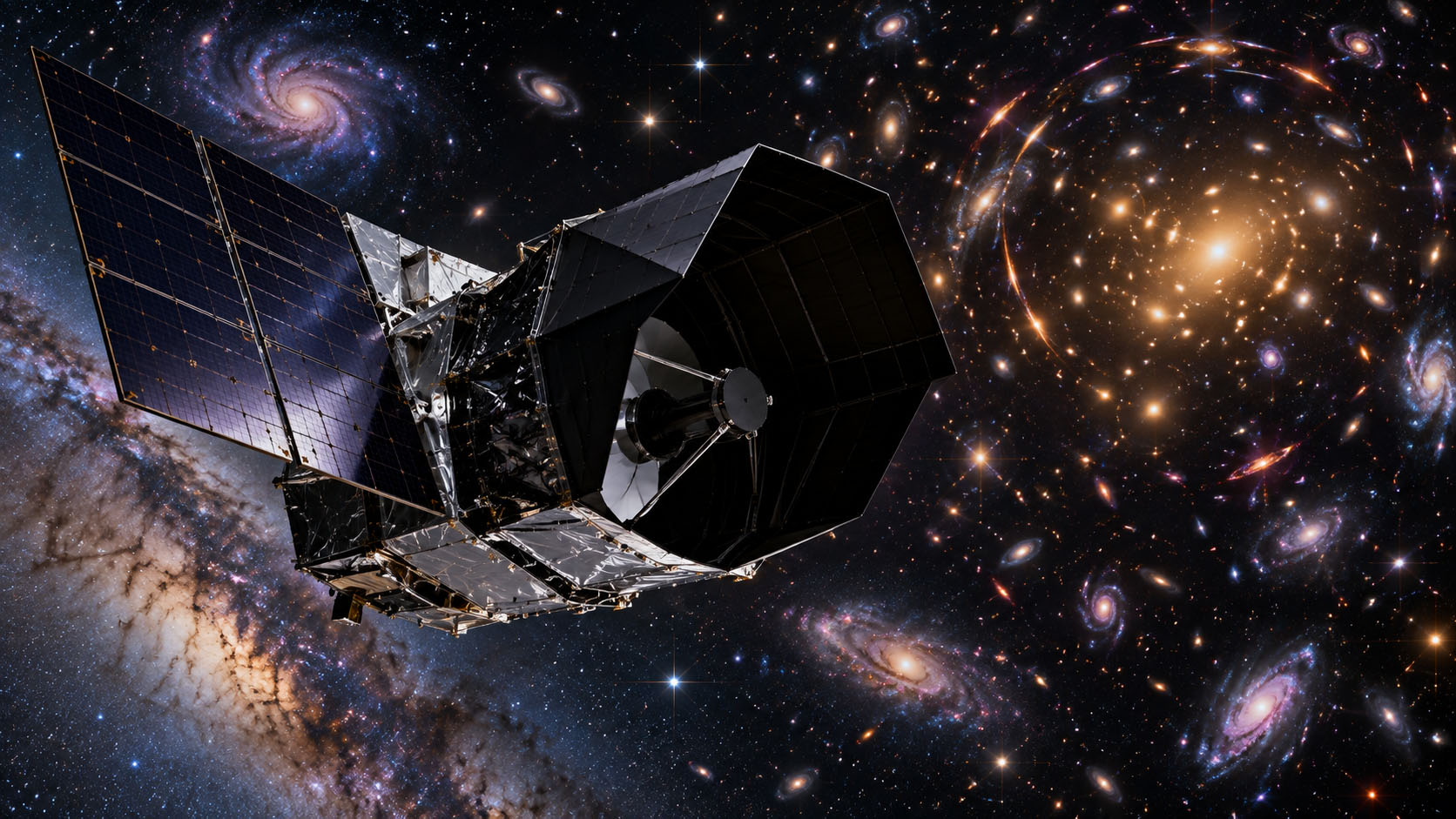
Launched on August 30, 2026, the Nancy Grace Roman Space Telescope is the newest major NASA space observatory. Roman does not replace James Webb. It attacks a different frontier: surveying enormous areas of the infrared sky with Hubble-class sharpness while generating data at a scale designed for population-level astronomy.
| Observatory | Primary strength | Field / observing style | Frontiers role |
|---|---|---|---|
| James Webb Space Telescope | Deep infrared sensitivity and spectroscopy | Narrower, extremely deep targeted observations | Still a premier operational observatory for detailed study. |
| Nancy Grace Roman | Wide-field infrared survey power | At least 100 times Hubble field of view with Hubble-like angular resolution | Newest deployed large NASA survey observatory and the headline current entry. |
| Habitable Worlds Observatory | Future direct study of potentially Earth-like worlds | Next-generation concept with high-contrast imaging ambitions | Serious future observatory concept, not yet a deployed machine. |
Roman also carries a Coronagraph Instrument technology demonstration designed to suppress starlight and advance the hardware needed to directly image planets and disks near bright stars.
Roman is currently on its journey toward the Sun-Earth L2 region. Its presence in Frontiers should be treated almost like a live exhibit: newly launched hardware whose commissioning and first major datasets will unfold while visitors are using the museum.
Engineering deep dive
What makes this frontier difficult
2026 public status: Roman launched August 30 aboard Falcon Heavy and began its roughly three-month journey toward the Sun-Earth L2 region for commissioning and survey operations.
| Frontier variable | Why it matters | Evidence that would move the field |
|---|---|---|
| Commissioning | Deployment, cooling, alignment and calibration | Transition from cruise to stable science operations |
| Survey power | Large-area infrared imaging | Data volume, cadence and uniform calibration |
| Exoplanets | Microlensing planet yield and coronagraph demonstrations | New populations and technology lessons |
Quantum Computing at the Error-Correction FrontierACTIVE DEVELOPMENT · Fault-tolerance race
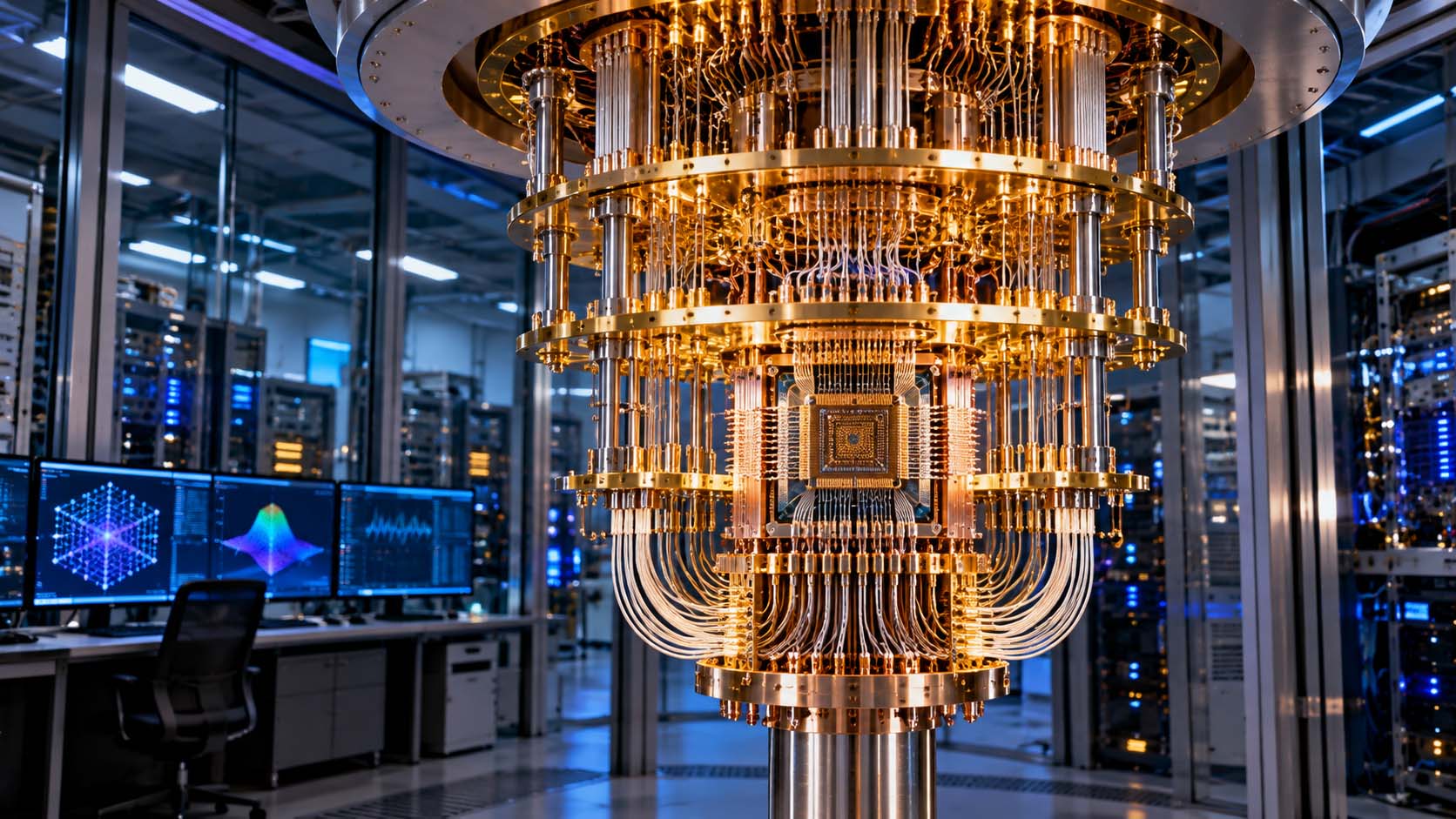
Quantum computing has passed the stage where simply counting physical qubits is enough. The decisive frontier is error correction: can a machine encode information into logical qubits whose reliability improves as more physical qubits and better control are added?
A processor with more physical qubits is not automatically more useful. Gate fidelity, connectivity, coherence, control electronics, error-correction overhead, and the quality of logical operations can matter more than raw qubit count.
| Layer | What has to work | Why it is hard |
|---|---|---|
| Physical qubit | Prepare, manipulate, entangle, and measure quantum states. | Every operation is imperfect and the environment constantly introduces noise. |
| Error-detection code | Spread one logical state across many physical qubits and repeatedly measure error syndromes. | The correction machinery itself can introduce errors. |
| Logical qubit | Perform operations while the encoded information remains protected. | Overhead can be enormous; scaling requires many high-quality physical operations. |
| Fault-tolerant algorithm | Run a useful computation long enough to outperform classical methods on a valuable task. | This demands both hardware scale and extremely low logical error rates. |
Engineering deep dive
What makes this frontier difficult
“What I want to talk about is the problem of manipulating and controlling things on a small scale.”Richard P. Feynman, Engineering and Science, vol. 23, no. 5, p. 22, 1960.
| Frontier variable | Why it matters | Evidence that would move the field |
|---|---|---|
| Logical qubits | Error rates below correction thresholds | Longer logical lifetime as code distance grows |
| Scale | More controllable qubits with acceptable fidelity | Wiring, cryogenics, calibration and fabrication yield |
| Applications | Tasks with verified practical advantage | Chemistry, materials, optimization or simulation with fair classical baselines |
Frontier Artificial IntelligenceOPERATIONAL NOW · Rapidly advancing

Artificial intelligence is already operational technology, but the frontier is moving rapidly from isolated text generation toward multimodal reasoning, tool use, long-horizon agents, scientific models, embodied robotics, and systems that can collaborate with people across complex digital workflows.
| Frontier layer | What is changing | Open problem |
|---|---|---|
| Reasoning systems | More compute can be spent during inference to solve difficult tasks step by step. | Reliability, calibration, cost, latency, and knowing when the system is wrong. |
| Agentic systems | Models can operate tools and complete multi-step work rather than only produce a response. | Permissions, security, error recovery, monitoring, and preventing cascading mistakes. |
| Scientific AI | Models assist with proteins, materials, weather, mathematics, code, and experimental design. | Ground-truth validation and translating predictions into reproducible science. |
| Robotics | General models connect perception, language, planning, and motor control. | Real-world reliability, dexterity, safety, continual learning, and hardware cost. |
Leaderboards and model releases change too quickly for a museum page to pretend a permanent winner exists. The exhibit focuses on capabilities that define the public frontier and on the infrastructure needed to make them work.
Engineering deep dive
What makes this frontier difficult
“I propose to consider the question, ‘Can machines think?’”Alan M. Turing, Mind, vol. 59, no. 236, p. 433, 1950.
| Frontier variable | Why it matters | Evidence that would move the field |
|---|---|---|
| Reasoning and agents | Reliable multi-step work with tools | Completion rate on real tasks, not demos |
| Efficiency | More capability per watt and per dollar | Inference energy, latency and hardware utilization |
| Scientific AI | Models that accelerate discovery | Externally validated results and reproducibility |
04Frontier 04Building Beyond EarthArtemis · Starship-class systems · Mars robotics · Planetary settlements
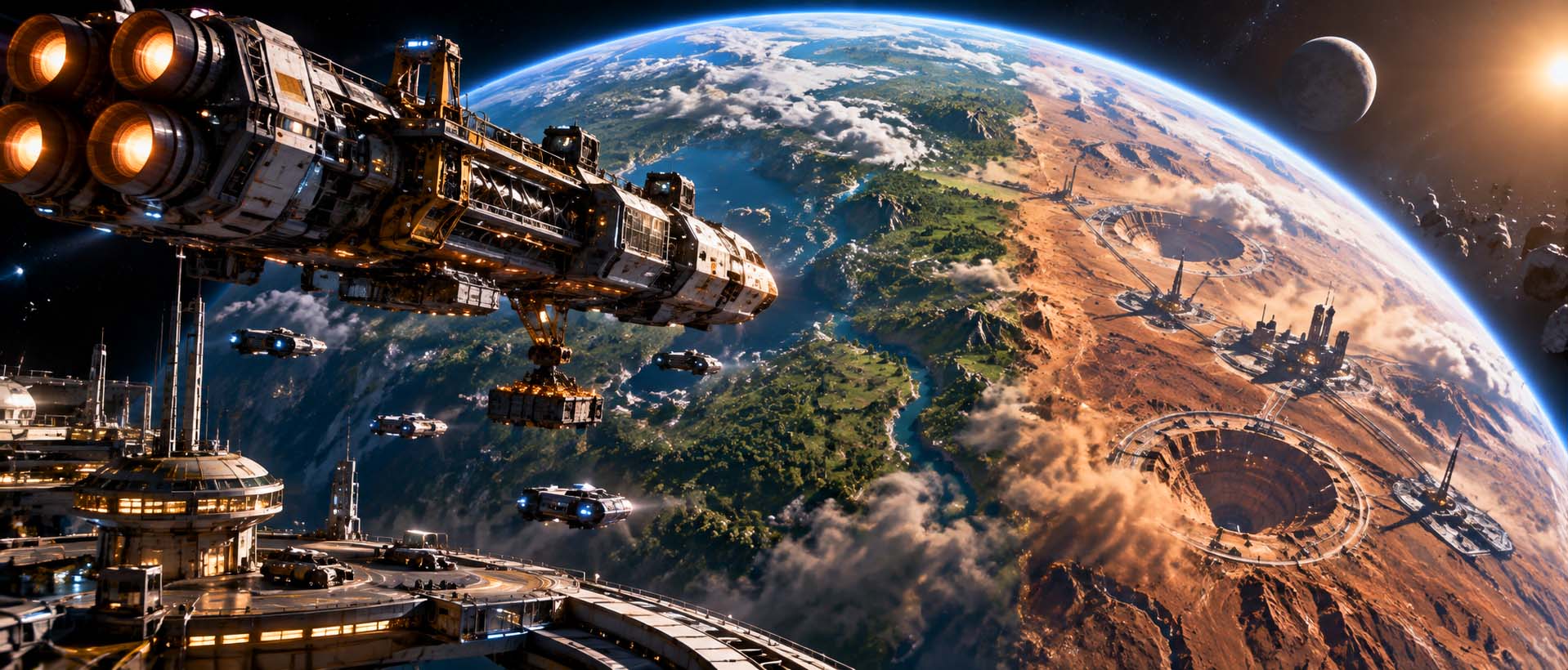
Spaceflight is changing from isolated missions into infrastructure. The current frontier is a connected architecture of launch vehicles, crew systems, cargo landers, autonomous robots, resource extraction, surface power, and reusable transportation that can eventually support sustained operations away from Earth.
Artemis and the Return to the MoonACTIVE PROGRAM · Sustained lunar capability
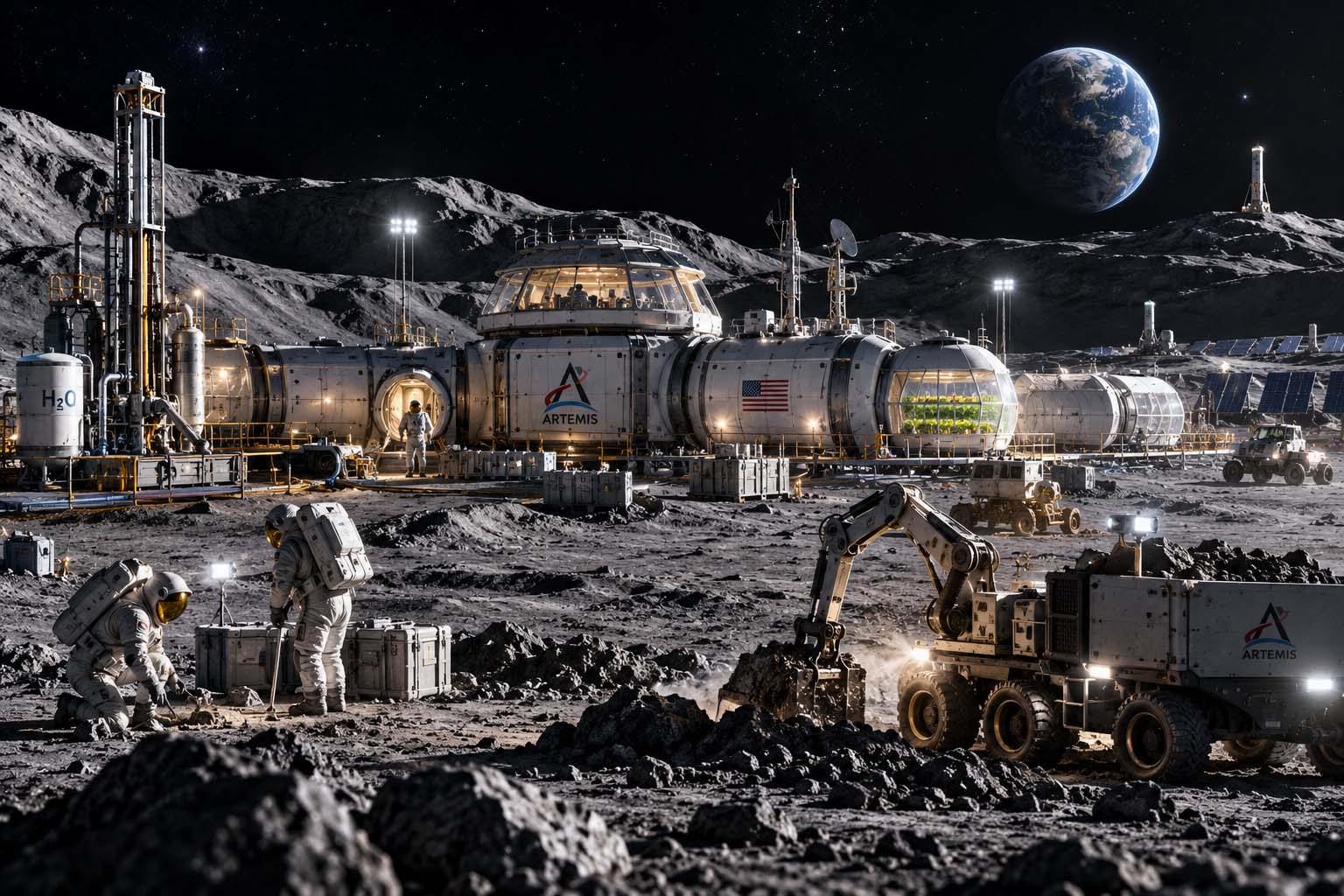
The lunar frontier has changed from a single flags-and-footprints mission into an infrastructure problem. Artemis II completed a crewed voyage around the Moon in April 2026. The current challenge is building a repeatable transportation and surface system that can deliver cargo, landers, rovers, power, communications, science, and eventually crews to the lunar South Pole.
| System | Role in the current architecture | 2026 status |
|---|---|---|
| SLS + Orion | Crew launch and deep-space transport architecture. | Artemis II completed crewed lunar voyage. |
| Commercial human landing systems | Move crews between lunar orbit and the surface. | SpaceX and Blue Origin systems in development and demonstration planning. |
| Blue Moon Mark 1 Endurance | Large uncrewed cargo lander and technology demonstrator. | Integrated testing in 2026; targeted lunar South Pole mission in the evolving Moon Base program. |
| Lunar terrain vehicles | Surface mobility for astronauts and autonomous operations. | Commercial rover systems under development and mission planning. |
The hardest problem is not simply landing once. It is creating a chain of launch, navigation, landing, power, mobility, maintenance, dust control, communications, life support, rescue, and resupply that can work repeatedly.
Engineering deep dive
What makes this frontier difficult
2026 public status: Artemis II launched April 1 and returned April 10 after carrying four astronauts around the Moon, providing the first crewed Artemis deep-space flight experience.
| Frontier variable | Why it matters | Evidence that would move the field |
|---|---|---|
| Crew transport | Post-Artemis II operational lessons | Orion performance and mission changes |
| Landing systems | Human-rated lunar landers | Integrated flight demonstrations and surface missions |
| Surface infrastructure | Power, mobility, communications and logistics | Persistent capability instead of isolated sorties |
Reusable Super-Heavy SpaceflightOPERATIONAL REUSE · ACTIVE DEVELOPMENT · SECOND-LIFE INFRASTRUCTURE
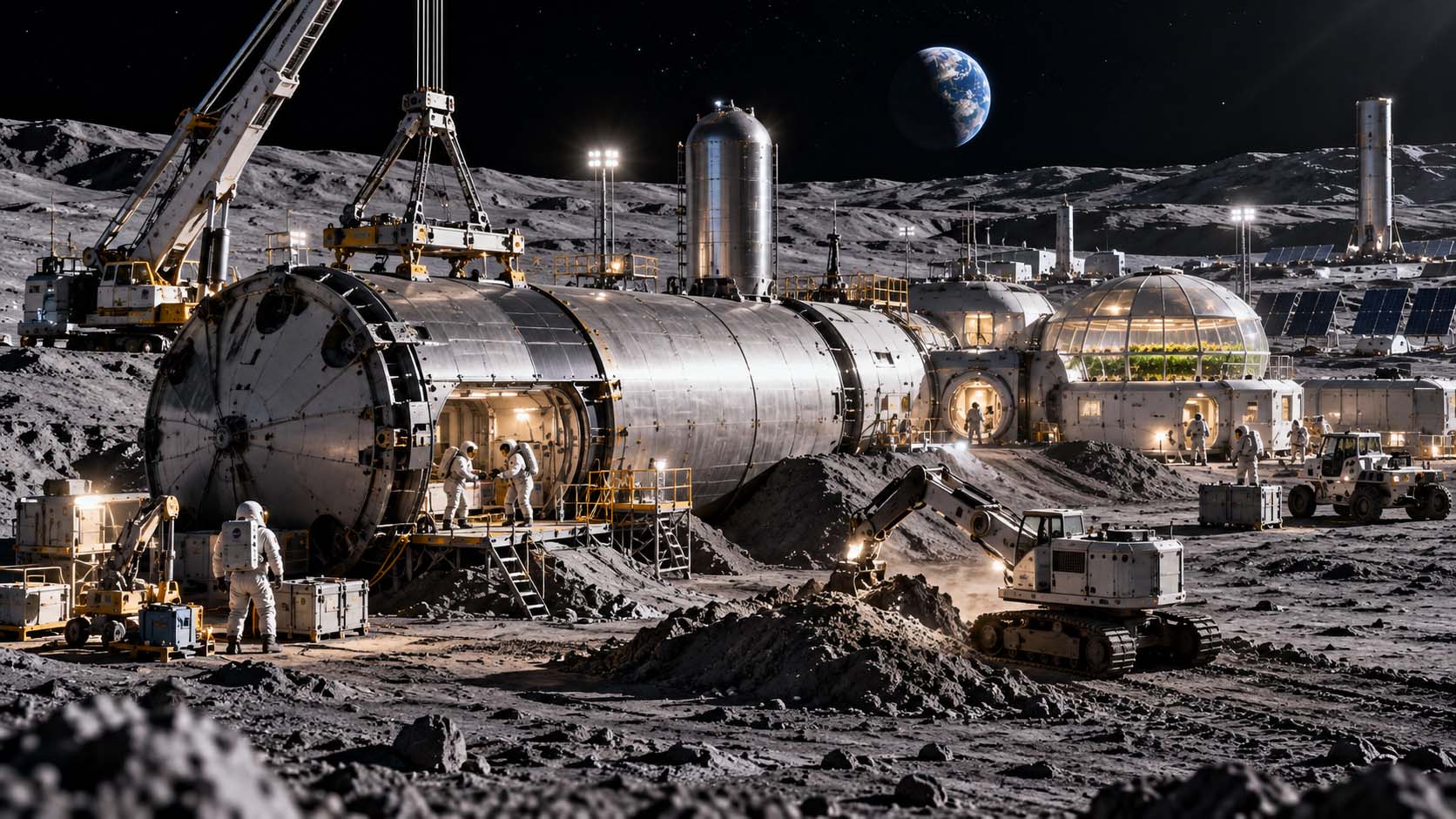
Reusable heavy-lift spaceflight is no longer only a future idea. Recoverable launch stages have already changed how frequently major hardware can be flown. The next frontier is broader: rapid reuse of increasingly large vehicles, orbital refueling, deep-space cargo transport, and designing spacecraft so that hardware delivered beyond Earth can serve a second purpose instead of becoming discarded mass.
Returning a vehicle to Earth is one form of reuse. For hardware that has already been transported to the Moon or another destination, a different question becomes possible: should some of that structure remain there and become part of the settlement?
| Capability | What it accomplishes | Frontier beyond it |
|---|---|---|
| Recoverable launch stages | Returns expensive propulsion hardware for inspection and another flight. | Higher flight rates, larger reusable vehicles, faster turnaround, and greater reliability. |
| Reusable deep-space transportation | Moves large cargo, propellant, landers, habitats, and equipment beyond low Earth orbit. | Orbital refueling, repeated lunar missions, and eventually routine interplanetary logistics. |
| Hardware delivered to the Moon | Places tanks, hulls, cargo modules, landing structures, and machinery on or near the lunar surface. | Designing selected hardware for a second life as permanent lunar infrastructure. |
Why launch the building twice? If a spacecraft has already carried its own pressure vessel, tanks, structural frame, plumbing, wiring, insulation, and equipment all the way to the Moon, future engineers could design portions of that hardware to remain useful after the transportation mission is complete.
This second-life approach would require spacecraft to be designed for conversion from the beginning. Residual propellants, contamination, pressure-vessel safety, landing loads, thermal cycling, interfaces, radiation protection, and the energy required to deliver large structures to the lunar surface all have to be solved. The concept should therefore be treated as forward-looking lunar engineering, not as a description of current Artemis plans.
Engineering deep dive
What makes this frontier difficult
| Frontier variable | Why it matters | Evidence that would move the field |
|---|---|---|
| Flight rate | Repeated use lowers the logistical barrier to large off-world projects | Reliable turnaround and repeated missions with the same vehicle families |
| Deep-space logistics | Lunar construction needs cargo, propellant, machinery, and replacement parts | Routine orbital transfer, refueling, cargo delivery, and surface operations |
| Second-life hardware | Delivered structure could reduce the amount of dedicated construction material launched later | Spacecraft or cargo systems intentionally designed and demonstrated for post-mission conversion |
Next-Generation Mars RoboticsACTIVE DEVELOPMENT · Autonomy and planetary operations
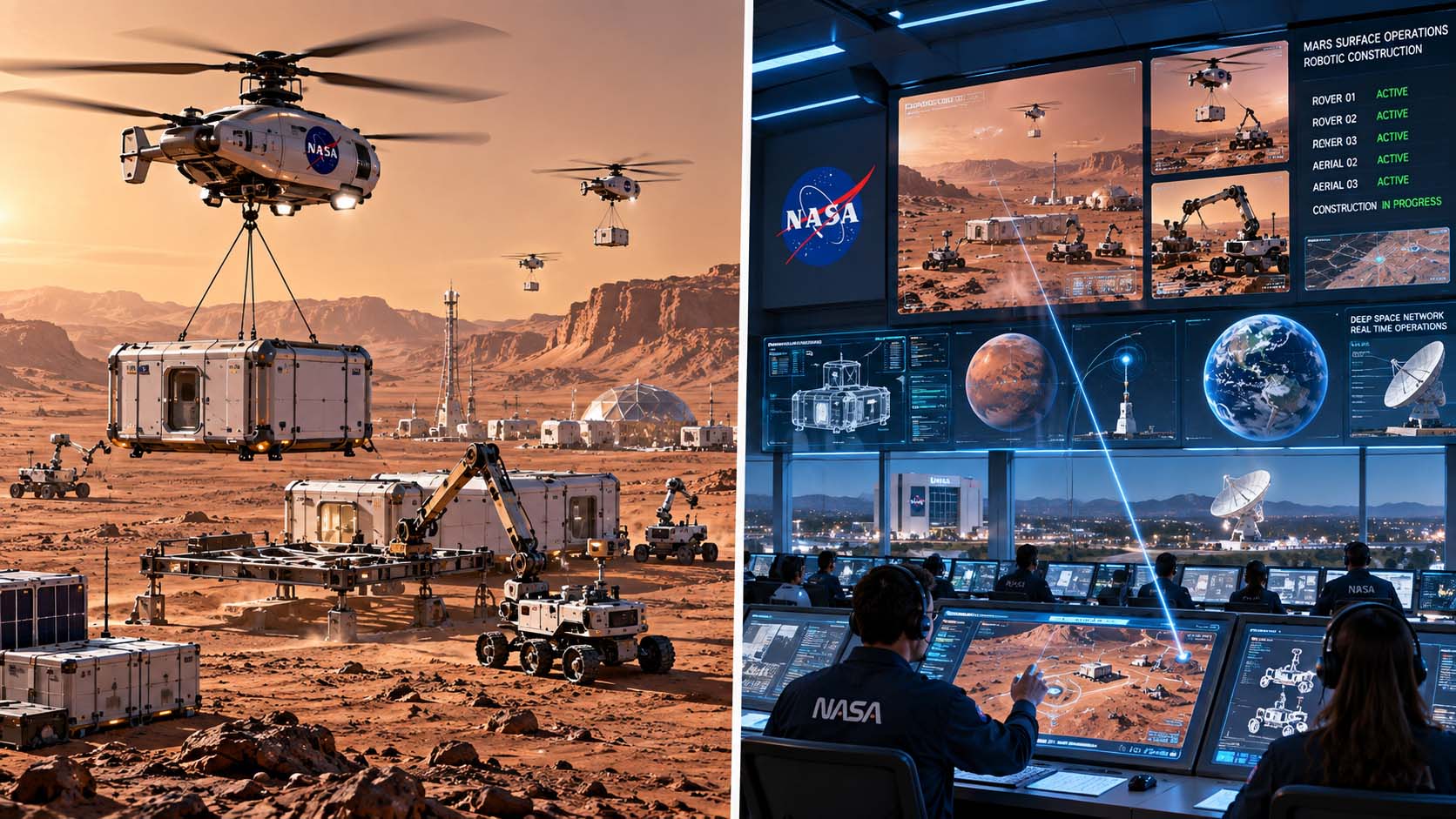
Mars robotics is becoming progressively more autonomous because communication delay makes joystick-style control impossible. The current frontier combines hazard-aware navigation, onboard science decisions, precision landing, aerial scouting, sample handling, and robots that may one day prepare infrastructure before humans arrive.
The Mars helicopter demonstrated that powered flight in the thin Martian atmosphere is practical. Future aerial vehicles can now be considered as legitimate planetary mobility systems rather than pure exploration.
Engineering deep dive
What makes this frontier difficult
| Frontier variable | Why it matters | Evidence that would move the field |
|---|---|---|
| Autonomy | Longer safe traverses without ground intervention | Science return per command cycle |
| Mobility | Access to cliffs, caves and rough terrain | Field demonstrations and planetary mission selections |
| Pre-deployment | Robotic setup of crew infrastructure | Integrated excavation, power and ISRU trials |
In-Situ Resource UtilizationACTIVE DEVELOPMENT · Living from local resources
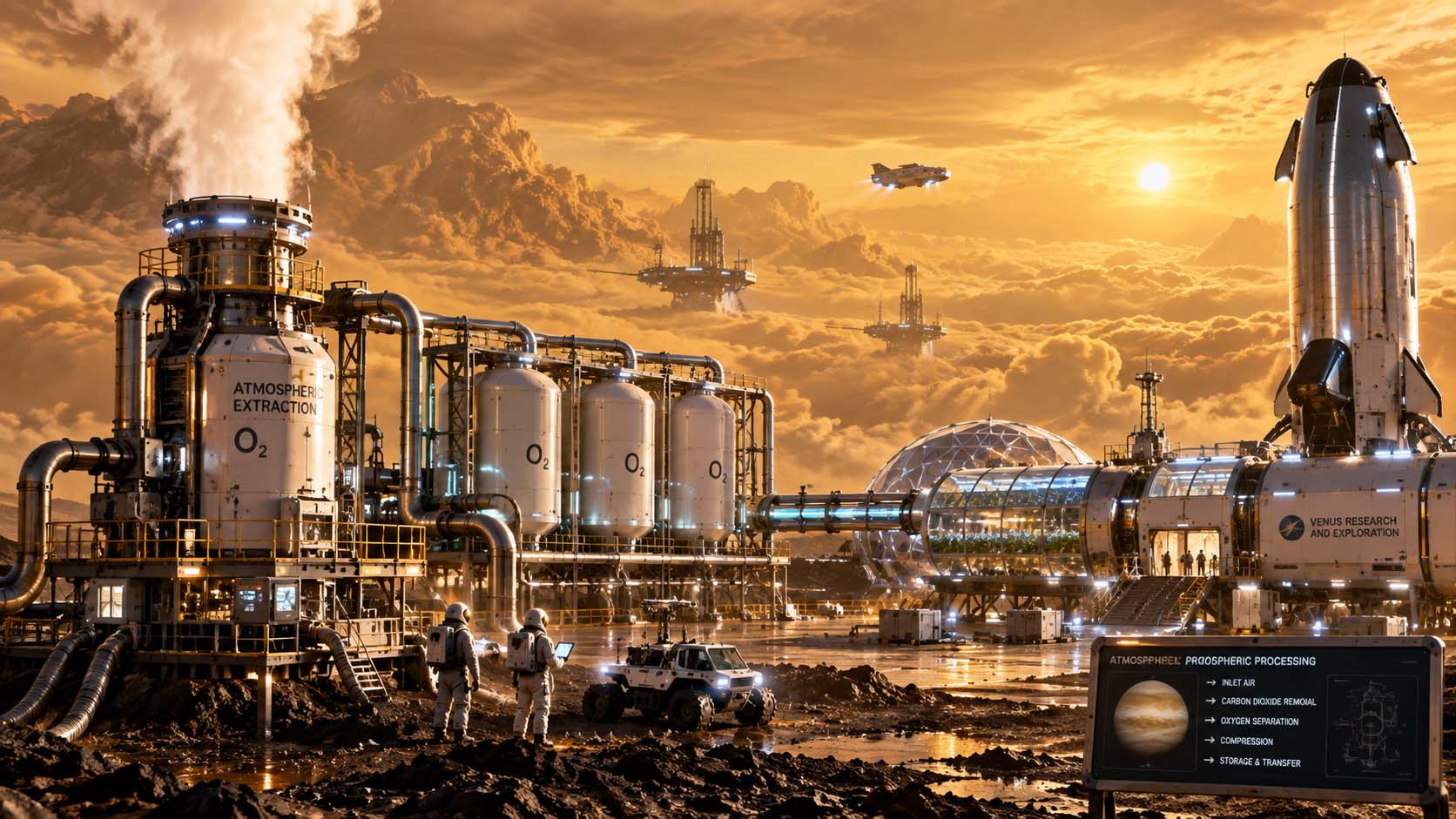
In-situ resource utilization, or ISRU, is the idea of using local extraterrestrial materials instead of launching every kilogram from Earth. This has moved beyond theory: NASA’s MOXIE experiment on Mars successfully extracted oxygen from the carbon-dioxide atmosphere, while lunar programs are developing systems to prospect for and process water, oxygen-bearing minerals, and other resources.
| Resource | Possible use | Technology path |
|---|---|---|
| Water ice | Drinking water, oxygen, hydrogen, radiation shielding, propellant feedstock. | Prospect, excavate, heat or separate, purify, store. |
| Martian CO2 | Oxygen for breathing and oxidizer for rocket propellant. | Solid-oxide electrolysis demonstrated by MOXIE. |
| Lunar regolith | Oxygen extraction, construction aggregate, shielding, metals. | Thermal, chemical, electrochemical, and sintering processes under study. |
| Local soil | Landing pads, berms, roads, radiation mass. | Excavation, grading, microwave or laser sintering, additive construction concepts. |
MOXIE was a technology demonstration. A human Mars mission would need industrial-scale oxygen production, storage, power, redundancy, maintenance, and months of reliable operation before astronauts depended on it.
ISRU is one of the technologies that most clearly separates exploration from settlement. A permanently supplied outpost behaves like an Antarctic station. A self-sustaining settlement must eventually manufacture and recycle far more of what it needs locally.
Engineering deep dive
What makes this frontier difficult
| Frontier variable | Why it matters | Evidence that would move the field |
|---|---|---|
| Prospecting | Reliable maps of accessible water and minerals | Ground-truth measurements at landing sites |
| Processing | Continuous extraction and purification | Mass throughput, power draw and maintenance |
| Storage | Cryogenic or compressed product handling | Loss rates and long-duration reliability |
The First Society on MarsNEXT-GENERATION PROPOSAL · Systems engineering study
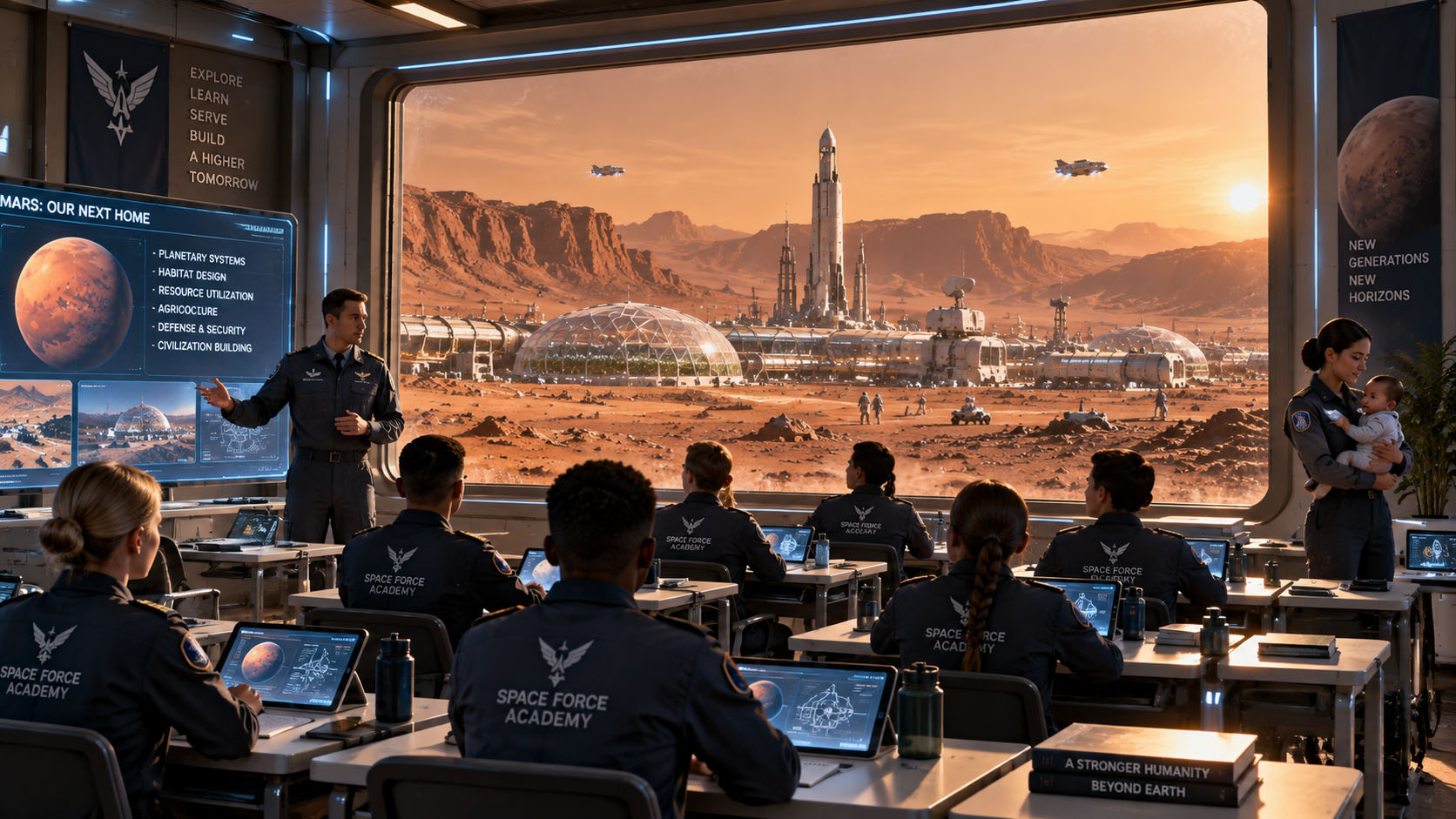
A Mars settlement is not one giant habitat. It is a chain of interdependent life-support, power, medical, industrial, transportation, agricultural, communication, and governance systems. The real frontier is reliability: every critical service has to keep working when replacement parts are millions of miles away and emergency return is not immediately possible.
| System | First-outpost requirement | What changes for a true society |
|---|---|---|
| Air and water | Highly redundant closed-loop life support with stored reserves. | Large-scale recycling, local production, industrial maintenance, and independent spare-part manufacture. |
| Food | Mostly imported with limited fresh production. | Large controlled-environment agriculture, nutrient cycles, seed systems, food processing, and redundancy. |
| Power | Solar plus storage and possibly nuclear systems. | Grid-scale generation, multiple independent sources, industrial loads, and long-term replacement capability. |
| Radiation | Storm shelters and shielding. | Habitats may require substantial regolith shielding, underground volumes, or other high-mass protection strategies. |
| Medicine | Crew medical systems and telemedicine. | Surgery, diagnostics, pharmaceuticals, dentistry, maternity, long-term public health, and emergency care. |
| Industry | Repair tools and spare parts. | Mining, metallurgy, plastics, electronics repair, machine tools, construction, chemical processing, and eventually local manufacturing chains. |
A settlement is not self-sustaining merely because it can grow lettuce or make oxygen. It must survive long disruptions in supply while maintaining life support, medicine, food, energy, repair, and the industrial capability to replace critical equipment.
Engineering deep dive
What makes this frontier difficult
| Frontier variable | Why it matters | Evidence that would move the field |
|---|---|---|
| Life support | Higher recycling and fault tolerance | Months to years without consumables failure |
| Local industry | Repair and fabrication from local or shipped feedstocks | Percentage of critical parts producible on site |
| Governance | Rules for risk, labor, property and emergency authority | Operational frameworks tested in isolated analog environments |
05Frontier 05Building WorldsHabitats · Terraforming · Interstellar Engineering
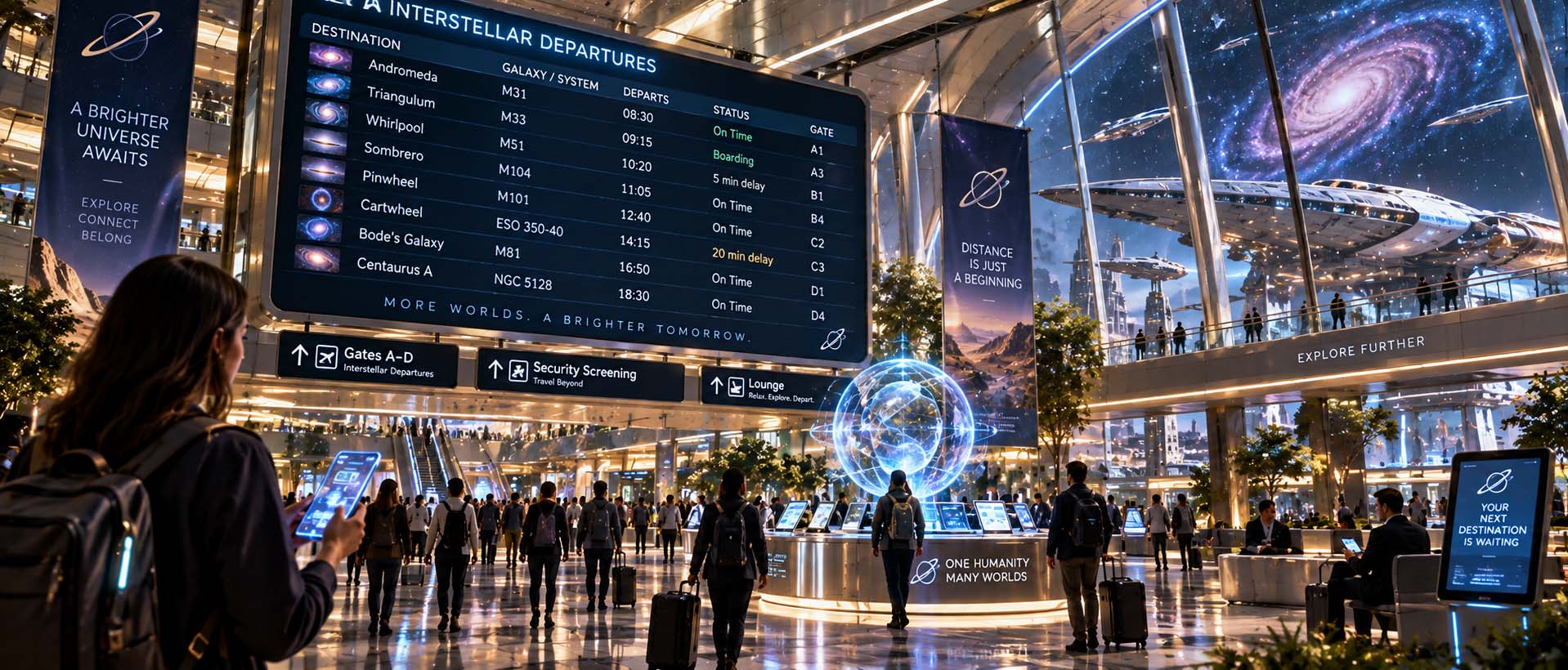
These exhibits move beyond hardware that exists today. Every concept in this Frontier is labeled according to its real status. The physics may be legitimate while the engineering remains generations away. The purpose is to show exactly where present capability ends and civilization-scale construction begins.
O’Neill Cylinders & Rotating HabitatsArtificial landscapes in space
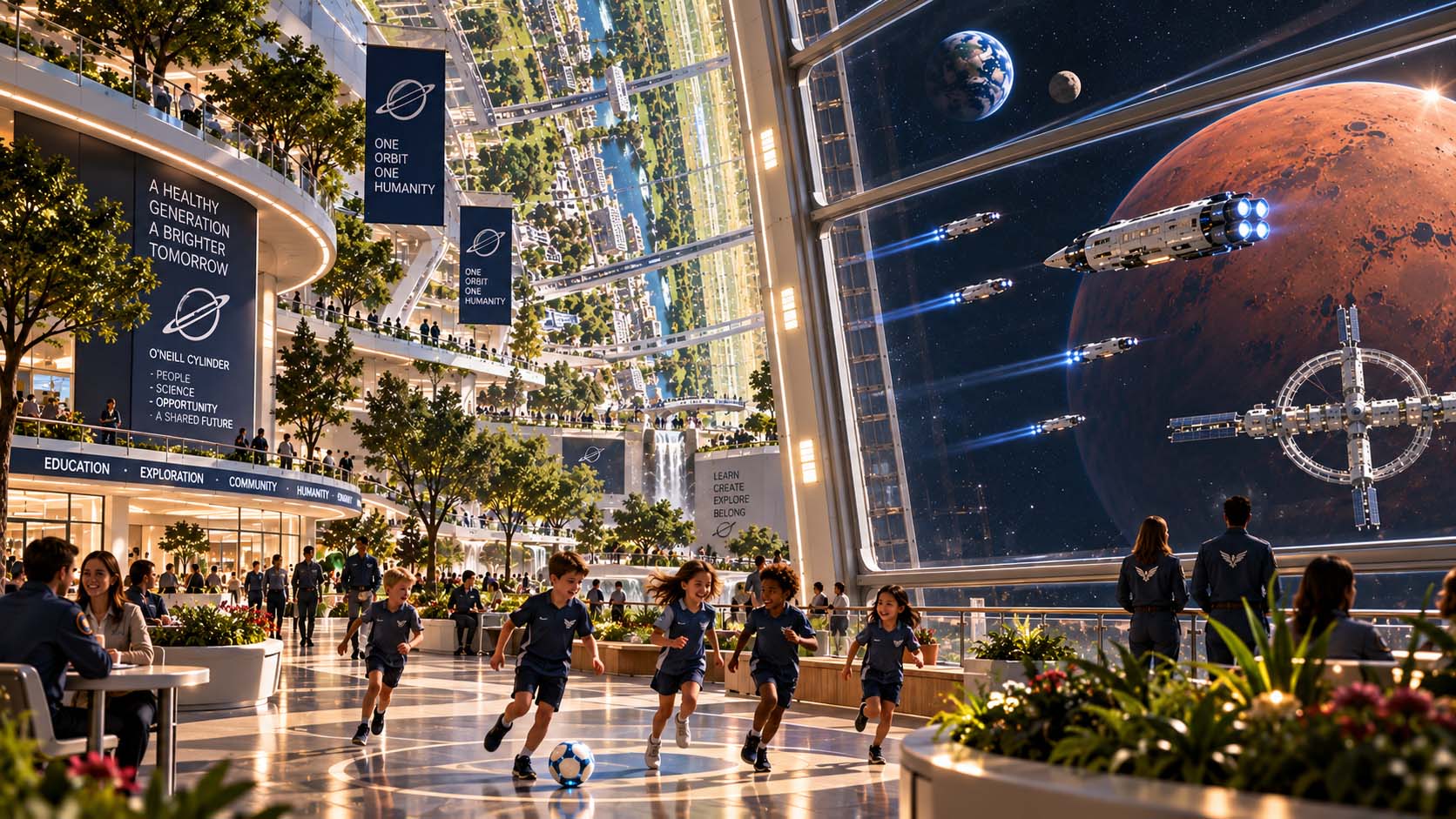
Rotating space habitats are one of the most physically grounded ideas for creating large human environments away from planets. Instead of inventing gravity, the habitat rotates so occupants experience an inward-support force that feels like weight against the inside surface.
A small rotating habitat must spin quickly to create Earth-like apparent gravity, increasing Coriolis effects that may cause disorientation. A much larger radius can create the same apparent gravity at a slower rotation rate.
| System | Engineering demand |
|---|---|
| Structure | The habitat wall carries enormous tensile loads from rotation, shielding, atmosphere, buildings, soil, water, and equipment. |
| Radiation shielding | Long-term residents need far more shielding than short-duration spacecraft typically carry. |
| Atmosphere | A city-size pressure vessel must manage leaks, fire zones, ventilation, humidity, contamination, and compartment isolation. |
| Ecology | Food, water, waste, nutrients, microbes, agriculture, and human health become one closed environmental system. |
| Construction | Launching all material from Earth is likely prohibitive; large habitats strongly favor space-based resources and manufacturing. |
Frontiers treats O’Neill-style habitats as serious physics-based proposals, but not as near-term projects. The concept becomes much more plausible only after launch, automation, space mining, manufacturing, and life-support technology have advanced dramatically.
Engineering deep dive
What makes this frontier difficult
“We can, if we so choose, build new habitats far more comfortable ... than is most of Earth.”Gerard K. O’Neill, Physics Today, vol. 27, no. 9, p. 32, 1974.
| Frontier variable | Why it matters | Evidence that would move the field |
|---|---|---|
| Artificial gravity | Human tolerance across rotation rates and radii | Long-duration experimental data |
| Materials | Pressure-vessel and radiation-shield mass | In-space manufacturing and resource availability |
| Closed ecology | Stable air, water, nutrients and agriculture | Multi-year integrated life-support demonstrations |
The Space ElevatorA roadway from Earth to orbit
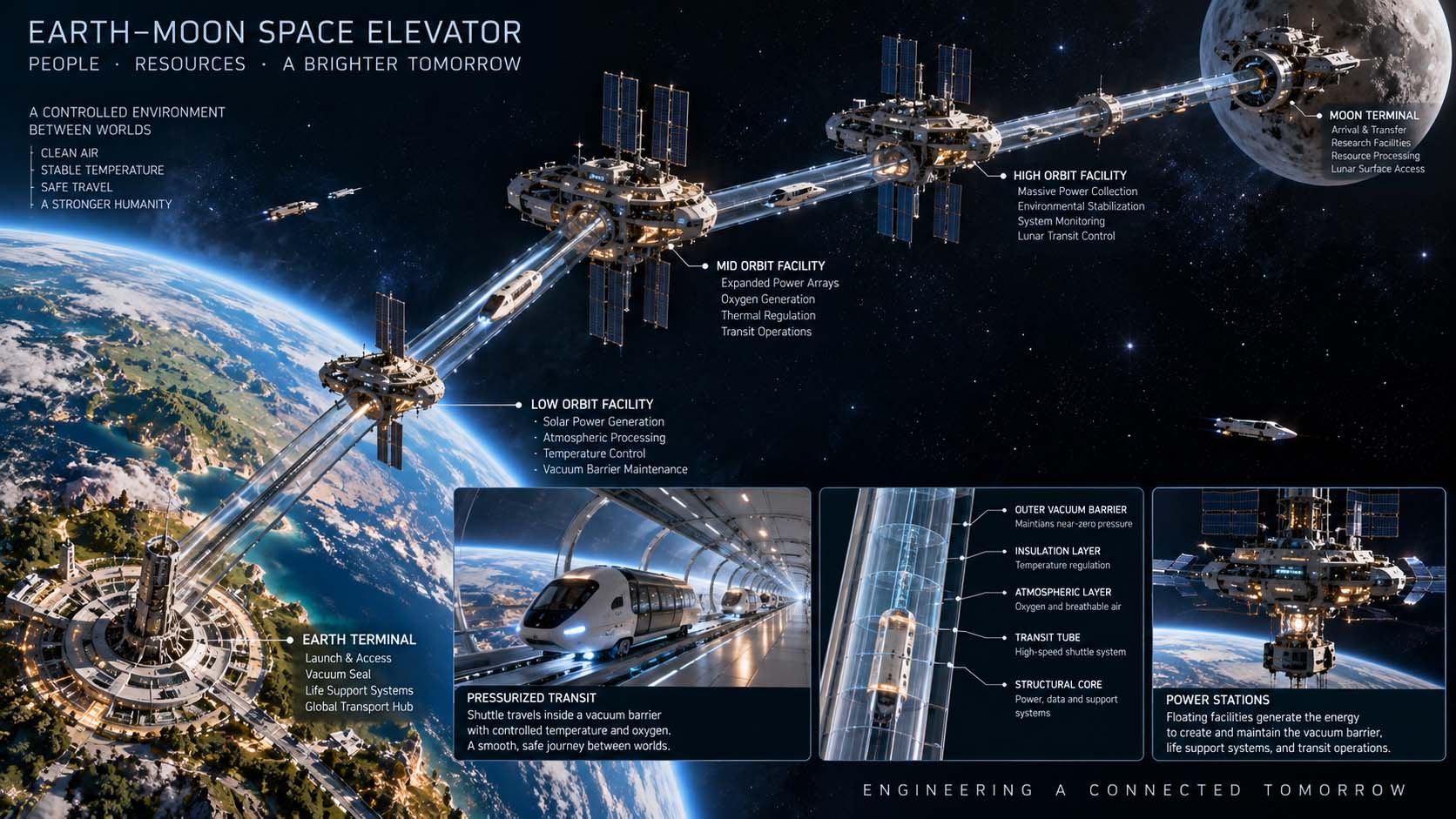
The classic space-elevator concept uses a climber ascending a tether from Earth beyond geostationary orbit. This exhibit extends that idea into a much more exploratory Earth-to-Moon transportation system: a segmented, collapsible controlled-environment corridor supported by floating facilities at different elevations. Those stations would generate power, regulate temperature and pressure, replenish life-support resources, monitor the corridor, and provide intermediate service points for transportation shuttles.
This Earth-to-Moon controlled corridor is a museum engineering thought experiment, not an existing space-elevator design or active program. A continuous oxygen-filled passage hundreds of thousands of kilometers long would create extraordinary structural, pressure, thermal, maintenance, and energy challenges. The intermediate stations shown here explore how a future system might divide those problems into serviceable segments.
| Transit segment | Illustrative shuttle time | Role of the next facility |
|---|---|---|
| Earth Terminal → Low-Orbit Facility | About 20 minutes | Initial systems check, pressure stabilization, traffic sequencing, and transfer to the orbital corridor. |
| Low-Orbit → Mid-Orbit Facility | About 45 minutes | Power transfer, environmental monitoring, thermal regulation, and emergency refuge. |
| Mid-Orbit → High-Orbit Facility | About 60 minutes | Deep-space transit control, corridor maintenance, life-support replenishment, and lunar approach preparation. |
| High-Orbit Facility → Moon Terminal | About 90 minutes | Lunar arrival, surface transfer, cargo handling, and connection to permanent Moon infrastructure. |
| Illustrative total | About 3 hr 35 min | Conceptual end-to-end travel time, excluding station dwell time. |
Curatorial note: These times are illustrative design targets for the fictional corridor shown in the concept art. They are not predictions from an established engineering proposal. Actual travel time would depend on station spacing, acceleration limits, propulsion, orbital mechanics, structural design, and passenger safety.
A terrestrial cable supports only a limited length of its own weight before tensile stress becomes unacceptable. A space-elevator tether would be so long that strength-to-weight ratio, defects, damage tolerance, manufacturing consistency, and repair dominate the design.
For now, the Earth space elevator belongs in the theoretical engineering tier, not the active-development tier. Smaller analogs on the Moon or other low-gravity bodies may face much easier materials requirements.
Engineering deep dive
What makes this frontier difficult
“Carbon nanotubes appear to have the strength-to-mass ratio required for this endeavor.”Bradley C. Edwards, Acta Astronautica, vol. 47, no. 10, p. 735, 2000.
| Frontier variable | Why it matters | Evidence that would move the field |
|---|---|---|
| Materials | Macroscopic tether with required specific strength | Manufactured length, defect tolerance and environmental durability |
| Dynamics | Stable tether under climber loads and oscillations | Full-system nonlinear simulations and demonstrations |
| Operations | Debris avoidance, power beaming, maintenance | Credible end-to-end architecture beyond material samples |
Asteroid EngineeringResources, defense and construction beyond Earth
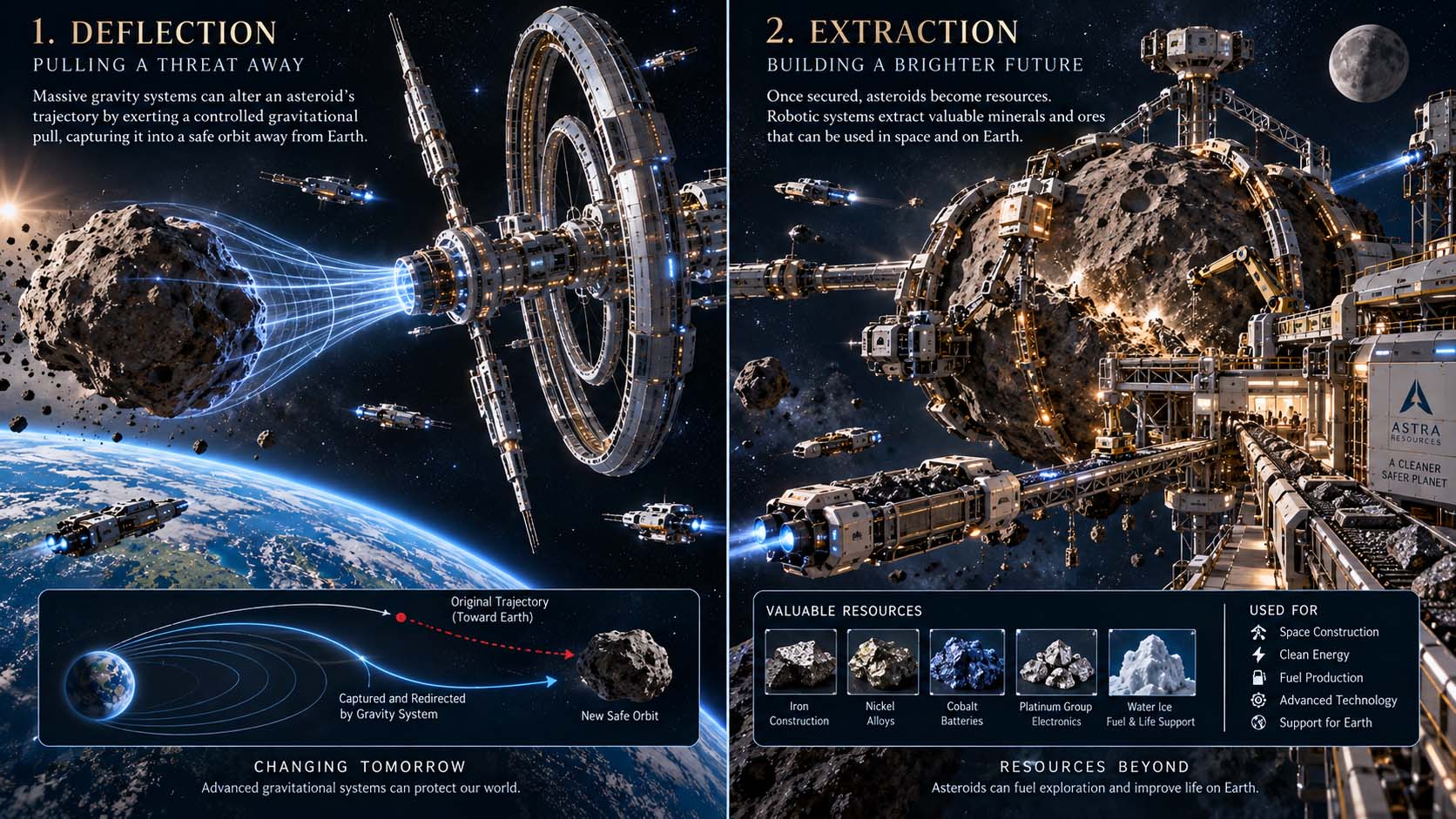
Asteroid engineering covers three distinct frontiers: changing an asteroid’s path to protect Earth, extracting resources in space, and eventually using asteroid material as feedstock for construction and industry. Planetary defense is already experimentally demonstrated; large-scale asteroid mining is not.
| Technique | Purpose | Status |
|---|---|---|
| Kinetic impactor | Strike an asteroid to alter its velocity slightly. | Demonstrated by NASA’s DART planetary-defense mission. |
| Gravity tractor | Hover near an asteroid so mutual gravity slowly changes its course. | Physics-based proposal, not operational. |
| Surface mining | Excavate or capture material in microgravity. | Sampling has been demonstrated; industrial mining has not. |
| Resource processing | Extract water or metals for propellant and construction. | Active research and commercial proposal space. |
| Illustrative asteroid diameter | Approx. metal at S-type benchmark | Approx. rare metals | How to read the estimate |
|---|---|---|---|
| 10 m | 650 metric tons | 50 kg | NASA-published reference example for a small S-type asteroid. |
| 25 m | ≈10,200 metric tons | ≈0.78 metric tons | Volume-scaled from the 10 m reference, assuming similar composition and density. |
| 50 m | ≈81,300 metric tons | ≈6.25 metric tons | Illustrative scaling only. Actual asteroid composition can differ greatly. |
| 100 m | ≈650,000 metric tons | ≈50 metric tons | Theoretical contained material, not the amount a mining operation could necessarily recover. |
NASA has cited an illustrative 10-meter S-type asteroid containing about 650,000 kg of metal, including roughly 50 kg of rare metals such as platinum and gold. The larger rows above scale that reference by volume, so they are order-of-magnitude illustrations rather than surveyed ore reserves. S-type asteroids contain silicate material mixed with nickel-iron, while metallic M-types can be much richer in nickel-iron. Actual recoverable yield would depend on composition, porosity, accessibility, processing losses, and the economics of moving the material.
Planetary defense works best with years of warning. A very small velocity change applied early can grow into a large positional difference by the time an asteroid would otherwise reach Earth.
Engineering deep dive
What makes this frontier difficult
| Frontier variable | Why it matters | Evidence that would move the field |
|---|---|---|
| Resource mapping | Composition and mechanical properties of targets | Sample returns and in-situ measurements |
| Extraction | Controlled excavation in microgravity | Demonstrations beyond laboratory simulants |
| Transport | Moving useful material to customers | Delta-v, propulsion and economic demand |
TerraformingCan a planetary environment be deliberately changed?
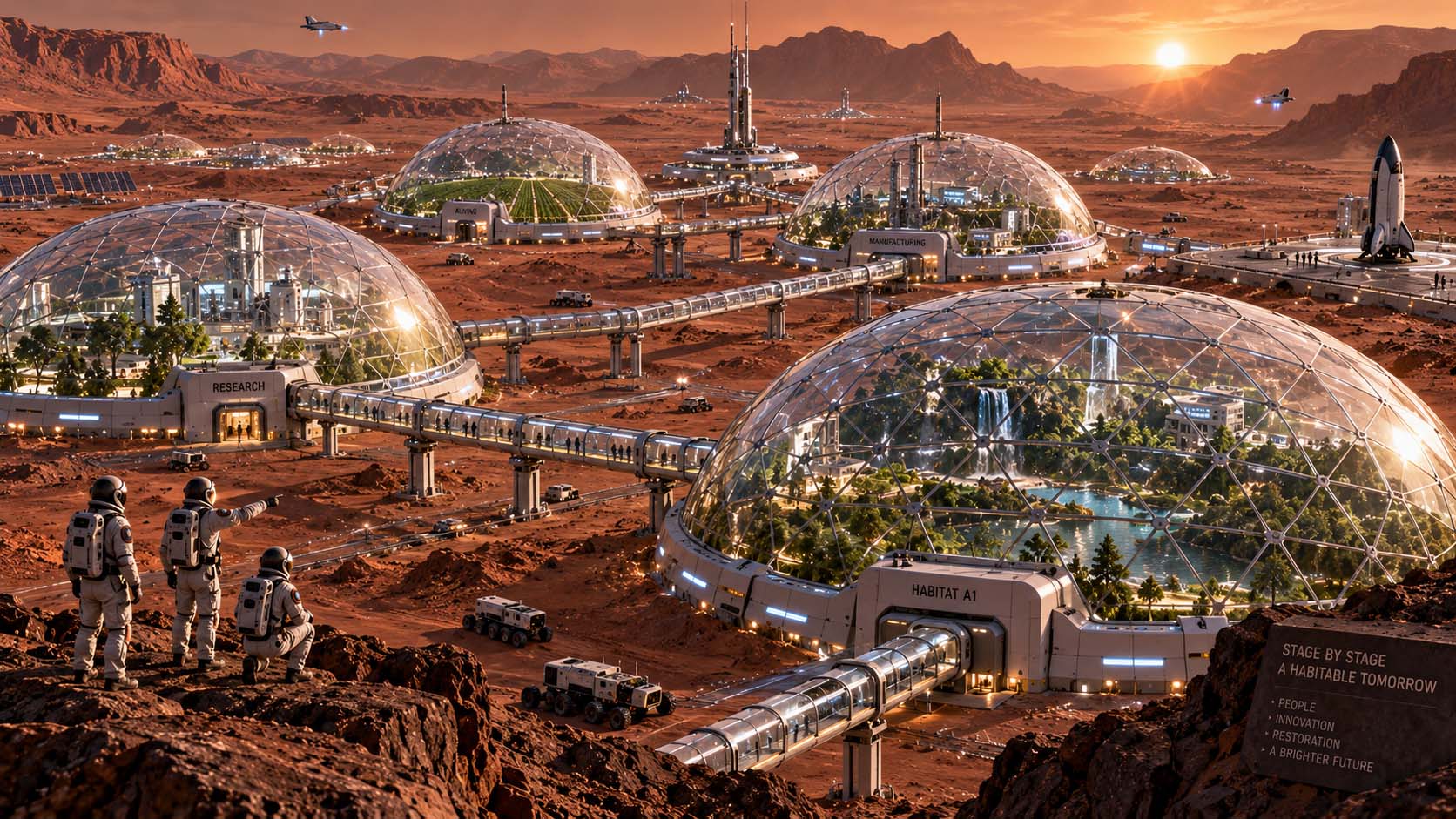
Terraforming means deliberately altering a planetary environment on an enormous scale so that it becomes more compatible with life. It is often discussed casually, but the engineering requirement is civilization-scale: atmosphere, temperature, radiation, water, chemistry, pressure, ecology, and time all interact.
Mars has low gravity, a thin atmosphere, intense surface radiation, scarce accessible atmospheric inventory, global dust, extreme cold, and no Earth-like magnetic protection. Changing one variable does not solve the system.
| Layer | What would have to change | Difficulty |
|---|---|---|
| Pressure | Increase atmospheric mass enough to support useful surface conditions. | Requires an enormous volatile inventory. |
| Temperature | Warm the surface and stabilize liquid water where desired. | Heating interacts with atmospheric loss and greenhouse chemistry. |
| Radiation | Reduce exposure from solar and cosmic radiation. | A thicker atmosphere helps, but deep-space radiation remains a major issue. |
| Biosphere | Establish durable microbial and eventually larger ecological cycles. | Biology cannot be treated as a simple final landscaping step. |
| Timescale | Maintain changes for generations or longer. | Planetary systems evolve slowly and may continually leak atmosphere to space. |
Near-term human settlement, if it occurs, will almost certainly rely on local enclosed environments rather than a terraformed planet. Terraforming belongs here because the physics can be discussed, but it is far beyond demonstrated engineering capability.
Engineering deep dive
What makes this frontier difficult
“Mars is believed to be lifeless, but it may be possible to transform it into a planet suitable for habitation by plants.”Christopher P. McKay, Owen B. Toon and James F. Kasting, Nature, vol. 352, p. 489, 1991.
| Frontier variable | Why it matters | Evidence that would move the field |
|---|---|---|
| Mars inventory | Accessible CO2, water and nitrogen | Planet-scale measurements and reservoir constraints |
| Climate forcing | Achievable warming with realistic materials and energy | Models tied to measured inventories |
| Ethics and protection | Whether alteration should occur at all | International policy and evidence for indigenous life |
Interstellar TravelCrossing the distance between stars
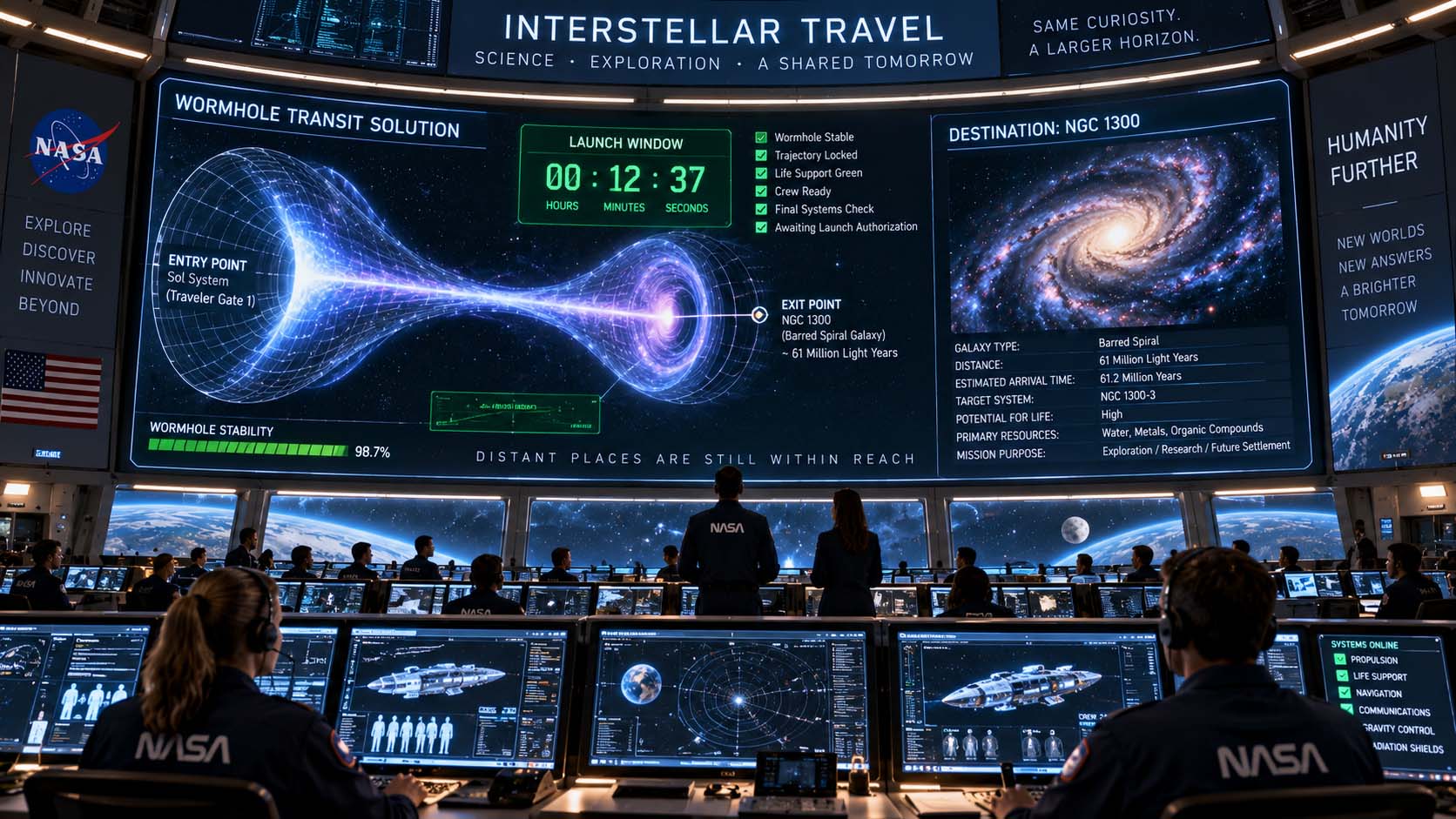
Interstellar distance is the ultimate transportation problem. Even the nearest star system is more than four light-years away. At ordinary spacecraft speeds, journeys last thousands to tens of thousands of years. The frontier therefore revolves around propulsion energy, vehicle mass, shielding, reliability, and whether a mission carries people or only instruments.
| Concept | Operating idea | Frontier assessment |
|---|---|---|
| Laser-driven sail | A powerful remote laser accelerates an ultralight sail to a significant fraction of light speed. | Serious research path for tiny probes; beam infrastructure and target survival are major challenges. |
| Fusion propulsion | Use fusion reactions directly for exhaust energy rather than generating electricity first. | Physics-based concept but far beyond current propulsion hardware. |
| Generation ship | A large habitat carries a self-sustaining human population across many generations. | Requires closed ecology and social continuity far beyond anything demonstrated. |
| Antimatter propulsion | Matter-antimatter annihilation offers extreme energy density. | Production, storage, quantity, and engineering make this far beyond practical capability. |
| Warp concepts | Manipulate spacetime geometry rather than locally exceeding light speed. | Highly theoretical; no known engineering path or evidence that useful configurations are physically realizable. |
According to established relativity, an object with mass cannot be accelerated through the speed of light by ordinary propulsion. The energy requirement rises dramatically as velocity approaches light speed.
Engineering deep dive
What makes this frontier difficult
| Frontier variable | Why it matters | Evidence that would move the field |
|---|---|---|
| Propulsion | High specific impulse with credible energy source | Integrated demonstrations at increasing velocity |
| Materials | Sails, shields and structures under extreme flux | Laboratory and space testing |
| Communication | Return of data across light-year distances | High-gain, low-power optical links and autonomous operations |
06Frontier 06Civilizations Beyond ImaginationKardashev · Dyson Structures · Galactic Engineering
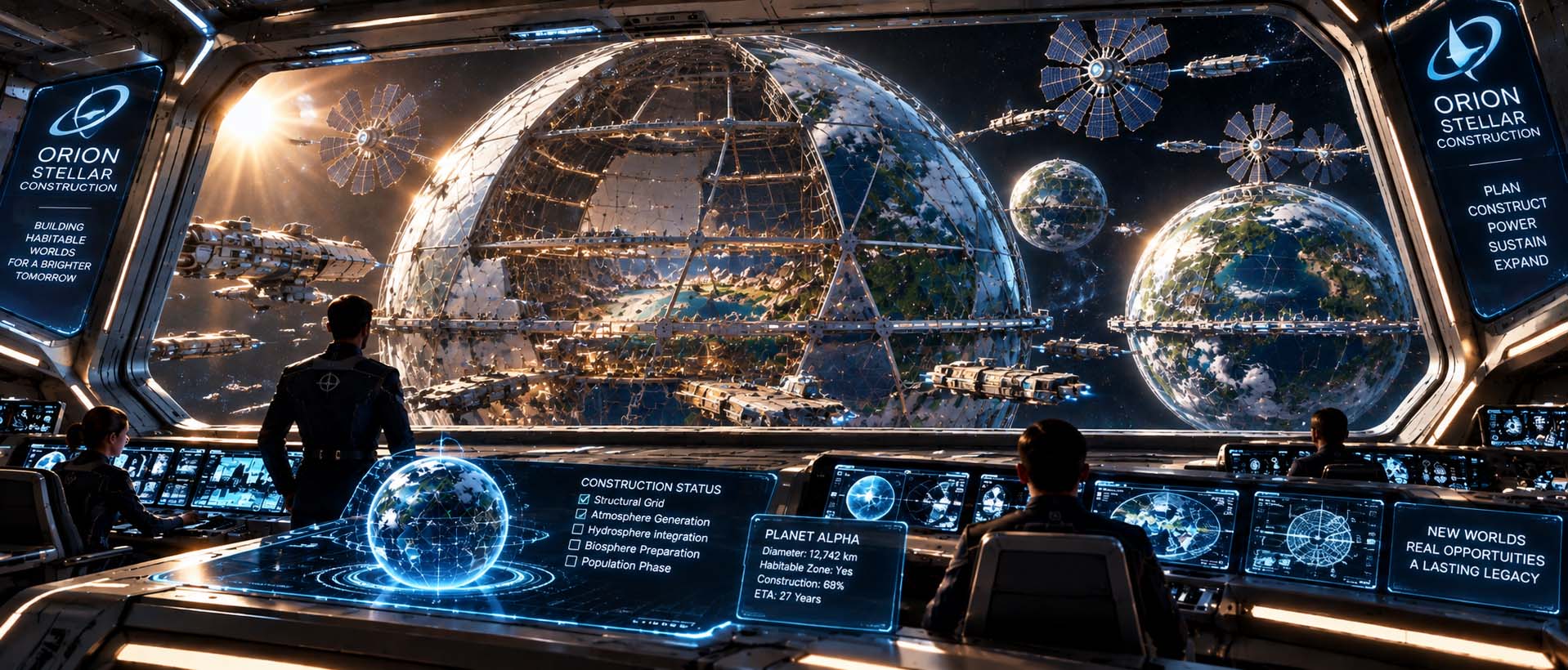
The final Frontier is explicitly theoretical. It asks what known physics might permit if technology continued to scale for thousands or millions of years. These are not predictions, accounts of hidden civilizations, or museum statements of fact. They are structured engineering thought experiments.
Kardashev Type IPlanetary-scale energy use
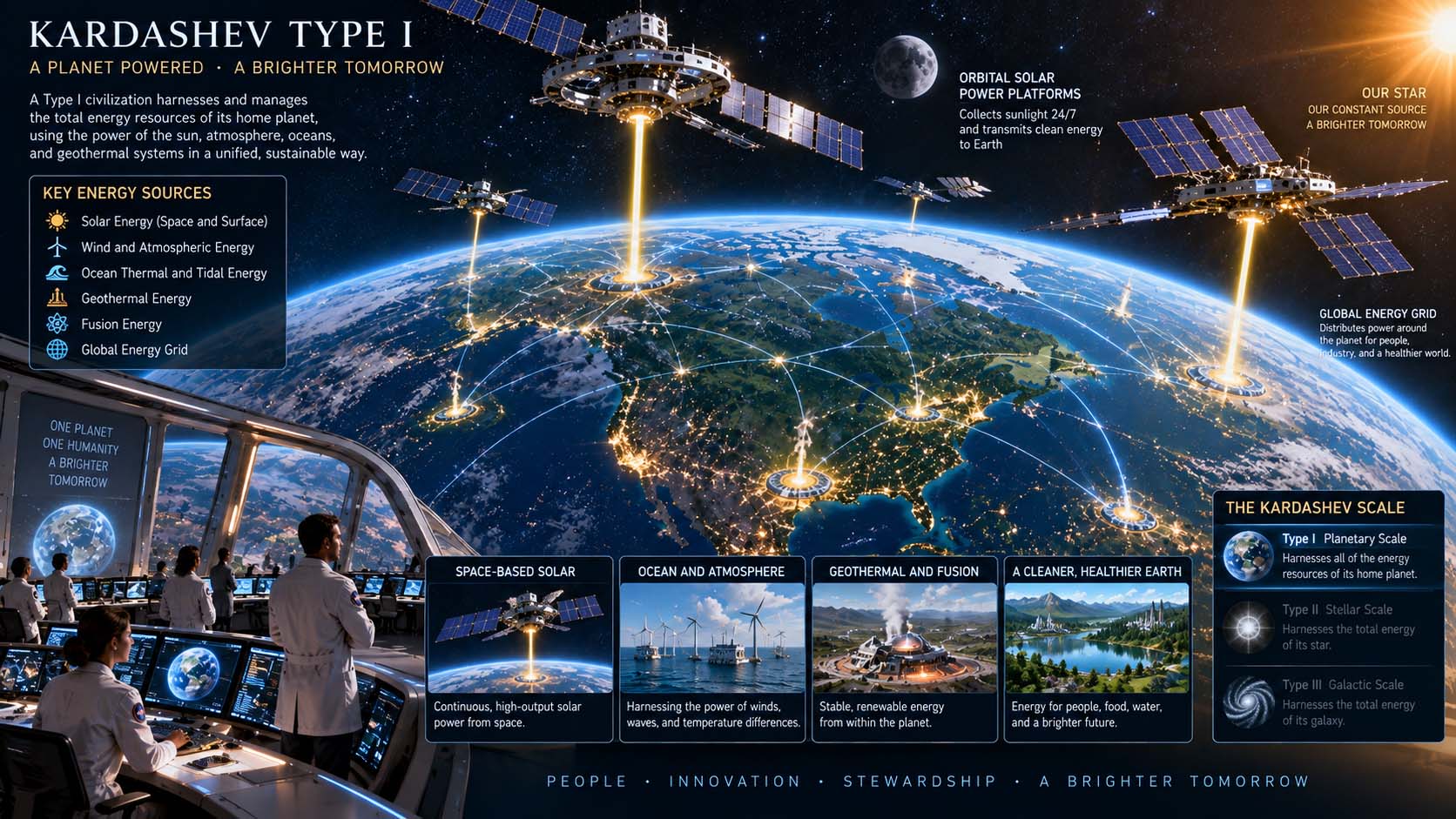
The Kardashev scale is a thought framework for classifying civilizations by the magnitude of energy they can command. A Type I civilization is usually described as operating at a planetary scale. Humanity is not there.
A civilization could become more efficient, use less material per unit of service, or deliberately limit energy growth. Kardashev is useful as a scale-of-engineering thought experiment, not as a complete score for civilization.
Engineering deep dive
What makes this frontier difficult
| Frontier variable | Why it matters | Evidence that would move the field |
|---|---|---|
| Energy systems | Massive low-carbon generation and storage | Grid reliability at continental and global scales |
| Planetary management | Climate, water and ecological stewardship | Ability to alter systems without destabilizing them |
| Civilization metric | Whether power alone is a useful measure | Alternative information and sustainability measures |
Kardashev Type IIStellar-scale energy use
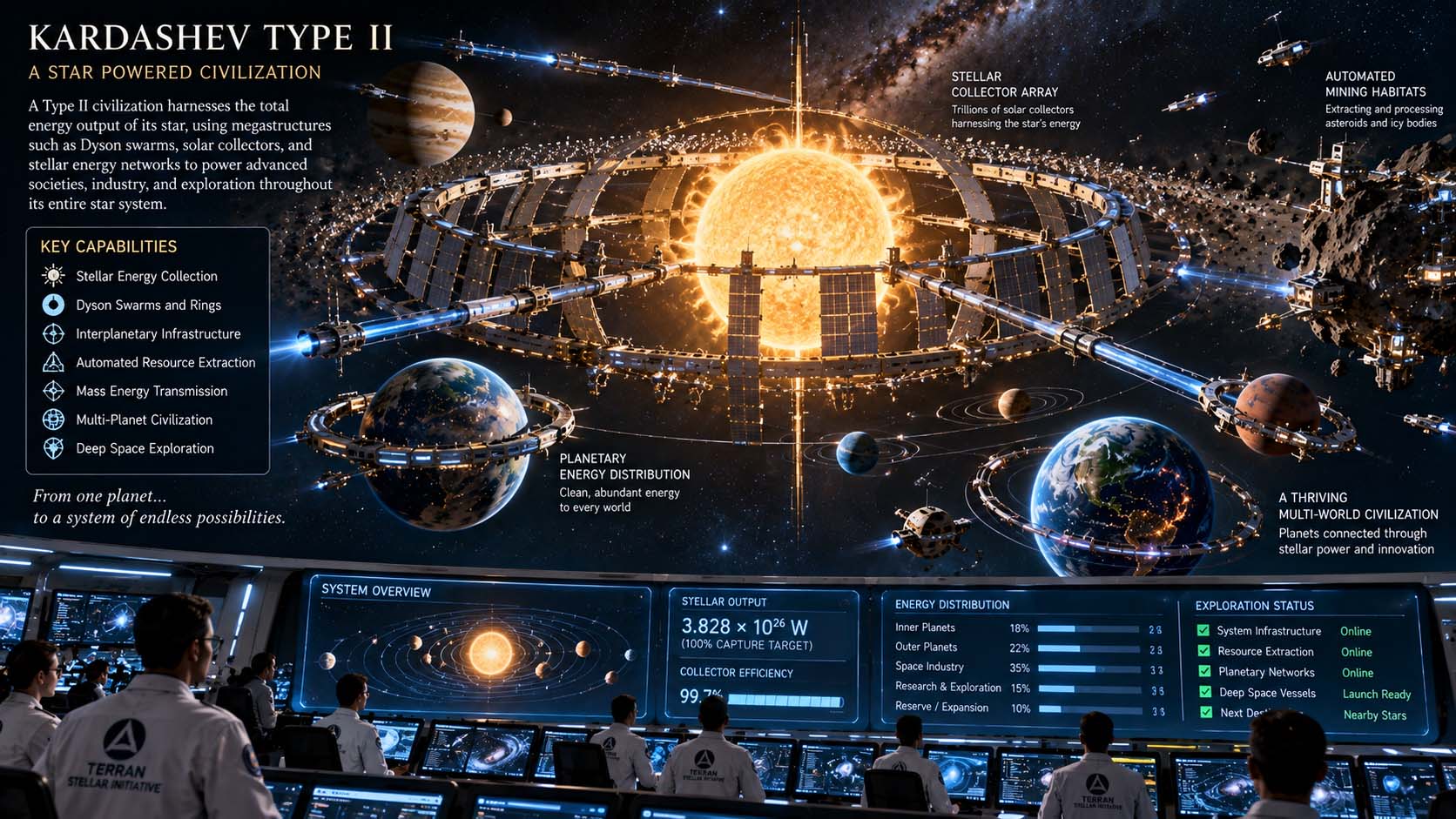
A Type II civilization extends the thought experiment from a planet to its parent star. The defining concept is access to a substantial fraction of stellar energy, which would require construction and coordination on scales that make today’s largest power systems almost invisible by comparison.
No known civilization has been demonstrated to possess Type II capability. This section is a physically motivated extrapolation used to ask what very large-scale engineering would require.
Engineering deep dive
What makes this frontier difficult
| Frontier variable | Why it matters | Evidence that would move the field |
|---|---|---|
| Space industry | Autonomous manufacturing from asteroid and planetary materials | Closed-loop robotic industry demonstrations |
| Energy collection | Large distributed solar infrastructure | Scalable power transmission and thermal rejection |
| Observational test | Searches for unusual waste heat | Astronomical surveys with natural explanations ruled out |
Dyson StructuresArchitecture surrounding a star
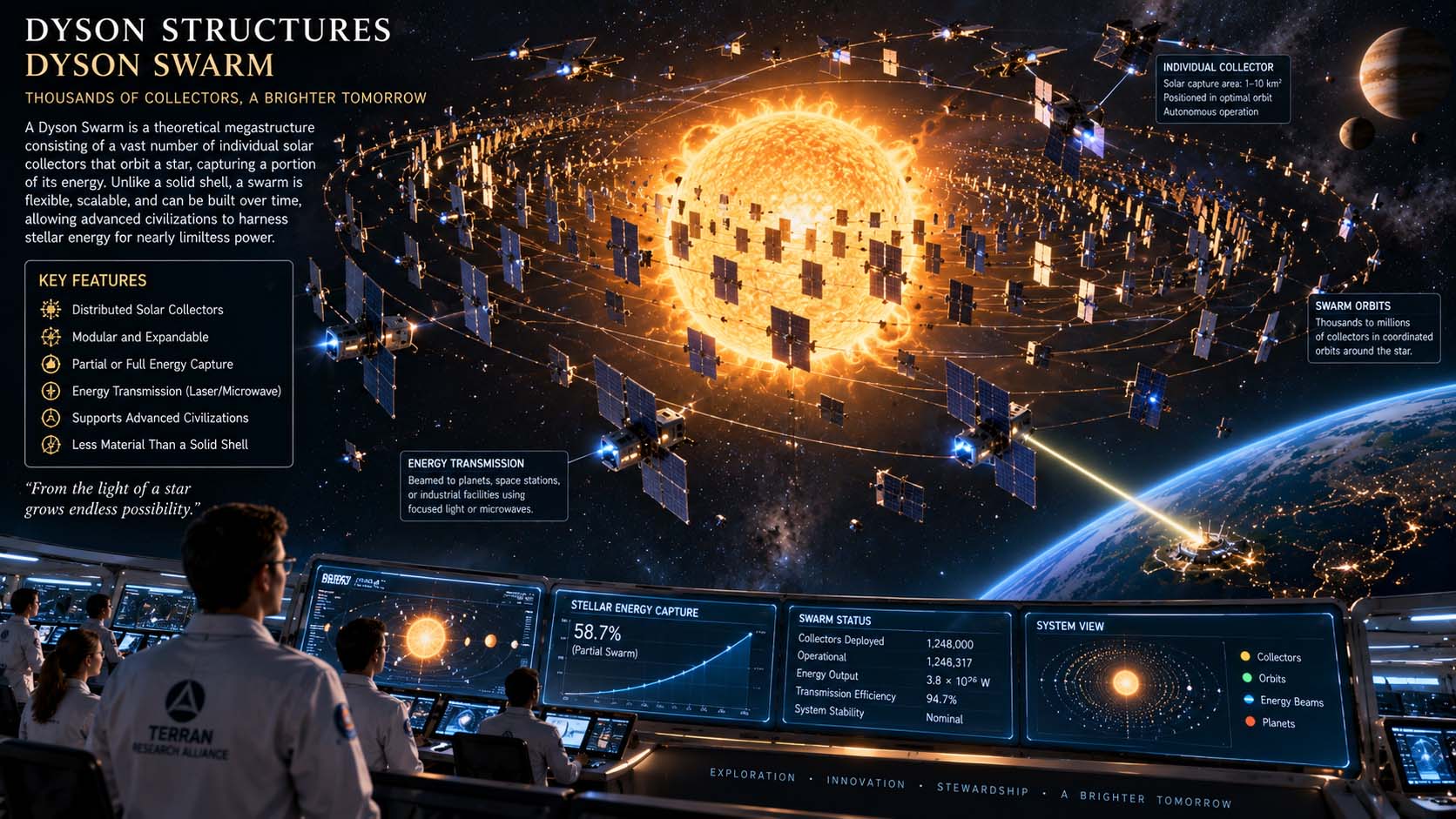
A Dyson structure is best understood not as a giant solid shell around a star, but as a family of concepts in which many independent collectors orbit a star and intercept a significant portion of its energy. A Dyson swarm avoids many impossible structural requirements associated with a rigid shell.
| Concept | Description | Engineering assessment |
|---|---|---|
| Dyson swarm | Very large numbers of independent solar collectors, habitats, or industrial stations in separate orbits. | Physically conceivable in principle, but requires solar-system-scale industry. |
| Dyson bubble | Very lightweight structures balance radiation pressure and gravity in special configurations. | Highly advanced and material-demanding concept. |
| Rigid Dyson shell | One continuous solid sphere around a star. | The popular science-fiction image has severe stability and structural problems and is not the preferred serious concept. |
A structure that captures starlight and uses the energy must reradiate waste heat. Astronomers have therefore discussed unusual infrared excess as one possible technosignature, while emphasizing that natural explanations must be ruled out first.
The important Frontiers lesson is scale. The engineering challenge is not one giant object. It is the creation of an industrial ecology capable of manufacturing, deploying, controlling, repairing, and replacing vast numbers of structures across a star system.
Engineering deep dive
What makes this frontier difficult
“One by-product of their energy metabolism is likely to be the large-scale conversion of starlight into far-infrared radiation.”Freeman J. Dyson, Science, vol. 131, no. 3414, p. 1667, 1960.
| Frontier variable | Why it matters | Evidence that would move the field |
|---|---|---|
| Search strategy | Infrared excess plus optical and spectral context | Candidates surviving natural-source vetting |
| Megastructure models | Swarm temperature and geometry | Predicted spectra distinguishable from dust |
| Engineering plausibility | Material mass and orbital stability | Incremental architectures with repair and collision control |
Stellar EngineeringWhen stars themselves become an engineering environment
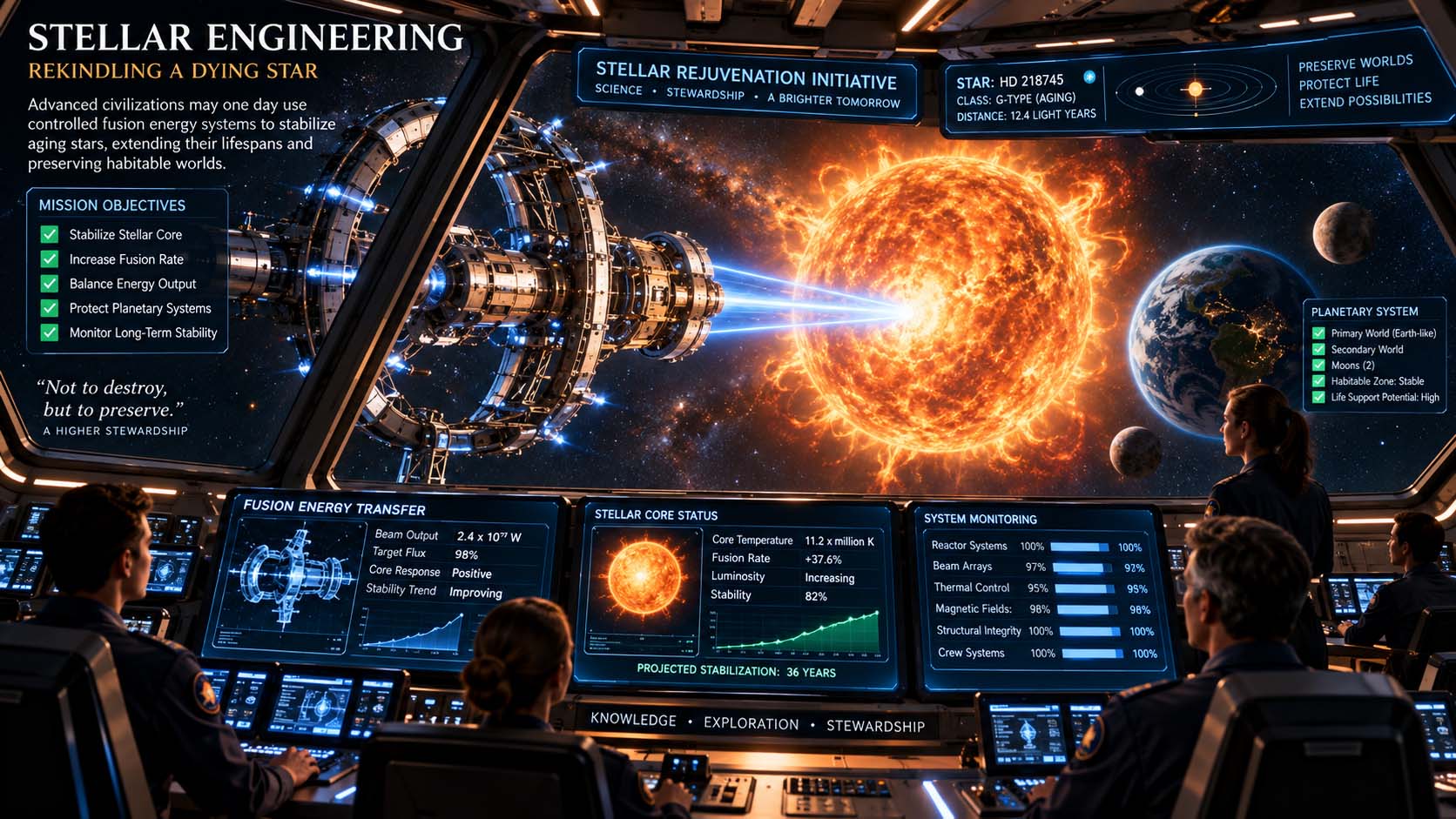
Stellar engineering asks whether a sufficiently advanced civilization could deliberately alter a star’s behavior, mass, motion, or lifetime. These ideas are highly theoretical but remain useful because they reveal how quickly engineering questions change once the available scale moves from planets to stars.
| Concept | Idea | Status |
|---|---|---|
| Star lifting | Remove usable material from a star through magnetic or radiation-driven processes. | Highly theoretical. |
| Stellar engines | Use asymmetric radiation or mass flow to produce a minute but persistent force on a star. | Physics-based thought concept. |
| Lifetime management | Alter fuel mixing or mass to change stellar evolution. | Far beyond known engineering. |
| Moving a planetary system | Over immense timescales, shifting a star also shifts its gravitationally bound system. | exploratory extrapolation, not demonstrated technology. |
At stellar mass, even fantastically small accelerations can accumulate into meaningful changes over millions of years. That does not make the engineering practical, but it explains why some stellar-engine concepts are discussed within physics rather than pure fantasy.
Engineering deep dive
What makes this frontier difficult
| Frontier variable | Why it matters | Evidence that would move the field |
|---|---|---|
| Astrophysics | Better models of stellar evolution and magnetic activity | Predictive accuracy across stellar types |
| Technosignatures | Observable consequences of unnatural stellar intervention | Signals distinguishable from rare natural stars |
| Feasibility | Energy and mass-flow accounting | No violation of known physics, plus plausible control mechanisms |
Kardashev Type IIIGalactic-scale civilization
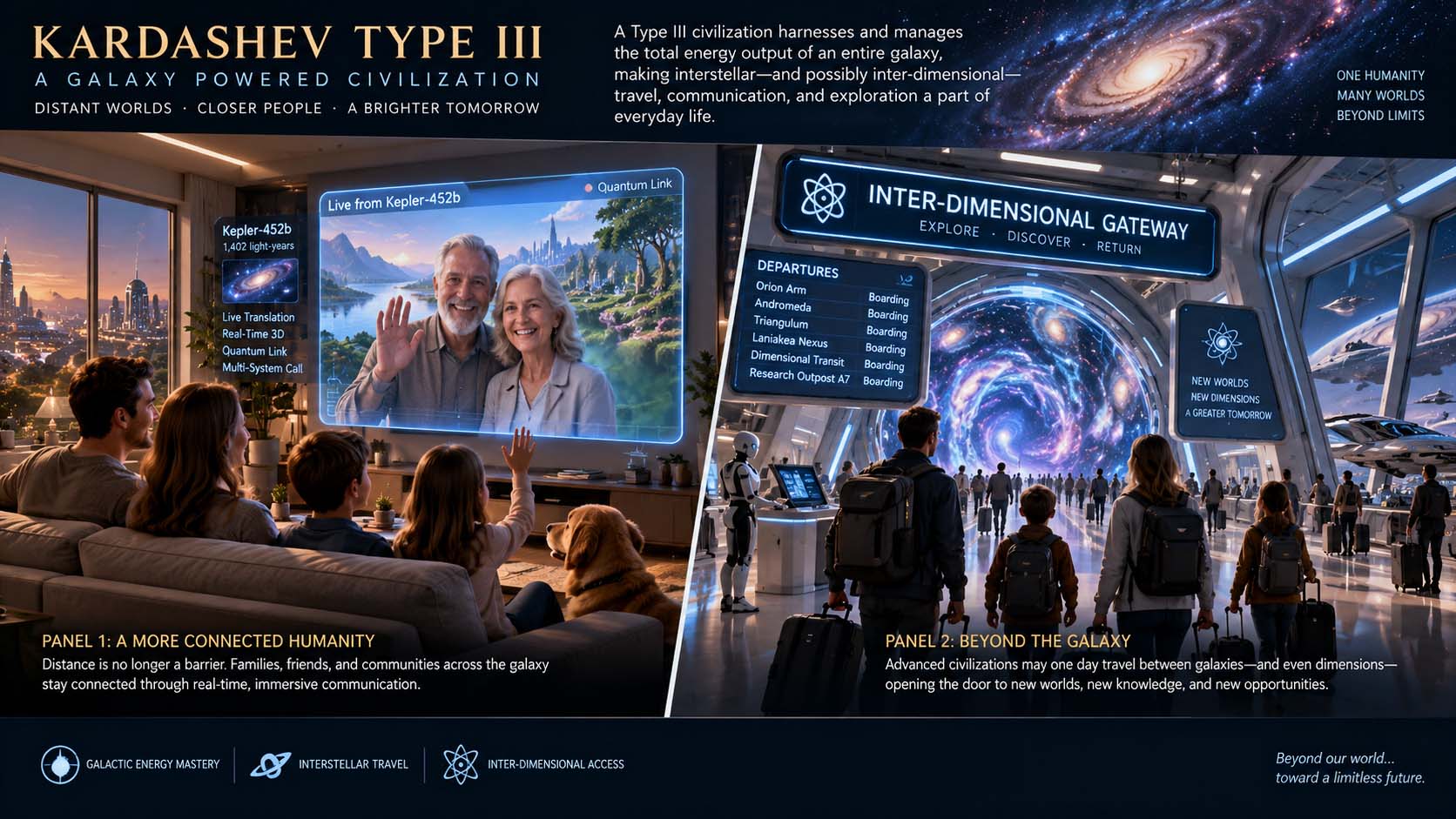
A Type III civilization extends technological activity across the scale of an entire galaxy. At that point the central problem is no longer a single machine. It is coordination across tens of thousands of light-years under the hard limit imposed by the speed of light.
Because information cannot propagate instantly, any real galactic-scale system would have to be profoundly decentralized. Local regions would operate with autonomy while information, culture, and instructions traveled on astronomical timescales.
Engineering deep dive
What makes this frontier difficult
“The protracted duration of signal propagation is a determining factor in the one-way transmission of information through space.”N. S. Kardashev, Soviet Astronomy, vol. 8, no. 2, p. 217, 1964.
| Frontier variable | Why it matters | Evidence that would move the field |
|---|---|---|
| Survey astronomy | Large infrared and optical galaxy catalogs | Outliers that remain after astrophysical vetting |
| Expansion models | Propagation through habitable star systems | Timescales consistent with stellar motions and travel physics |
| Civilization theory | Whether a galaxy-wide society could remain coherent | Models that do not assume instantaneous coordination |
How Far Can Intelligence Go?The closing question

The final room is deliberately left as a question. Human technology has repeatedly converted apparent impossibilities into engineering disciplines, yet every advance also exposes new limits in energy, computation, materials, biology, distance, reliability, and knowledge.
| Boundary | What we know now | Frontier question |
|---|---|---|
| Energy | Every machine requires an energy source and ultimately produces waste heat. | How much useful order can a civilization create before energy and heat become dominant constraints? |
| Computation | Information processing is physical and therefore constrained by energy, noise, latency, and hardware. | Are there ultimate useful limits to intelligence and computation? |
| Relativity | Light speed limits how fast information and causal influence propagate. | How does civilization change when communication delays become years, centuries, or millennia? |
| Materials | Structures fail, fatigue, corrode, irradiate, crack, and deform. | Can self-repairing and self-manufacturing systems push engineering far beyond present maintenance limits? |
| Life | Humans evolved for a narrow planetary environment. | Will future civilization adapt environments to biology, biology to environments, or both? |
The museum should never confuse imagination with evidence. But imagination becomes especially valuable when it is constrained by known physics, clearly labeled by status, and used to expose the real engineering steps between what exists now and what might one day be possible.
That progression is the identity of Frontiers of Science & Architecture: begin with machines that exist, move through machines being tested, and only then ask what the same physical laws might permit on scales beyond present civilization.
Engineering deep dive
What makes this frontier difficult
| Frontier variable | Why it matters | Evidence that would move the field |
|---|---|---|
| Computation | Energy-efficient information processing | Approach to physical limits without intolerable heat |
| Longevity | Systems that preserve knowledge over extreme timescales | Fault tolerance, self-repair and migration |
| Search strategy | Technosignatures not tied to one cultural assumption | Multiple independent observational channels |
Research Voice Source Ledger
Short quotations in this exhibition are paired with the periodical, volume, page, and year so visitors can trace the scientific or engineering source. The quotation panels are historical research voices, not accounts that every older prediction has been realized.
- High-Luminosity LHC: ATLAS Collaboration, Physics Letters B, vol. 716, p. 1, 2012.
- Frontier Artificial Intelligence: Alan M. Turing, Mind, vol. 59, no. 236, p. 433, 1950.
- O’Neill Cylinders & Rotating Habitats: Gerard K. O’Neill, Physics Today, vol. 27, no. 9, p. 32, 1974.
- The Space Elevator: Bradley C. Edwards, Acta Astronautica, vol. 47, no. 10, p. 735, 2000.
- Terraforming: Christopher P. McKay, Owen B. Toon and James F. Kasting, Nature, vol. 352, p. 489, 1991.
- Dyson Structures: Freeman J. Dyson, Science, vol. 131, no. 3414, p. 1667, 1960.
- Kardashev Type III: N. S. Kardashev, Soviet Astronomy, vol. 8, no. 2, p. 217, 1964.
- Quantum Computing at the Error-Correction Frontier: Richard P. Feynman, Engineering and Science, vol. 23, no. 5, p. 22, 1960.