Signature Installation
The Architecture of Creation
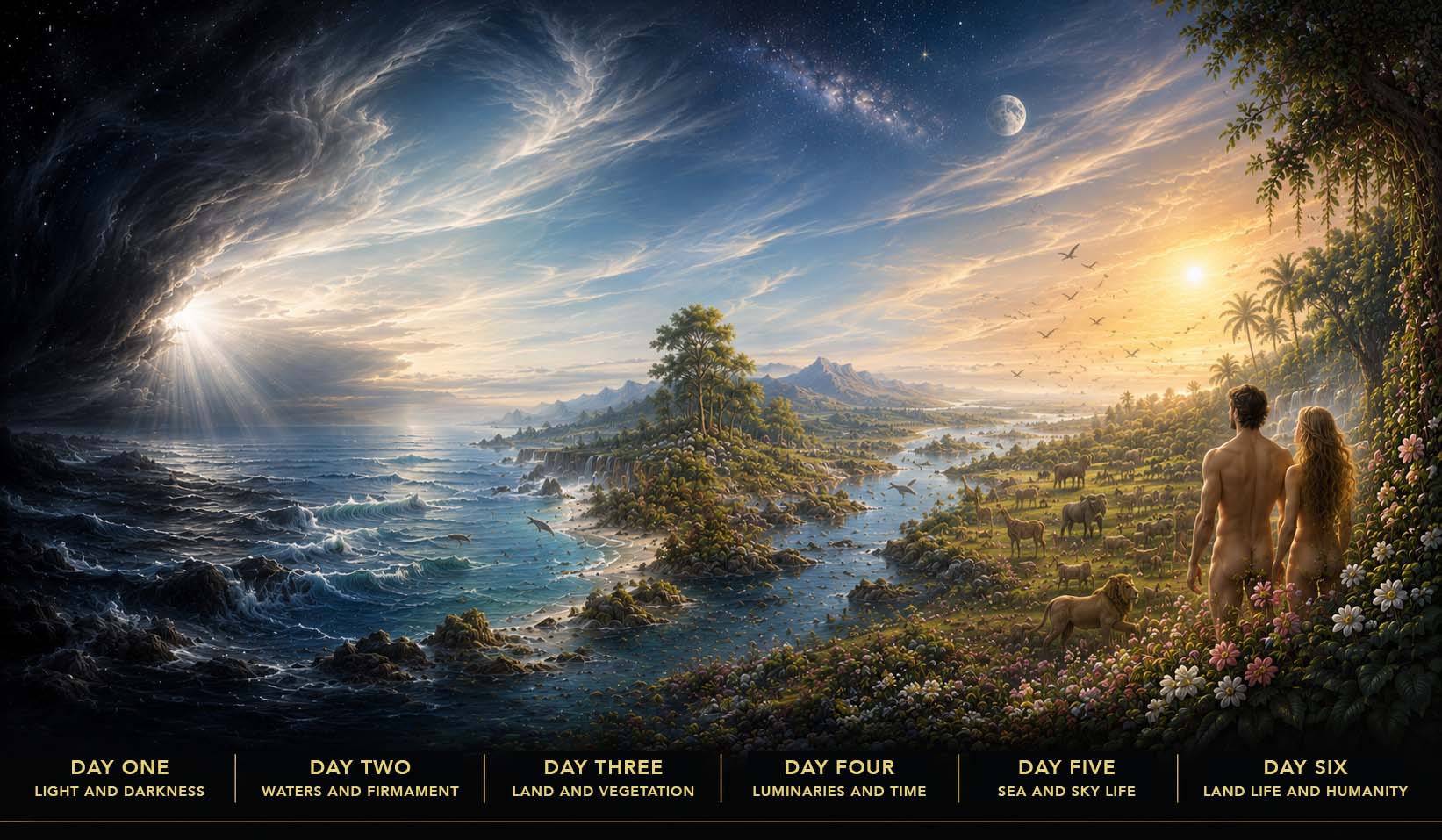
The six days are not presented as disconnected acts. The narrative repeatedly uses speech, separation, naming, appointment, blessing, and evaluation. One widely observed pattern places the first three days beside the next three: realms are formed, then corresponding realms are filled.
Light and Darkness
Light is called forth and separated from darkness; day and night are named.
Lights in the Firmament
The sun, moon, and stars are appointed as heavenly lights for signs, seasons, days, and years, and to rule day and night.
Waters and Firmament
The waters are divided, and the expanse called Heaven establishes an upper realm.
Fish and Flying Creatures
The waters teem with living creatures, and winged creatures fly across the open firmament.
Dry Land and Vegetation
The seas are gathered, dry land appears, and the earth brings forth plants and fruit-bearing trees.
Land Creatures and Humanity
Animals inhabit the land, and humanity is created in God’s image and given dominion.
The forming-and-filling arrangement is a useful literary observation, but Genesis does not label the days with those terms. Readers differ over how tightly the pairs correspond and how literary structure relates to chronological sequence.
The Biblical Sequence
Six days, six movements of ordered creation
Light
“Let there be light: and there was light.”
- Divine act
- Light is called forth.
- Separation
- Light is divided from darkness.
- Naming
- Light is called Day; darkness is called Night.
- Evaluation
- God sees the light, that it is good.
The text introduces light before the luminaries of Day Four. It distinguishes the created phenomenon from the later objects appointed to govern and mark time.
The Firmament
“Let there be a firmament in the midst of the waters, and let it divide the waters from the waters.”
- Divine act
- An expanse is made in the midst of the waters.
- Separation
- Waters below are divided from waters above.
- Naming
- The firmament is called Heaven.
- area for further study
- The verse describes function and separation without supplying a modern technical model.
Day Two creates a realm but does not yet describe its inhabitants. The birds appear on Day Five.
Land, Seas, and Vegetation
“Let the waters under the heaven be gathered together unto one place, and let the dry land appear.”
- Gathering
- The waters are gathered and dry land appears.
- Naming
- Dry land is called Earth; gathered waters are called Seas.
- Fruitfulness
- Grass, seed-bearing plants, and fruit trees come forth.
- Repetition
- The phrase “after his kind” emphasizes ordered reproduction.
Day Three contains two divine commands and two declarations that the work is good. The land is both formed and furnished with food-bearing vegetation.
Lights for Times and Seasons
“Let there be lights in the firmament of the heaven to divide the day from the night.”
- Appointment
- Lights mark signs, seasons, days, and years.
- Rule
- The greater light rules the day; the lesser light rules the night.
- Placement
- God sets them in the firmament to give light upon the earth.
- Heavenly lights
- The greater light, the lesser light, and the stars are placed in the firmament. Genesis explicitly mentions the stars; other visible celestial bodies, including the planets, are not named separately in this passage.
The luminaries do more than illuminate. The sun, moon, and stars establish a visible celestial order associated with signs, seasons, days, and years. The planets are part of the visible heavens, although Genesis 1 does not identify them individually.
Creatures of Water and Sky
“Let the waters bring forth abundantly the moving creature that hath life.”
- Abundance
- The waters swarm with living creatures.
- Realms filled
- Sea creatures inhabit the waters; winged creatures cross the firmament.
- Blessing
- Living creatures receive the first explicit blessing to be fruitful and multiply.
- Great creatures
- The text specifically includes the great creatures of the sea.
Blessing enters the sequence here. Creation is not merely occupied; living creatures are empowered to multiply within their appointed realms.
Land Animals and Humanity
“Let us make man in our image, after our likeness: and let them have dominion.”
- Land life
- Cattle, creeping things, and beasts of the earth appear after their kinds.
- Human distinction
- Male and female are created in the image of God.
- Commission
- Humanity is blessed, told to multiply, fill the earth, subdue it, and exercise dominion.
- Final evaluation
- The completed creation is declared “very good.”
Humanity is introduced last, yet not as an afterthought. The passage gives humans a distinctive identity, blessing, and responsibility within the created order.
Patterns in Plain Sight
The repeated language that holds the chapter together
Creation advances through a repeated pattern of divine command.
The stated command is followed by its accomplishment.
The chapter repeatedly evaluates creation as fitting its intended purpose.
Light from darkness, waters from waters, seas from dry land, and day from night.
Day, Night, Heaven, Earth, and Seas receive names within the ordering sequence.
Plants and animals reproduce within ordered groupings.
Creatures and humanity are blessed to be fruitful and multiply.
Each of the six movements closes with a repeated temporal formula.
Creation is presented as order emerging through the purposeful acts of the Creator—not as order arising by chance.
The Completion
The Seventh Day is different
Genesis 2:1–3 completes the creation account by stating that the heavens and the earth were finished. God rests from his work, blesses the seventh day, and sanctifies it.
- No new realm or creature is introduced.
- The day is blessed and set apart.
- The sequence moves from making and filling to completion and rest.
- The seventh day becomes foundational for later biblical Sabbath language.
The Order Established at Creation
After His Kind
A Repeated Creation Pattern
Life was created with order and distinction
Genesis does not merely record that God created living things. It repeatedly states that plants and creatures were brought forth “after his kind” or “after their kind.” Before Scripture describes the corruption of the world, it first establishes an ordered Creation.
“And God made the beast of the earth after his kind, and cattle after their kind, and every thing that creepeth upon the earth after his kind: and God saw that it was good.”
Genesis 1:25, KJV
The picture is simple: God establishes an ordered world. A creature reproducing according to its own kind follows that order. The deliberate crossing of fundamentally different created kinds would represent something different, the crossing of a distinction established in the Creation account.
The question is therefore not merely, “Can it be done?” It is also, “Should it be done?”
| Passage | Created Life | Language of Order |
|---|---|---|
| Genesis 1:11–12 | Grass, herbs, and fruit trees | “after his kind” and “after their kind” |
| Genesis 1:21 | Sea creatures and winged fowl | “after their kind” and “after his kind” |
| Genesis 1:24–25 | Cattle, beasts, and creeping things | Repeatedly “after his kind” and “after their kind” |
| Genesis 6:20 | Creatures preserved through the Flood | The same “after their kind” order appears again |
When the Order Is Corrupted
From Creation to the Days of Noah
This pattern becomes especially significant as the Genesis narrative moves toward the Flood. Genesis 1 presents God establishing order and distinction. Genesis 6:1–4 then records the sons of God taking the daughters of men, followed by the appearance of the Nephilim. The account soon describes a world overwhelmed by wickedness and corruption.
“And God looked upon the earth, and, behold, it was corrupt; for all flesh had corrupted his way upon the earth.”
Genesis 6:12, KJV
Scripture does not explicitly state that Genesis 6:12 describes the intermingling of animals or genetic alteration. That conclusion should not be placed into the text. But the contrast is worth observing: Genesis begins with an ordered Creation, while the pre-Flood world is later described as corrupted. The violation involving the sons of God and the daughters of men stands within that larger movement from order toward corruption.
An Order Established Before the Corruption
The language returns with Noah
When God commands Noah to preserve living creatures through the coming judgment, the language of Creation appears again:
“Of fowls after their kind, and of cattle after their kind, of every creeping thing of the earth after his kind, two of every sort shall come unto thee, to keep them alive.”
Genesis 6:20, KJV
Question to Carry Forward
God established the order before the corruption. When He preserved life through the Flood, He again commanded that it be preserved “after his kind.” Why does Scripture repeat this distinction?
This question becomes part of the investigation as the museum moves forward into the Days of Noah, the sons of God, the Nephilim, and the corruption of the pre-Flood world.
Ancient Texts & Cultural Memory
Echoes of a Broken Order
Composite Beings in the Ancient Record
Ancient cultures repeatedly pictured the crossing of ordinary created forms
Museum illustration. Presented as a visual study of composite forms in ancient Egyptian art, not as a photograph of a single archaeological artifact.
Across the ancient world, artists and writers portrayed composite beings: human and animal forms joined together, animals bearing features of other animals, winged guardians, hybrid monsters, and divine figures represented with mixed characteristics. Egyptian, Mesopotamian, Greek, and other traditions preserve many such images.
These representations do not demonstrate that composite creatures actually existed. They establish that ancient peoples repeatedly imagined, described, carved, painted, and preserved beings whose forms crossed ordinary boundaries between humans and animals, or between different kinds of animals.
Placed beside the repeated Genesis language of life being created “after his kind,” these ancient images raise a historical question: why did the ancient world so often preserve images of mixed forms?
Three Extra-Biblical Witnesses
What the ancient writings actually say
The following works are not being presented as canonical Scripture. They are included because they preserve ancient or later traditional interpretations of the corruption surrounding the pre-Flood world. Their wording is allowed to stand on its own without making one text say more than it actually says.
1 Enoch 7
“They began to sin against birds, and beasts, and reptiles, and fish”
In 1 Enoch, the Watchers take human wives and their offspring become giants. The giants consume what mankind produces, turn against mankind, and the corruption then extends into the animal world. The account says that they began to sin against birds, beasts, reptiles, and fish, followed by the devouring of flesh and the drinking of blood.
What Enoch says: the corruption reaches beyond humanity and involves the animal creation.
What Enoch does not explicitly say: this passage does not state that one animal species was deliberately bred or mixed with another.
Jubilees 7
“They sinned against the beasts and birds”
Jubilees retells the pre-Flood corruption in Noah's instruction to his descendants. It connects the Flood with the transgression of the Watchers and the daughters of men, the violence of their offspring, widespread bloodshed, and then states that they sinned against the beasts, birds, and everything that moves upon the earth.
What Jubilees contributes: like Enoch, it remembers the corruption as extending beyond human society into mankind's treatment of the wider living creation.
Jasher 4:18 · 1840 English Edition
“Taught the mixture of animals of one species with the other”
The later noncanonical Book of Jasher is considerably more explicit. Its account says that the sons of men took from the cattle, beasts of the field, and birds of the air and “taught the mixture of animals of one species with the other”, describing the act as something done to provoke the Lord.
The passage immediately connects this behavior with a corrupted earth and says that all flesh had corrupted its ways, including men and animals.
Important distinction: this is the wording of the later Book of Jasher represented by the 1840 English edition. It should not be confused with proof that this work is the lost ancient Book of Jasher mentioned in Joshua 10:13 and 2 Samuel 1:18.
| Record | What It Contributes | Status in This Exhibit |
|---|---|---|
| Genesis 1 | Living things repeatedly created “after their kind.” | Canonical Scripture |
| Genesis 6:1–4, 12 | Sons of God and daughters of men; Nephilim; “all flesh” described as corrupted. | Canonical Scripture |
| 1 Enoch 7 | Giants sin against birds, beasts, reptiles, and fish. | Ancient noncanonical text |
| Jubilees 7 | Watchers, their offspring, bloodshed, and sin extending to beasts and birds. | Ancient noncanonical text |
| Jasher 4:18 | Explicit tradition of “the mixture of animals of one species with the other.” | Later noncanonical tradition, 1840 English edition |
| Ancient imagery | Repeated portrayals of composite human-animal and animal-animal forms. | Cultural evidence of the idea, not proof of biological existence |
Three Records · One area for further study
What are we actually looking at?
The Biblical Record establishes an ordered Creation and subsequently describes its corruption.
The Extra-Biblical Record preserves traditions describing the pre-Flood corruption in greater detail, with Jasher going so far as to describe the deliberate mixture of different animal species.
The Material and Cultural Record shows that ancient civilizations repeatedly represented beings combining characteristics that ordinarily belonged to different creatures.
Were these images purely symbolic? Religious representations? Products of imagination? Memories transformed into mythology? Or were ancient peoples attempting to represent something they believed belonged to a much older world?
The surviving evidence cannot establish that composite creatures actually existed. But the recurrence of the idea in ancient texts, traditions, sculpture, reliefs, seals, pottery, and religious imagery makes the question worthy of preservation.
A Question to Carry Forward
God established the order first. “After his kind” appears before Scripture introduces the corruption of the pre-Flood world. Genesis later records the extraordinary union of the sons of God and the daughters of men and eventually declares that “all flesh had corrupted his way upon the earth.”
When Noah is commanded to preserve living creatures, the original language of order appears again: “after their kind.”
The question is no longer simply what ancient people imagined. It is why so many of them imagined the crossing of boundaries that Genesis took care to establish at Creation.
Questions Scholars Continue to Discuss
Text, chronology, and interpretation
Are the days chronological, literary, or both?
The text numbers the days and repeats evening-and-morning language, while also displaying strong literary organization. Interpreters differ over whether the structure describes six ordinary days, a literary framework, analogical divine workdays, or another chronological model.
Why is light present before the luminaries of Day Four?
Genesis distinguishes the creation or appearance of light on Day One from the appointment of lights in the firmament on Day Four. Interpretations vary regarding mechanism, but the narrative’s stated sequence is clear.
What does the firmament describe?
The Hebrew term describes an expanse associated with the separation of waters and later with the placement or movement of heavenly lights and flying creatures. The passage communicates ordered realms but does not supply a modern scientific cross-section.
How should Genesis 1 and Genesis 2 be read together?
Genesis 1 presents a broad, ordered account culminating in humanity. Genesis 2 narrows attention to the man, the garden, the command, the animals, and the woman. Readers differ over whether Genesis 2 is a topical expansion, a complementary perspective, or a differently arranged account.
What is meant by the image and likeness of God?
Proposals emphasize representation, relationship, moral capacity, royal vocation, embodied stewardship, or a combination of these. Genesis explicitly connects the image with male and female humanity and with dominion over living creatures.
How should the creation account relate to modern scientific models?
The museum begins with what the biblical text states and distinguishes that from later interpretive models. Correlation with modern cosmology, geology, biology, and chronology requires additional assumptions and belongs in dedicated Research Library rather than being silently inserted into Genesis.
Why This Matters
The world of the biblical story is purposeful and ordered
Creation is intelligible
The sequence portrays distinctions, realms, functions, and recurring order rather than an unknowable or capricious cosmos.
Created things are not gods
Light, waters, luminaries, creatures, and humanity belong within creation and remain subject to the Creator.
Life receives blessing
Fruitfulness is not merely biological expansion; it is introduced as divine blessing and vocation.
Human dominion is delegated
Human authority is received within creation and therefore carries responsibility rather than absolute ownership.
Goodness precedes the Fall
The world is declared very good before sin, curse, violence, and death enter the human story in the chapters that follow.
Rest completes the pattern
The account reaches its completion not with endless production, but with a blessed and sanctified seventh day.
Illuminated Collection
Plate II · The Ordering of the World
Museum Connections
Follow the sequence or investigate a single question
Return to Genesis 1:1–2 and the condition before the first command.
Timeline Creation and the Adamic LineSee how the museum’s chronology begins and proceeds toward Noah.
Research Collection Creation Models and ChronologyPlanned study of day-length interpretations, chronology, and scientific correlation.
Gallery Gallery I OverviewReview the sequence from Creation toward Eden and the first human history.
Exhibit Sources
Primary text and related biblical passages
Genesis 1:3–31; 2:1–3
The six creative days and the completion, blessing, and sanctification of the seventh day.
Exodus 20:8–11; Psalm 8; Psalm 19; Psalm 104
Related passages concerning creation, the heavens, humanity’s role, and the Sabbath pattern.
John 1:1–5; Colossians 1:15–17; Hebrews 1:1–3
New Testament passages reflecting on creation, divine agency, light, and the sustaining of all things.
Mesopotamian and Egyptian creation traditions
Comparative sources concerning cosmic waters, divine generations, conflict, luminaries, humanity, kingship, and temple order.
Literary structure and chronology
Secondary discussions of the day sequence, forming and filling, evening and morning, the firmament, and the relationship between Genesis 1 and 2.
The exhibit distinguishes the wording of Genesis from later literary arrangements and chronological models. A full bibliography will be developed in the Research Library as the related Research Library are opened.