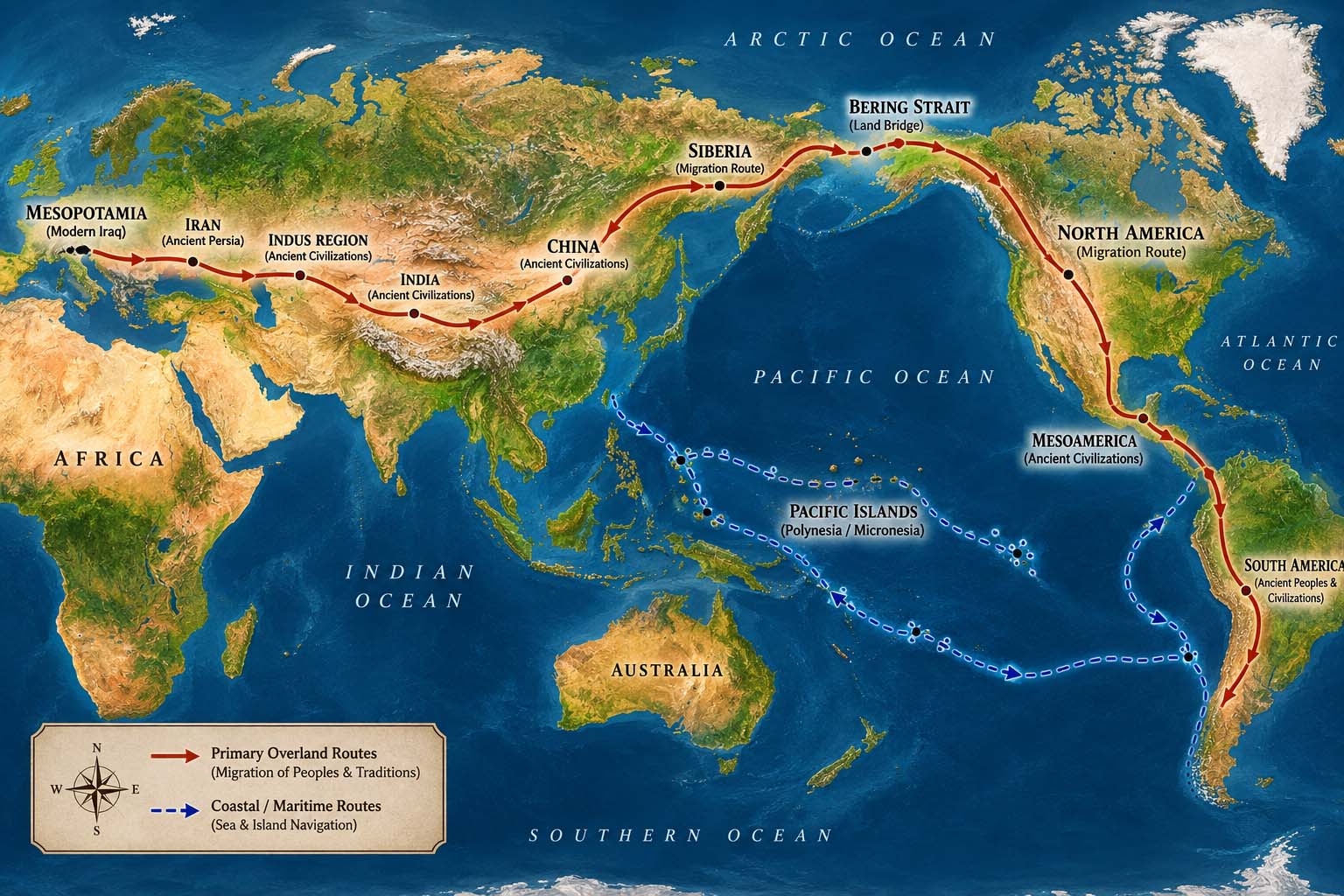
| 4th millennium BC onward | Sumer / southern Mesopotamia | Ziusudra | Sumerian literary tradition; surviving Nippur Flood Tablet c. 1650 BC. Penn Museum notes the composition may reach c. 2000 BC or earlier. | ~650 mi / 1,050 km | Warning, huge boat, seven days and nights, preservation of mankind, sacrifice |
| 3rd millennium BC onward | Mesopotamian / Babylonian civilization | Atrahasis | Old Babylonian literary witness; dated Atrahasis tablet c. 1635 BC | ~530 mi / 850 km | Human multiplication, divine decision, warning, boat, survival |
| 3rd millennium BC onward | Mesopotamian tradition later copied at Nineveh | Utnapishtim / Gilgamesh XI | Flood episode belongs to the older Gilgamesh tradition; famous K.3375 copy is 7th century BC | ~300 mi / 480 km | Warning, vessel, family, living creatures, birds, landing, sacrifice |
| 3rd–2nd millennium BC cultural background | Indian subcontinent | Manu | Śatapatha Brāhmaṇa 1.8.1; textual composition belongs to a later Vedic horizon. It must not simply be dated to the beginning of the Indus cities. | ~1,800–2,200+ mi | Warning, Flood, ship, northern mountain, receding waters, sacrifice, renewed offspring |
| 2nd millennium BC onward | Ancient Chinese civilization | Gun and Yu | Preserved in ancient Chinese literary tradition; written witnesses are later than the period traditionally assigned to Yu | ~3,000–4,000+ mi | Great Flood, overwhelmed settlements, control of waters, restoration of habitable land |
| Ancient Iranian cultural sphere | Iranian / Zoroastrian tradition | Yima and the Vara | Avesta, Vendidad 2; long oral and textual transmission prevents a single secure manuscript-origin date | ~700–1,000+ mi | Warning, world-destroying winter, constructed refuge, selected humans, animals and plants |
| Ancient regional traditions, dates under study | Southwest China / Miao-Hmong | Flood survivors | Oral traditions documented ethnographically; recording date is not the origin date | ~4,000+ mi | Flood, small remnant, protected drum or vessel in some versions, renewed humanity |
| Ancient regional traditions, dates under study | Northern Vietnam / Lolo | Sibling Flood survivors | Oral tradition documented ethnographically | ~3,650 mi / 5,875 km | Flood, two siblings, floating drums, mountain survival, renewed lineage |
| Ancient regional traditions, dates under study | Sumatra / Batak | Drowned-world traditions | Oral traditions preserved in 19th-century published accounts | ~4,260 mi / 6,855 km | World-covering water, high refuge, preserved ancestry, renewed humanity |
| Ancient regional traditions, dates under study | Northern Luzon / Ifugao | Great Flood | Oral tradition in early ethnographic publication, 1913 | ~4,800 mi / 7,720 km | Flood, brother and sister, mountain refuge, receding waters, repopulation |
| Ancient northeastern Asian tradition | Kamchatka | Great Deluge | Oral tradition recorded in the 18th century; published 1774 | ~4,830 mi / 7,775 km | Deluge, boats and rafts, provisions, stone anchors, high mountain |
| Indigenous North American traditions | Tlingit / Alaska | Great Flood traditions | Oral traditions preserved in early ethnographic collections | ~5,665 mi / 9,115 km | Flooding, mountain refuges, survivors, Raven-cycle traditions |
| Indigenous North American traditions | Dakota / Great Plains | Dakota Flood | Oral tradition later documented by ethnographers and Indigenous cultural sources | ~6,155 mi / 9,905 km | Human misconduct, divine judgment, catastrophic flooding |
| Indigenous North American traditions | Quileute / Northwest Coast | Flood tradition | Recorded in early 20th-century ethnographic and linguistic collections | ~6,350 mi / 10,220 km | Documented Flood lore; details vary by source |
| Indigenous North American traditions | Choctaw / Southeast | Prophet and Flood | Swanton research summarized in 1932; report distinguishes the tradition from later Genesis-influenced versions | ~6,610 mi / 10,635 km | Wickedness, warning, rejected prophet, raft, birds, renewed humanity |
| Indigenous North American traditions | Hopi / Southwest | Flooded-village tradition | Traditional material preserved in 20th-century Smithsonian/NMAI archival collections | ~6,975 mi / 11,225 km | Flooded settlements and Water Serpent tradition |
| Mesoamerican civilization | Nahua / Central Mexico | Nata and Nena | Preserved in post-conquest Nahuatl manuscript tradition; possible Christian influence must be considered | ~7,720 mi / 12,425 km | Warning, husband and wife, wooden refuge, overwhelming Flood, submerged mountain |
| Andean civilization | Peruvian Andes | Unu Pachacuti | Indigenous traditions recorded by 16th-century Spanish-period chroniclers | ~8,200 mi / 13,200 km | General Flood, destruction, mountain survivors in some versions, renewed peoples |