Archoseum

Museum Exhibition

Preparing the exhibition

0%
← Museum Home ← Miracles Gallery

Extraordinary Biblical Miracles · Section 03

The Ark of the Covenant

The sacred chest, the divine presence, and the journey from Sinai to Jerusalem

Built at Sinai according to a precise pattern, carried before Israel, captured by the Philistines, returned without a driver, brought to Jerusalem, and finally placed in Solomon’s Temple. This research room follows the Ark through Scripture, geography, archaeology, symbolism, judgment, deliverance, and worship.

Research Room Orientation

The Ark Through Israel’s History

This room follows the Ark as a continuous historical thread: commanded at Sinai, placed in the Tabernacle, carried into Canaan, captured in war, returned from Philistia, housed at Kirjath-jearim, brought to Jerusalem, and installed in Solomon’s Temple. Scripture remains the controlling record, while archaeology and later traditions are labeled separately.

Canonical RecordExodus, Numbers, Deuteronomy, Joshua, Samuel, Kings, Chronicles and Jeremiah in the KJV.
ArchaeologySite evidence from Beth-shemesh, Kiriath-jearim and other locations illuminates setting, chronology and culture.
Cross-ReferenceRelated passages are brought together so the Ark is studied across the biblical record, not from isolated verses.
Later Tradition2 Maccabees, Ethiopian tradition and modern Ark accounts are clearly identified as later or non-canonical material.
SinaiTabernacleJordanJerichoShilohPhilistiaBeth-shemeshKirjath-jearimJerusalemSolomon’s Temple
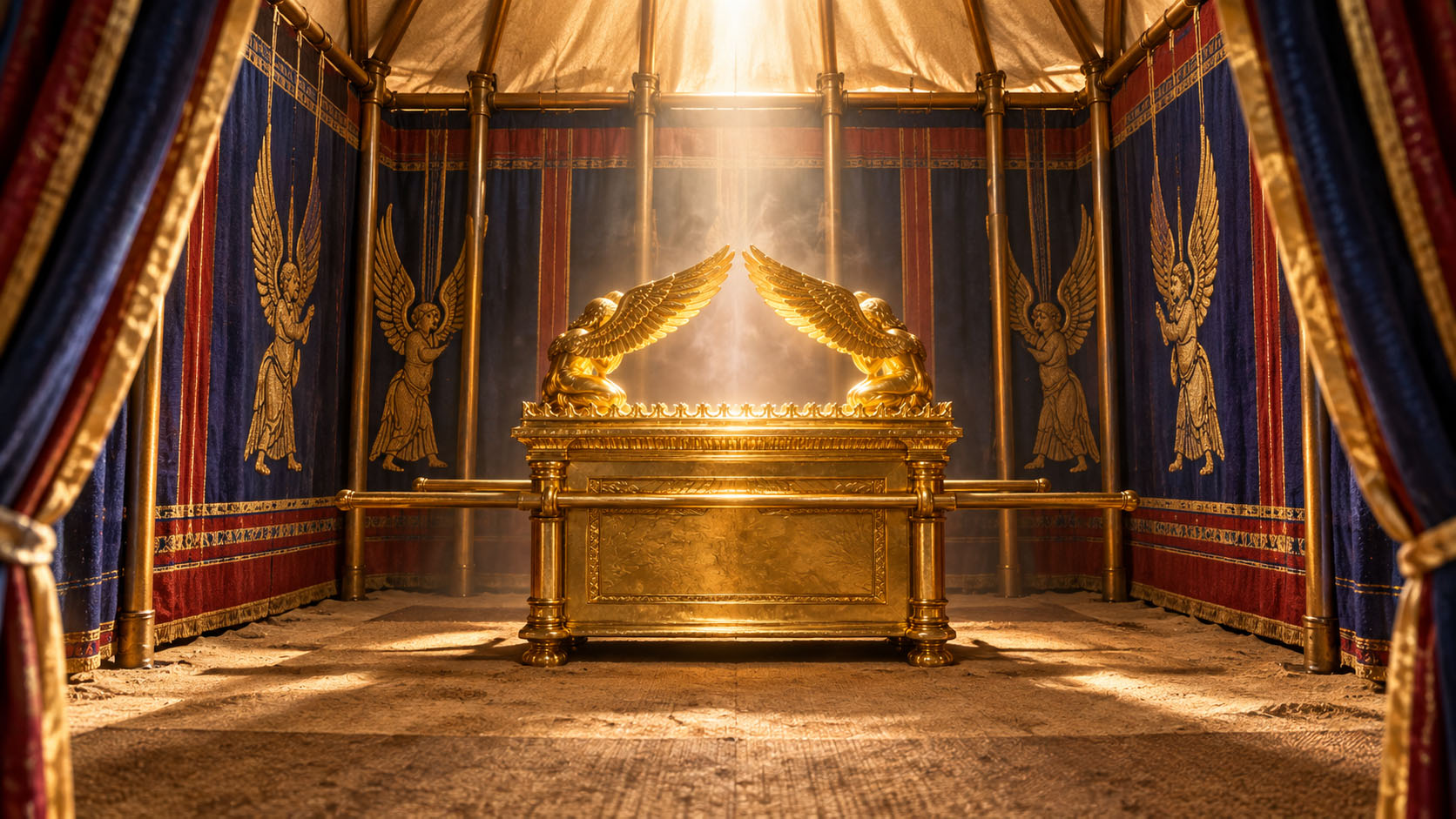
The Ark of the Covenant resting within the Holy of Holies of the wilderness Tabernacle

The Biblical Record

The Ark of the Covenant

Each exhibit expands the complete event rather than reducing it to a single verse. Open an entry to examine the story, related Scripture, physical details, chronology, symbolism, geography, archaeology, and the distinction between canonical evidence and later tradition.

The Ark begins with a command given to Moses at Sinai. It was not an improvised battlefield object. Exodus gives dimensions, materials, carrying arrangements, and the design of the mercy seat. Bezaleel later constructs it according to the pattern Moses received.

“And they shall make an ark of shittim wood: two cubits and a half shall be the length thereof...”
Exodus 25:10 · KJV
“And thou shalt overlay it with pure gold, within and without shalt thou overlay it.”
Exodus 25:11 · KJV
Construction at a Glance
ElementBiblical descriptionFunction
ChestShittim, or acacia, wood overlaid with pure gold inside and outside.The sacred container for the testimony.
Dimensions2½ cubits long, 1½ cubits wide, 1½ cubits high.About 3¾ × 2¼ × 2¼ feet if an 18-inch cubit is used.
Four ringsGold rings fixed for the staves.Allowed the Ark to be carried without direct handling.
StavesShittim wood overlaid with gold and kept in the rings.Permanent carrying system.
Mercy seatA pure-gold cover matching the Ark’s length and width.Focal place of atonement in Leviticus 16.
CherubimTwo beaten-gold cherubim facing inward with wings spread above.They overshadowed the mercy seat.
Symbols and meaning
✦Testimony: the covenant words formed the Ark’s central identity.
✦Mercy seat: connected directly with the Day of Atonement.
✦Cherubim: throne and divine-presence imagery appears elsewhere in Scripture.
✦Poles: the carrying system reinforced reverent handling.
Exodus 25:10-22; 37:1-9 · Construction · Mercy seat · Cherubim · Staves

Several passages must be read together. The stone tables are explicitly placed in the Ark. Manna and Aaron’s rod are described in the Pentateuch as being laid up before the LORD or before the testimony. Hebrews later lists the golden pot of manna, Aaron’s rod and the tables in relation to the Ark.

“And thou shalt put into the ark the testimony which I shall give thee.”
Exodus 25:16 · KJV
“There was nothing in the ark save the two tables of stone, which Moses put there at Horeb.”
1 Kings 8:9 · KJV
ObjectPrimary passagesDetail
Stone tablesExodus 25:16; Deuteronomy 10:1-5Placed in the Ark as the covenant testimony.
Golden pot of mannaExodus 16:32-34; Hebrews 9:4Preserved as a memorial of wilderness provision.
Aaron’s rodNumbers 17:8-10; Hebrews 9:4Kept before the testimony as a sign of the chosen priesthood.
Chronology mattersAt Solomon’s Temple dedication, 1 Kings 8:9 states that only the two stone tables were in the Ark. The passages should therefore be read with attention to time and wording.
Exodus 16:32-34; 25:16; Numbers 17:8-10; Deuteronomy 10:1-5; 1 Kings 8:9; Hebrews 9:4

When the Tabernacle was completed, the Ark was placed within the veil in the Most Holy Place. The cloud then covered the tent and the glory of the LORD filled the Tabernacle so powerfully that Moses could not enter.

“Then a cloud covered the tent of the congregation, and the glory of the LORD filled the tabernacle.”
Exodus 40:34 · KJV
“For the cloud of the LORD was upon the tabernacle by day, and fire was on it by night.”
Exodus 40:38 · KJV
MomentWhat happened
Ark placedThe testimony was put inside, the staves installed, and the mercy seat set above.
Veil erectedThe Ark was separated within the Most Holy Place.
Cloud descendedThe cloud covered the tent.
Glory filled the TabernacleMoses could not enter because of the glory.
Journey guidanceIsrael moved when the cloud rose and remained when it stayed.
Presence, not an idol

The biblical narrative never presents the Ark as a god. The LORD speaks from above the mercy seat, while the Ark functions as covenant testimony and sacred throne imagery within Israel’s sanctuary.

Exodus 40:17-38; Numbers 9:15-23 · Tabernacle · Cloud · Fire · Glory

At the Jordan, the Ark moves to the center of a national crossing. The river is described as overflowing all its banks at harvest. When the priests carrying the Ark step into the water, the upstream flow is cut off and stands in a heap near Adam while the people cross opposite Jericho.

“The priests that bare the ark of the covenant of the LORD stood firm on dry ground in the midst of Jordan.”
Joshua 3:17 · KJV
“The waters which came down from above stood and rose up upon an heap very far from the city Adam.”
Joshua 3:16 · KJV
DetailRecord
SeasonJordan overflowed its banks during harvest.
TriggerThe priests’ feet reached the brim of the water.
Upstream pointThe waters stood near Adam, beside Zaretan.
SurfaceThe priests stood on dry ground while the nation crossed.
MemorialTwelve stones were taken from the river and erected at Gilgal.
GeographyThe biblical city Adam is commonly associated with the area of Tell ed-Damiyeh in the Jordan Valley. Later historical landslides have temporarily blocked the Jordan, illustrating the valley’s unstable geology. Joshua, however, emphasizes the exact timing, the Ark-bearing priests and the complete national crossing as the LORD’s act.
Joshua 3-4 · Jordan · Adam · Gilgal · Twelve stones · Dry ground

Jericho is an unusual siege narrative. For six days armed men, seven priests with seven trumpets and the Ark circle the city once. On the seventh day they circle seven times. At the final trumpet blast the people shout and the wall falls down flat.

“And seven priests shall bear before the ark seven trumpets of rams’ horns.”
Joshua 6:4 · KJV
“The people shouted... and the wall fell down flat.”
Joshua 6:20 · KJV
ElementRole
7 priestsCarried seven trumpets before the Ark.
7 trumpetsRams’ horns sounded during the procession.
6 daysOne circuit each day.
7th daySeven circuits were completed.
ArkMoved in the procession behind the priests.
Final shoutThe wall’s collapse followed the commanded signal.
Jericho archaeologyTell es-Sultan preserves major Bronze Age fortifications and destruction levels. John Garstang, Kathleen Kenyon and later Bryant Wood reached different conclusions about the relevant destruction chronology. The museum should keep excavation evidence, chronological interpretation and the biblical account clearly separated.
The Ark was not a weapon

Israel follows a commanded sacred procession. The later defeat at Ebenezer proves that possession of the Ark did not function as automatic military power.

Joshua 6 · Jericho · Seven priests · Trumpets · Ark procession · Wall collapse

Israel suffered defeat before the Philistines at Ebenezer. The elders then brought the Ark from Shiloh into camp with Hophni and Phinehas. Israel shouted so loudly that the earth rang, yet the second battle ended in disaster.

“And the ark of God was taken; and the two sons of Eli, Hophni and Phinehas, were slain.”
1 Samuel 4:11 · KJV
“The glory is departed from Israel: for the ark of God is taken.”
1 Samuel 4:22 · KJV
StageWhat happened
First battleAbout four thousand Israelites fell.
Ark summonedThe elders brought it from Shiloh as an assurance of victory.
Philistine alarmThey recalled the mighty acts associated with Egypt.
Second battleThirty thousand Israelite footmen are reported fallen.
Ark capturedHophni and Phinehas died and the Ark was taken.
Eli diesHearing the news, Eli fell backward and died.
The narrative’s warningThe episode distinguishes reverence for the LORD from attempting to use a sacred object as a guarantee. The next sequence shows the LORD acting in Philistine territory without an Israelite army.
1 Samuel 4 · Ebenezer · Shiloh · Capture · Hophni · Phinehas · Eli · Ichabod

The Philistines carried the Ark to Ashdod and placed it in Dagon’s house beside the idol. The next morning Dagon lay face down before the Ark. They restored the image. On the following morning it had fallen again, with its head and both hands cut off upon the threshold.

“Dagon was fallen upon his face to the ground before the ark of the LORD.”
1 Samuel 5:3 · KJV
“The head of Dagon and both the palms of his hands were cut off upon the threshold.”
1 Samuel 5:4 · KJV
MorningScene
FirstDagon lies face down before the Ark.
RestoredThe Philistines set the idol back in place.
SecondDagon is again face down.
Head and handsThe idol is symbolically stripped of authority and power.
ThresholdThe narrative connects the event with a later priestly custom.
Ashdod settingExcavations at Ashdod have documented a major Philistine city with substantial Iron Age occupation. Archaeology establishes the urban and cultural setting; Dagon’s fall itself is preserved in the biblical narrative rather than as an excavated event.
Head and hands

In ancient symbolism the head represented authority and identity, while the hands represented action and power. Their removal intensifies the narrative’s declaration that Dagon cannot stand or act before the LORD.

1 Samuel 5:1-5 · Ashdod · Dagon · Temple · Head · Hands

The crisis spread beyond Dagon’s temple. The hand of the LORD was described as heavy upon Ashdod and its territory. The Ark was transferred to Gath and then toward Ekron, but distress followed the movement.

“The hand of the LORD was heavy upon them of Ashdod.”
1 Samuel 5:6 · KJV
“There was a deadly destruction throughout all the city.”
1 Samuel 5:11 · KJV
PlaceArk movementReported result
AshdodFirst Philistine city to hold the Ark.Dagon falls and the people are smitten.
GathArk transferred after Ashdod’s council.A very great destruction is reported.
EkronArk sent onward.The Ekronites protest its arrival.
Five lordsPhilistine rulers deliberate together.They decide the Ark must return to Israel.

The KJV uses the word emerods. The return offering later included five golden emerods and five golden mice, corresponding to the five Philistine lords and linking bodily affliction with damage in the land.

1 Samuel 5:6-12; 6:1-5 · Ashdod · Gath · Ekron · Emerods · Mice · Five lords

After seven months, Philistine priests and diviners devised a test. Two milk cows that had never borne a yoke were harnessed to a new cart, while their calves were shut at home. If the cows carried the Ark directly toward Beth-shemesh, the journey would confirm the source of the calamities.

“The kine took the straight way to the way of Beth-shemesh... and turned not aside.”
1 Samuel 6:12 · KJV
“They clave the wood of the cart, and offered the kine a burnt offering unto the LORD.”
1 Samuel 6:14 · KJV
TestWhy remarkableOutcome
Milk cowsNursing cows would naturally be drawn toward their calves.They moved away from them.
Never yokedThe pair had not been trained as a team.They pulled together.
No driverThe route itself was the test.They went directly to Beth-shemesh.
Five lords watchedPhilistine rulers personally observed.They followed to the border.
Israel receives ArkReapers saw it and rejoiced.The cart wood and cows became an offering.
Tel Beth-shemeshTel Beth-shemesh is an extensively excavated Iron Age site in the Sorek Valley about 20 km west of Jerusalem. Tel Aviv University describes it as a border city between Judah and Philistia and specifically notes the Ark-return tradition. Excavations have exposed Iron Age settlement, fortifications, domestic remains and a major water system, giving strong physical context to the biblical border setting.
1 Samuel 6:1-18 · Seven months · New cart · Milk cows · Beth-shemesh · Golden offering

The celebration at Beth-shemesh is followed by a sobering judgment. The KJV states that men were smitten because they had looked into the Ark, reinforcing the holiness regulations that surround sacred objects throughout the Torah.

“He smote the men of Beth-shemesh, because they had looked into the ark of the LORD.”
1 Samuel 6:19 · KJV
“Who is able to stand before this holy LORD God?”
1 Samuel 6:20 · KJV
The number in verse 19

The KJV reads “fifty thousand and threescore and ten men.” Ancient textual witnesses and later translations preserve a well-known numerical variation, with seventy appearing in some textual reconstructions. The museum keeps the KJV reading visible while noting the manuscript question.

IssueMuseum treatment
KJV reading50,070 men, preserving the traditional Masoretic form reflected in the Authorized Version.
Textual variationAncient evidence has produced alternate readings, most notably seventy.
Core eventThe narrative remains a judgment connected with irreverent treatment of the Ark.
ResponseBeth-shemesh sends messengers to Kirjath-jearim.
1 Samuel 6:19-21 · Beth-shemesh · Holiness · Judgment · Textual question

The men of Kirjath-jearim brought the Ark from Beth-shemesh to the house of Abinadab in the hill and sanctified Eleazar to keep it. The record says twenty years passed and all Israel lamented after the LORD.

“The men of Kirjath-jearim came, and fetched up the ark of the LORD.”
1 Samuel 7:1 · KJV
“The time was long; for it was twenty years.”
1 Samuel 7:2 · KJV
Kiriath-jearim excavationsThe site commonly identified with biblical Kiriath-jearim is Deir el-Azar near Abu Ghosh, west of Jerusalem. Tel Aviv University describes the identification as widely accepted and treats the Ark Narrative as a central research question. Excavations have documented Iron Age occupation and a monumental summit compound from a later phase, illuminating the importance and cultic history of the site without turning archaeological interpretation into proof of every narrative detail.
Place / personDetail
Kirjath-jearimA prominent hill site west of Jerusalem.
AbinadabThe Ark is housed at his property.
EleazarSanctified to keep the Ark.
Twenty yearsMarks a prolonged period before the next national transition.
Modern researchThe Shmunis Family Excavations at Kiriath-jearim, led by Tel Aviv University and the Collège de France, have published peer-reviewed excavation reports and a major 2025 monograph on the site.
1 Samuel 6:21-7:2 · Kirjath-jearim · Abinadab · Eleazar · Twenty years

David sought to bring the Ark to Jerusalem. The first attempt used a new cart. When the oxen shook the cart at Nachon’s threshingfloor, Uzzah reached out and took hold of the Ark. He died there, and David’s celebration became fear and grief.

“Uzzah put forth his hand to the ark of God, and took hold of it.”
2 Samuel 6:6 · KJV
“There he died by the ark of God.”
2 Samuel 6:7 · KJV
Instruction / actionTorah patternFirst procession
TransportThe Ark had rings and staves for carrying.It was placed on a new cart.
CarriersKohathite Levites had sacred carrying duties.Uzzah and Ahio drove the cart.
TouchThe holy things were not to be touched.Uzzah took hold of the Ark.
CorrectionDavid later requires Levites and the commanded order.The second procession succeeds.
“The LORD our God made a breach upon us, for that we sought him not after the due order.”
1 Chronicles 15:13 · KJV
Scripture explains the failure1 Chronicles interprets the first attempt from inside the biblical record. David prepares a second procession in which the Levites sanctify themselves and carry the Ark by the staves as commanded.
Numbers 4:15; 7:9; 2 Samuel 6:1-10; 1 Chronicles 13; 15:2, 11-15 · Uzzah · Due order

After Uzzah’s death, the Ark was carried aside to the house of Obed-edom the Gittite. It remained there three months, and the record repeatedly states that the LORD blessed Obed-edom and his household.

“The ark of the LORD continued in the house of Obed-edom the Gittite three months.”
2 Samuel 6:11 · KJV
“The LORD hath blessed the house of Obed-edom... because of the ark of God.”
2 Samuel 6:12 · KJV
DurationThree months

The Ark remains at Obed-edom’s house after the failed procession.

EffectThe house is blessed

The blessing becomes public knowledge and reaches David.

Next stepJourney resumes

David prepares the correctly ordered movement to Jerusalem.

Judgment and blessing

The Uzzah and Obed-edom stories stand side by side. The narrative’s focus remains the holiness and presence of the LORD, not magical power in the object.

2 Samuel 6:10-12; 1 Chronicles 13:13-14 · Obed-edom · Three months · Blessing

David’s second procession is organized differently. The Levites sanctify themselves. The Ark is carried on their shoulders with the staves. Singers, instruments, sacrifices and public worship accompany the journey. David dances before the LORD as the Ark enters Jerusalem.

“The children of the Levites bare the ark of God upon their shoulders with the staves thereon.”
1 Chronicles 15:15 · KJV
“David and all the house of Israel brought up the ark of the LORD with shouting.”
2 Samuel 6:15 · KJV
ElementSecond procession
CarriersLevites sanctified for the task.
MethodCarried on shoulders with the staves.
SacrificeOfferings accompany the successful movement.
MusicSingers, cymbals, psalteries, harps and trumpets are named.
DavidDavid dances and worships before the LORD.
JerusalemThe Ark is placed in the tent David prepared.
Public blessingDavid blesses the people and distributes food.

Michal sees David leaping and dancing from a window and despises him in her heart. Their confrontation contrasts royal dignity as she understands it with David’s willingness to humble himself in public worship.

2 Samuel 6:12-23; 1 Chronicles 15-16 · Levites · Music · Sacrifice · Jerusalem · David

Under Solomon, the Ark was carried into the new Temple and placed beneath the wings of the great cherubim in the Most Holy Place. The text states that the Ark then contained the two stone tables placed there at Horeb. When the priests came out, the cloud filled the house of the LORD.

“The priests brought in the ark of the covenant of the LORD unto his place... to the most holy place.”
1 Kings 8:6 · KJV
“The cloud filled the house of the LORD.”
1 Kings 8:10 · KJV
Temple momentDetail
LocationMost Holy Place, called the oracle.
CherubimThe Ark rested beneath the wings of the great cherubim.
ContentsOnly the two stone tables are named inside the Ark at this moment.
PriestsThe priests withdrew from the holy place.
CloudThe cloud filled the Temple.
GloryThe priests could not stand to minister.
Exodus parallelThe Temple scene echoes Exodus 40, where the completed Tabernacle is covered by cloud and filled with glory. The portable sanctuary and permanent Temple are linked by the same presence imagery.
1 Kings 8:1-21; 2 Chronicles 5:2-14 · Solomon · Temple · Most Holy Place · Cloud · Glory

The biblical narrative becomes quieter about the Ark after the Temple period. A later reference under Josiah speaks of the holy Ark being put in Solomon’s house. Jeremiah looks forward to a time when the Ark will no longer be the focal object of remembrance.

“Put the holy ark in the house which Solomon the son of David king of Israel did build.”
2 Chronicles 35:3 · KJV
“They shall say no more, The ark of the covenant of the LORD: neither shall it come to mind.”
Jeremiah 3:16 · KJV
The trail of accounts and traditions
Museum methodScripture establishes the Ark’s history through the monarchy. Ancient literature preserves later concealment traditions. Religious communities preserve additional accounts. Archaeology can investigate the relevant sites and periods. The Ark’s final location remains an open historical question.
What archaeology contributesExcavations at Shiloh, Beth-shemesh, Kiriath-jearim, Jerusalem and Philistine centers illuminate the places, settlement history and political geography in which the Ark narratives are set.
2 Kings 25; 2 Chronicles 35:3; Jeremiah 3:16; 52; 2 Maccabees 2:4-8 · Canonical record · Ancient tradition · Modern accounts