01Exhibit 01 · Biblical Places UnearthedLachishTell ed-Duweir · Shephelah of Judah · A fortified city named throughout Scripture
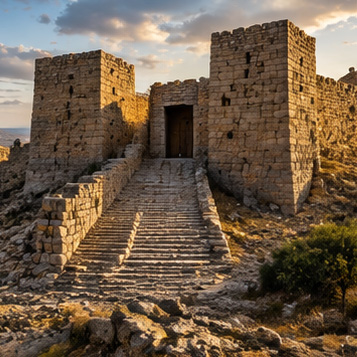
Biblical Places Unearthed · Exhibit 01
Lachish
Tell ed-Duweir · Southern Israel · Ancient fortified city of Canaan and Judah
Lachish is one of the most dramatic places where the written world of Scripture can be set beside an excavated ancient city. The Bible remembers Lachish as a Canaanite royal city encountered by Joshua, a fortified city of Judah, a refuge of King Amaziah, a major Assyrian objective during Sennacherib's campaign against Hezekiah, and one of the last fortified cities of Judah still resisting Babylon. Archaeology has exposed monumental gates, city walls, a palace-fort, destruction levels, a massive Assyrian siege ramp, weapons and sling stones, and the famous Lachish Letters. Hundreds of miles away at Nineveh, Sennacherib decorated a palace room with stone reliefs portraying the assault on Lachish, its defenders, captives, booty and the Assyrian king receiving the conquered population.
The Scriptural Record
Every Biblical Verse That Names Lachish
The name Lachish occurs twenty-four times in the King James Version, distributed across twenty-two verses. Two verses, 2 Kings 14:19 and 2 Chronicles 25:27, contain the name twice. The record below preserves every verse in canonical order so the archaeological site can be encountered first through Scripture itself.
“And Hezekiah king of Judah sent to the king of Assyria to Lachish, saying, I have offended; return from me: that which thou puttest on me will I bear. And the king of Assyria appointed unto Hezekiah king of Judah three hundred talents of silver and thirty talents of gold.”King James Version
Wherefore Adonizedec king of Jerusalem sent unto Hoham king of Hebron, and unto Piram king of Jarmuth, and unto Japhia king of Lachish, and unto Debir king of Eglon, saying,
Therefore the five kings of the Amorites, the king of Jerusalem, the king of Hebron, the king of Jarmuth, the king of Lachish, the king of Eglon, gathered themselves together, and went up, they and all their hosts, and encamped before Gibeon, and made war against it.
And they did so, and brought forth those five kings unto him out of the cave, the king of Jerusalem, the king of Hebron, the king of Jarmuth, the king of Lachish, and the king of Eglon.
And Joshua passed from Libnah, and all Israel with him, unto Lachish, and encamped against it, and fought against it:
And the LORD delivered Lachish into the hand of Israel, which took it on the second day, and smote it with the edge of the sword, and all the souls that were therein, according to all that he had done to Libnah.
Then Horam king of Gezer came up to help Lachish; and Joshua smote him and his people, until he had left him none remaining.
And from Lachish Joshua passed unto Eglon, and all Israel with him; and they encamped against it, and fought against it:
And they took it on that day, and smote it with the edge of the sword, and all the souls that were therein he utterly destroyed that day, according to all that he had done to Lachish.
The king of Jarmuth, one; the king of Lachish, one;
Lachish, and Bozkath, and Eglon,
Now they made a conspiracy against him in Jerusalem: and he fled to Lachish; but they sent after him to Lachish, and slew him there.
And Hezekiah king of Judah sent to the king of Assyria to Lachish, saying, I have offended; return from me: that which thou puttest on me will I bear. And the king of Assyria appointed unto Hezekiah king of Judah three hundred talents of silver and thirty talents of gold.
And the king of Assyria sent Tartan and Rabsaris and Rabshakeh from Lachish to king Hezekiah with a great host against Jerusalem. And they went up and came to Jerusalem. And when they were come up, they came and stood by the conduit of the upper pool, which is in the highway of the fuller's field.
So Rabshakeh returned, and found the king of Assyria warring against Libnah: for he had heard that he was departed from Lachish.
And Adoraim, and Lachish, and Azekah,
Now after the time that Amaziah did turn away from following the LORD they made a conspiracy against him in Jerusalem; and he fled to Lachish: but they sent to Lachish after him, and slew him there.
After this did Sennacherib king of Assyria send his servants to Jerusalem, (but he himself laid siege against Lachish, and all his power with him,) unto Hezekiah king of Judah, and unto all Judah that were at Jerusalem, saying,
Zanoah, Adullam, and in their villages, at Lachish, and the fields thereof, at Azekah, and in the villages thereof. And they dwelt from Beersheba unto the valley of Hinnom.
And the king of Assyria sent Rabshakeh from Lachish to Jerusalem unto king Hezekiah with a great army. And he stood by the conduit of the upper pool in the highway of the fuller's field.
So Rabshakeh returned, and found the king of Assyria warring against Libnah: for he had heard that he was departed from Lachish.
When the king of Babylon's army fought against Jerusalem, and against all the cities of Judah that were left, against Lachish, and against Azekah: for these defenced cities remained of the cities of Judah.
O thou inhabitant of Lachish, bind the chariot to the swift beast: she is the beginning of the sin to the daughter of Zion: for the transgressions of Israel were found in thee.
Place and Landscape
A Fortress in the Shephelah
Ancient Lachish stood in the low hill country of Judah, the Shephelah, on a prominent mound commanding routes through the southern approaches to the Judean highlands. The archaeological mound is known as Tell ed-Duweir, today commonly called Tel Lachish. Its position helps explain why the city repeatedly appears in accounts of war. An army moving through the region toward Judah's interior could not ignore a major fortified center controlling roads, agricultural territory and communication between the coastal plain and the hill country.
The mound preserves occupation extending far beyond the Biblical kingdom of Judah. Lachish was already an important Canaanite center in the Bronze Age and appears in Late Bronze Age documentary evidence outside the Bible. In the Iron Age it became one of Judah's principal fortified cities. The Biblical record itself reflects those changing roles: first a Canaanite city with its own king, later a city assigned to Judah, then a fortified royal center and military objective.
The Story in Scripture
From Joshua to the Last Days of Judah
The Canaanite city
Joshua introduces Lachish as a royal Canaanite city ruled by Japhia. Its king joins the coalition formed against Gibeon. The narrative later brings Joshua and Israel directly to Lachish, where they encamp against the city. The repeated naming of Lachish in Joshua establishes it not as a passing geographical label but as a political center with a king, defenses and regional relationships, including the attempt by Horam king of Gezer to aid it.
A fortified city of Judah
In the divided monarchy, 2 Chronicles names Lachish among the cities fortified by Rehoboam. The city's strategic value is visible again in the account of Amaziah, who fled from Jerusalem to Lachish during a conspiracy and was killed there. These notices fit the larger picture of Lachish as an important southern administrative and defensive center.
Sennacherib comes to Lachish
The most famous Biblical episode involving the city occurs in the reign of Hezekiah. Assyria under Sennacherib invaded Judah. The Biblical text places the Assyrian king at Lachish and records Hezekiah sending to him there. It also says that Assyrian officials departed from Lachish with a great force toward Jerusalem. Chronicles is especially explicit: Sennacherib himself was laying siege to Lachish with his power. The city therefore becomes the geographical hinge between the Assyrian devastation of Judah's fortified cities and the confrontation over Jerusalem.
Babylon approaches
More than a century later, Jeremiah again names Lachish in a moment of national crisis. As the Babylonian army fought against Judah, Jeremiah 34:7 identifies Lachish and Azekah among the fortified cities still remaining. The verse gives Lachish a final dramatic Biblical setting before the Babylonian destruction of the kingdom. Archaeology would eventually uncover written messages from this same era, the Lachish Letters, preserving the anxious military world immediately before Judah's collapse.
Rediscovery and Excavation
How Ancient Lachish Returned to View
The modern archaeological story developed over generations. Scholars sought to match the Biblical and ancient Near Eastern name Lachish with a physical mound in the Judean Shephelah. William F. Albright argued in 1929 for identifying Tell ed-Duweir with Lachish, an identification that became accepted as excavation and historical evidence accumulated. The mound then became the focus of one of the major archaeological projects in the region.
What Archaeologists Uncovered
The Evidence Beneath the Mound
Excavations exposed a massive approach and multi-chambered gate complex, demonstrating the scale of Lachish as a fortified administrative city of Judah.
At the summit of the mound stood a monumental Iron Age complex generally described as a palace-fort, reflecting centralized authority and the strategic importance of the city.
At the southwest corner of the mound, archaeologists investigated the great ramp associated with the Assyrian assault of 701 BC. The ramp and the defensive response on the city side allow the mechanics of the siege to be reconstructed on the ground.
Arrowheads, sling stones and other remains from the siege zone contribute to the physical picture of a violent assault rather than an abstract historical event.
The Iron Age city associated with Sennacherib's campaign ended in a major destruction. Excavation of this horizon has been central to reconstructing the Assyrian conquest of Lachish.
Inscribed pottery sherds discovered in the gate area preserve Hebrew correspondence from the final years of the kingdom of Judah. They belong to the world of military communication shortly before the Babylonian destruction.
The rebuilt Judean city also came to a destructive end in the early sixth century BC, giving archaeological context to Jeremiah's picture of Lachish and Azekah among Judah's remaining fortified cities.
Temples, architecture, pottery and other finds from the Bronze Age demonstrate that Lachish had a substantial history before the kingdom of Judah, matching the Biblical presentation of Lachish first as a Canaanite royal city.
An Assyrian Record in Stone
Sennacherib Put Lachish on His Palace Walls
The archaeological story becomes extraordinary when the evidence at Lachish is placed beside discoveries from Nineveh, the Assyrian capital. In Sennacherib's Southwest Palace, a sequence of gypsum wall reliefs decorated a room with a detailed representation of the assault and capture of Lachish. The surviving panels show Assyrian archers and slingers, siege engines advancing up ramps, defenders on the fortifications, prisoners leaving the conquered city, booty being carried away, executions, the Assyrian military camp, and Sennacherib seated on his throne receiving captives.
The British Museum preserves the surviving Lachish relief panels. Their imagery identifies the represented city as Lachish and places Sennacherib at the center of the victory scene. The reliefs were produced in the years following the campaign, during Sennacherib's reign. They do not merely show generic Assyrian warfare: Lachish was important enough to become the subject of a monumental palace narrative at Nineveh.
“After this did Sennacherib king of Assyria send his servants to Jerusalem, (but he himself laid siege against Lachish, and all his power with him,) unto Hezekiah king of Judah, and unto all Judah that were at Jerusalem, saying,”King James Version
That makes Lachish unusually vivid for a Biblical archaeological exhibit. Scripture names the city and places Sennacherib's campaign there. Excavation exposes the attacked fortress and siege works. Assyrian royal art from Nineveh portrays the conquest from the imperial side. These are separate bodies of evidence that converge on the same ancient place and historical crisis.
The Final Judean City
The Lachish Letters and the Approach of Babylon
One of the first expedition's most famous discoveries came from the gate area: a cache of inscribed pottery fragments written in Hebrew, known as the Lachish Letters. They date to the final period of the kingdom of Judah before the Babylonian conquest. These are not literary compositions written centuries later. They are pieces of correspondence from the administrative and military world of a kingdom under extreme pressure.
The letters are particularly evocative beside Jeremiah 34:7, which says that the Babylonian army fought against Jerusalem and the cities of Judah that remained, specifically naming Lachish and Azekah. The ostraca do not simply duplicate Jeremiah's verse, and individual interpretations of their wording require care, but they open a window into the same final phase of Judean history: fortified centers, military observation, messages moving between officials, and the approaching end of the kingdom.
“When the king of Babylon's army fought against Jerusalem, and against all the cities of Judah that were left, against Lachish, and against Azekah: for these defenced cities remained of the cities of Judah.”King James Version
Why Lachish Matters
A Biblical City Recovered Layer by Layer
Lachish is not important because of a single artifact. Its power comes from accumulation. The Biblical text names the city repeatedly across different periods. The mound preserves a Canaanite city, a fortified Judean center, Assyrian destruction, rebuilding and another destruction near the end of Judah. The Assyrian siege can be studied both at the attacked city and through monumental imagery commissioned by the conqueror. The later Judean city yielded Hebrew correspondence from the era of Babylon's advance.
For the visitor, Lachish demonstrates what Biblical archaeology can do at its best. Archaeology does not excavate a verse. It excavates walls, gates, pottery, weapons, inscriptions, destruction debris, roads, ramps and buildings. Those remains can then be compared carefully with ancient texts. At Lachish, that comparison allows an ancient place named again and again in Scripture to emerge as a physical city with a long history, changing rulers, catastrophic sieges and people who left traces of their lives in the ground.
Documentation
Sources and Archaeological Record
- The Renewed Archaeological Excavations at Lachish (1973–1994). David Ussishkin, ed., five volumes, Institute of Archaeology, Tel Aviv University, 2004. The principal final publication of the renewed excavations and restoration project.
- The Fourth Expedition to Lachish. Project history and excavation documentation from the expedition associated with Southern Adventist University and partner institutions, including the research history of the Starkey-Tufnell, Aharoni and Ussishkin expeditions.
- Garfinkel, Hasel, Klingbeil and collaborators. Publications of the Fourth Expedition, including the 2013–2017 results on the Canaanite and Judean cities of Lachish.
- Israel Antiquities Authority. Preliminary reports for renewed work at Tel Lachish, including the Austrian-Israeli excavations directed by Katharina Streit and Felix Höflmayer.
- British Museum, Assyrian Lachish reliefs. Southwest Palace of Sennacherib at Nineveh, Room XXXVI. The museum records document panels portraying the assault, siege engines, captives, booty, camp and Sennacherib receiving prisoners.
- King James Version. Scripture quotations and the complete Lachish occurrence record used in this exhibit.
02Exhibit 02 · Biblical Places UnearthedMegiddoTel Megiddo · Jezreel Valley · Strategic city overlooking the Via Maris
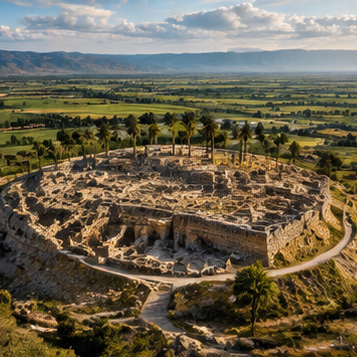
Biblical Places Unearthed · Exhibit 02
Megiddo
Tel Megiddo · Jezreel Valley · Strategic city overlooking the Via Maris
Megiddo stood above one of the most important crossroads of the ancient Near East. Armies moving between Egypt, the coast, Galilee, Syria and Mesopotamia repeatedly passed beneath its mound. Scripture remembers the city in the conquest lists, the inheritance of Manasseh, the Song of Deborah, Solomon’s administrative and building program, the death of King Ahaziah, and the fatal encounter of King Josiah with Pharaoh Necho. Centuries of excavation have exposed a deep sequence of cities, monumental gates, palaces, temples, waterworks, fortifications and administrative architecture. The name ultimately reappears in the New Testament in the Greek form Armageddon, “the mount of Megiddo,” in Revelation 16:16.
The Scriptural Record
Every Biblical Reference to This Place
The KJV names Megiddo or Megiddon in the following twelve Old Testament verses. Revelation 16:16 uses the Greek name Armageddon, traditionally understood as Har-Megiddo, “Mount of Megiddo.”
“Nevertheless Josiah would not turn his face from him, but disguised himself, that he might fight with him, and hearkened not unto the words of Necho from the mouth of God, and came to fight in the valley of Megiddo.”King James Version
The king of Taanach, one; the king of Megiddo, one;
And Manasseh had in Issachar and in Asher Bethshean and her towns, and Ibleam and her towns, and the inhabitants of Dor and her towns, and the inhabitants of Endor and her towns, and the inhabitants of Taanach and her towns, and the inhabitants of Megiddo and her towns, even three countries.
Neither did Manasseh drive out the inhabitants of Bethshean and her towns, nor Taanach and her towns, nor the inhabitants of Dor and her towns, nor the inhabitants of Ibleam and her towns, nor the inhabitants of Megiddo and her towns: but the Canaanites would dwell in that land.
The kings came and fought, then fought the kings of Canaan in Taanach by the waters of Megiddo; they took no gain of money.
Baana the son of Ahilud; to him pertained Taanach and Megiddo, and all Bethshean, which is by Zartanah beneath Jezreel, from Bethshean to Abelmeholah, even unto the place that is beyond Jokneam:
And this is the reason of the levy which king Solomon raised; for to build the house of the LORD, and his own house, and Millo, and the wall of Jerusalem, and Hazor, and Megiddo, and Gezer.
But when Ahaziah the king of Judah saw this, he fled by the way of the garden house. And Jehu followed after him, and said, Smite him also in the chariot. And they did so at the going up to Gur, which is by Ibleam. And he fled to Megiddo, and died there.
In his days Pharaohnechoh king of Egypt went up against the king of Assyria to the river Euphrates: and king Josiah went against him; and he slew him at Megiddo, when he had seen him.
And his servants carried him in a chariot dead from Megiddo, and brought him to Jerusalem, and buried him in his own sepulchre. And the people of the land took Jehoahaz the son of Josiah, and anointed him, and made him king in his father’s stead.
And by the borders of the children of Manasseh, Bethshean and her towns, Taanach and her towns, Megiddo and her towns, Dor and her towns. In these dwelt the children of Joseph the son of Israel.
Nevertheless Josiah would not turn his face from him, but disguised himself, that he might fight with him, and hearkened not unto the words of Necho from the mouth of God, and came to fight in the valley of Megiddo.
In that day shall there be a great mourning in Jerusalem, as the mourning of Hadadrimmon in the valley of Megiddon.
And he gathered them together into a place called in the Hebrew tongue Armageddon.
Place and Landscape
A City Above the Great Road
The mound rises at the western edge of the Jezreel Valley beside the ancient international road often called the Via Maris. Control of this passage meant control of traffic, tribute and armies. That geography helps explain why Megiddo became a fortified and repeatedly rebuilt center and why its name became associated with battle.
Rediscovery and Excavation
Four Great Archaeological Campaigns
Gottlieb Schumacher opened the first major excavation in 1903–1905 for the German Society for Oriental Research. The University of Chicago’s Oriental Institute returned in 1925 with an extraordinarily ambitious plan to expose the mound layer by layer. Clarence S. Fisher directed from 1925–1927, P. L. O. Guy from 1927–1934, and Gordon Loud from 1935–1939, when World War II halted the expedition. Yigael Yadin conducted shorter Hebrew University campaigns in 1960 and the early 1970s. Since 1994 the Megiddo Expedition, associated with Tel Aviv University and international partners, has re-examined the chronology and monuments with modern stratigraphic, ceramic and radiocarbon methods.
What Archaeologists Uncovered
Twenty Major Occupation Levels and Monumental Architecture
The Chicago expedition identified roughly twenty major levels of occupation. Excavators uncovered monumental fortifications and gates, palatial buildings, a large sacred precinct, extensive water installations and the famous pillared buildings long called “Solomonic stables.” Later projects have revisited their dates and functions. The site is especially important because its long sequence allows archaeologists to compare pottery, architecture, destruction layers and radiocarbon dates across many centuries.
Why the Discovery Matters
From a Biblical City to Armageddon
Megiddo is not known from one isolated verse. Scripture places it in conquest, settlement, administration, royal construction, warfare and national tragedy. The excavated mound supplies the physical setting behind those references. Revelation’s Armageddon gives the name an additional theological afterlife, transforming a landscape repeatedly associated with armies into the setting for an ultimate gathering in apocalyptic prophecy.
03Exhibit 03 · Biblical Places UnearthedHazorTel Hazor · Upper Galilee · “Head of all those kingdoms”
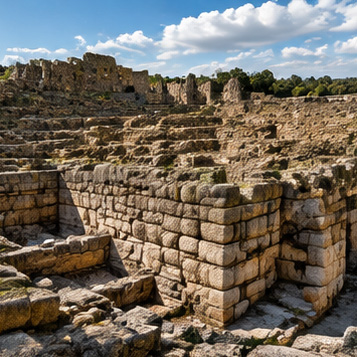
Biblical Places Unearthed · Exhibit 03
Hazor
Tel Hazor · Upper Galilee · “Head of all those kingdoms”
Hazor was the great northern Canaanite center that Joshua 11 calls “the head of all those kingdoms.” Its immense mound and lower city cover an area far larger than most ancient sites in the region. Scripture returns to Hazor in the days of Deborah and Barak, in Solomon’s building program, and again when Tiglath-pileser III of Assyria captured northern Israel. Excavation has revealed palatial architecture, temples, fortifications, cuneiform tablets, cultic objects and violent destruction horizons, making Hazor one of the most important archaeological windows into the Bronze and Iron Age north.
The Scriptural Record
Every Biblical Reference to This Place
The Hebrew name Hazor is also used for other places in Scripture. The verses below are the references that concern the great northern city excavated at Tel Hazor; unrelated southern, Benjaminite and Arabian places bearing the same name are not folded into this exhibit.
“And Joshua at that time turned back, and took Hazor, and smote the king thereof with the sword: for Hazor beforetime was the head of all those kingdoms.”King James Version
And it came to pass, when Jabin king of Hazor had heard those things, that he sent to Jobab king of Madon, and to the king of Shimron, and to the king of Achshaph,
And Joshua at that time turned back, and took Hazor, and smote the king thereof with the sword: for Hazor beforetime was the head of all those kingdoms.
And they smote all the souls that were therein with the edge of the sword, utterly destroying them: there was not any left to breathe: and he burnt Hazor with fire.
But as for the cities that stood still in their strength, Israel burned none of them, save Hazor only; that did Joshua burn.
The king of Madon, one; the king of Hazor, one;
And Adamah, and Ramah, and Hazor,
And the LORD sold them into the hand of Jabin king of Canaan, that reigned in Hazor; the captain of whose host was Sisera, which dwelt in Harosheth of the Gentiles.
And when they forgat the LORD their God, he sold them into the hand of Sisera, captain of the host of Hazor, and into the hand of the Philistines, and into the hand of the king of Moab, and they fought against them.
And this is the reason of the levy which king Solomon raised; for to build the house of the LORD, and his own house, and Millo, and the wall of Jerusalem, and Hazor, and Megiddo, and Gezer.
In the days of Pekah king of Israel came Tiglathpileser king of Assyria, and took Ijon, and Abelbethmaachah, and Janoah, and Kedesh, and Hazor, and Gilead, and Galilee, all the land of Naphtali, and carried them captive to Assyria.
Place and Landscape
The Great City of Northern Canaan
Tel Hazor lies north of the Sea of Galilee on routes linking the Jordan Valley, Damascus and the Mediterranean world. At its Bronze Age height the settlement included an upper acropolis and an enormous lower city. Its scale fits the biblical description of Hazor as a leading regional center and also helps explain why the site appears repeatedly in military and royal contexts.
Rediscovery and Excavation
Yigael Yadin and the Search for Biblical Hazor
Large-scale excavation began under Yigael Yadin of the Hebrew University of Jerusalem in 1955. Campaigns in 1955–1958 and again in 1968 exposed the upper city, lower city, temples, palaces, gates and fortifications. Yadin’s work became one of the formative projects of Israeli archaeology. Renewed excavation began in 1990 under Amnon Ben-Tor and continued for decades, with Sharon Zuckerman later serving as co-director. The renewed project returned to key areas with improved stratigraphic methods and expanded study of the Bronze and Iron Age city.
What Archaeologists Uncovered
Palaces, Temples, Tablets and Destruction
Excavators uncovered monumental Canaanite buildings including a large ceremonial palace, temples and cultic installations, together with imported goods and cuneiform tablets that show Hazor’s participation in the literate diplomatic world of the Late Bronze Age. The site also preserves major destruction evidence and later Iron Age fortifications. A six-chambered gate and associated casemate defenses became central to discussions of 1 Kings 9:15 because comparable gate plans were found at Megiddo and Gezer.
Why the Discovery Matters
A Biblical Capital Beneath an Enormous Mound
Hazor gives the visitor something unusually tangible: the Bible calls it the head of northern kingdoms, and archaeology reveals a city whose physical scale dwarfed many neighbors. The excavations allow the biblical episodes involving Joshua, Jabin, Sisera, Solomon and Assyria to be placed against a long-lived urban center that was repeatedly destroyed, rebuilt and fortified.
04Exhibit 04 · Biblical Places UnearthedDan / LaishTel Dan · Northern Israel · The city renamed by the tribe of Dan
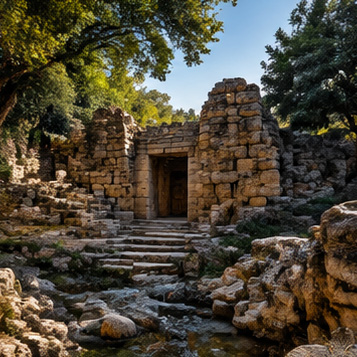
Biblical Places Unearthed · Exhibit 04
Dan / Laish
Tel Dan · Northern Israel · The city renamed by the tribe of Dan
Tel Dan preserves the remains of the northern city that Judges says was first called Laish and was renamed Dan after its capture by migrating Danites. The site stands beside one of the principal springs feeding the Jordan River. Excavation revealed a massive Middle Bronze Age mudbrick gateway, Iron Age fortifications and a cultic precinct associated with the northern kingdom. In 1993 an excavation team directed by Avraham Biran uncovered a broken Aramaic victory inscription whose surviving text includes the expression widely read as “House of David,” one of the most consequential epigraphic discoveries in Biblical archaeology.
The Scriptural Record
Every Biblical Reference to This Place
The word Dan appears many times in Scripture as the name of Jacob’s son and the tribe descended from him. The references below are the principal passages that explicitly concern the northern city or use Dan as the northern geographic endpoint of Israel; tribal references unrelated to the site are excluded.
“And they called the name of the city Dan, after the name of Dan their father, who was born unto Israel: howbeit the name of the city was Laish at the first.”King James Version
Then the five men departed, and came to Laish, and saw the people that were therein, how they dwelt careless, after the manner of the Zidonians, quiet and secure; and there was no magistrate in the land, that might put them to shame in any thing; and they were far from the Zidonians, and had no business with any man.
Then answered the five men that went to spy out the country of Laish, and said unto their brethren, Do ye know that there is in these houses an ephod, and teraphim, and a graven image, and a molten image? now therefore consider what ye have to do.
And they took the things which Micah had made, and the priest which he had, and came unto Laish, unto a people that were at quiet and secure: and they smote them with the edge of the sword, and burnt the city with fire.
And they called the name of the city Dan, after the name of Dan their father, who was born unto Israel: howbeit the name of the city was Laish at the first.
And the children of Dan set up the graven image: and Jonathan, the son of Gershom, the son of Manasseh, he and his sons were priests to the tribe of Dan until the day of the captivity of the land.
Then all the children of Israel went out, and the congregation was gathered together as one man, from Dan even to Beersheba, with the land of Gilead, unto the LORD in Mizpeh.
And all Israel from Dan even to Beersheba knew that Samuel was established to be a prophet of the LORD.
To translate the kingdom from the house of Saul, and to set up the throne of David over Israel and over Judah, from Dan even to Beersheba.
Therefore I counsel that all Israel be generally gathered unto thee, from Dan even to Beersheba, as the sand that is by the sea for multitude; and that thou go to battle in thine own person.
For the king said to Joab the captain of the host, which was with him, Go now through all the tribes of Israel, from Dan even to Beersheba, and number ye the people, that I may know the number of the people.
And Judah and Israel dwelt safely, every man under his vine and under his fig tree, from Dan even to Beersheba, all the days of Solomon.
And he set the one in Bethel, and the other put he in Dan.
And this thing became a sin: for the people went to worship before the one, even unto Dan.
So Benhadad hearkened unto king Asa, and sent the captains of the hosts which he had against the cities of Israel, and smote Ijon, and Dan, and Abelbethmaachah, and all Cinneroth, with all the land of Naphtali.
Howbeit from the sins of Jeroboam the son of Nebat, who made Israel to sin, Jehu departed not from after them, to wit, the golden calves that were in Bethel, and that were in Dan.
And David said to Joab and to the rulers of the people, Go, number Israel from Beersheba even to Dan; and bring the number of them to me, that I may know it.
And Benhadad hearkened unto king Asa, and sent the captains of his armies against the cities of Israel; and they smote Ijon, and Dan, and Abelmaim, and all the store cities of Naphtali.
They that swear by the sin of Samaria, and say, Thy god, O Dan, liveth; and, The manner of Beersheba liveth; even they shall fall, and never rise up again.
Place and Landscape
At the Springs of the Jordan
Tel Dan lies in the lush northern Hula Valley beside a powerful spring that contributes to the Jordan River. The abundant water and position near routes into Syria made the location attractive long before the Israelite period. The mound preserves remains from Canaanite Laish and from the later Israelite city of Dan.
Rediscovery and Excavation
Avraham Biran’s Long Excavation
Systematic excavation at Tel Dan began in 1966 under Avraham Biran, working for the Hebrew Union College–Jewish Institute of Religion. The project continued for decades and exposed successive fortifications, domestic areas, monumental architecture and the sanctuary complex. The unusually long excavation history allowed the team to follow the city across many occupational phases rather than treating it as a single biblical-period settlement.
What Archaeologists Uncovered
The Gate, the High Place and the Stele
Among the most striking remains is a monumental Middle Bronze Age mudbrick gateway with a preserved arched entrance, centuries older than the Israelite city. Iron Age excavations revealed fortifications and a large sacred precinct commonly discussed in connection with the royal sanctuary established at Dan in 1 Kings 12. In 1993, surveyor Gila Cook noticed lettering on a basalt fragment reused in a later wall. The fragment, and two more found in 1994, belonged to an Aramaic victory stele. Its surviving wording includes a phrase widely read as bytdwd, “House of David.”
Why the Discovery Matters
A City Whose Biblical Name Change Can Be Followed
Dan is remarkable because Scripture itself explains the transition from Laish to Dan, while archaeology reveals a major settlement at the exact northern location remembered by the repeated formula “from Dan even to Beersheba.” The cultic remains illuminate the northern kingdom’s religious landscape, and the Tel Dan Stele brings an external Aramaic royal inscription into the discussion of the Davidic dynasty.
05Exhibit 05 · Biblical Places UnearthedPool of SiloamJerusalem · Southern City of David · Reservoir fed by the Gihon water system
Biblical Places Unearthed · Exhibit 05
Pool of Siloam
Jerusalem · Southern City of David · Reservoir fed by the Gihon water system
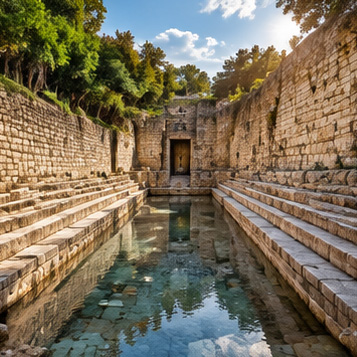
The Pool of Siloam joins the Old Testament waterworks of Jerusalem with one of the most memorable healing narratives in the Gospel of John. The water name appears in several forms in the KJV: Shiloah in Isaiah, Siloah in Nehemiah, and Siloam in Luke and John. Archaeological work has revealed elements of Jerusalem’s ancient water system and, beginning with an accidental rediscovery in 2004, monumental stepped sides belonging to the large Second Temple-period pool. The site places a named Gospel location into an excavated urban landscape at the southern end of the City of David.
The Scriptural Record
Every Biblical Reference to This Place
The KJV preserves related forms of the ancient water-name. Isaiah 8:6 names the “waters of Shiloah”; Nehemiah 3:15 names the “pool of Siloah”; Luke 13:4 names the tower in Siloam; and John 9 names the Pool of Siloam in the healing of the man born blind. These are presented together because they belong to the same Jerusalem water-name and landscape.
“And said unto him, Go, wash in the pool of Siloam, (which is by interpretation, Sent.) He went his way therefore, and washed, and came seeing.”King James Version
Forasmuch as this people refuseth the waters of Shiloah that go softly, and rejoice in Rezin and Remaliah’s son;
But the gate of the fountain repaired Shallun the son of Colhozeh, the ruler of part of Mizpah; he built it, and covered it, and set up the doors thereof, the locks thereof, and the bars thereof, and the wall of the pool of Siloah by the king’s garden, and unto the stairs that go down from the city of David.
Or those eighteen, upon whom the tower in Siloam fell, and slew them, think ye that they were sinners above all men that dwelt in Jerusalem?
And said unto him, Go, wash in the pool of Siloam, (which is by interpretation, Sent.) He went his way therefore, and washed, and came seeing.
He answered and said, A man that is called Jesus made clay, and anointed mine eyes, and said unto me, Go to the pool of Siloam, and wash: and I went and washed, and I received sight.
The Biblical Story
From Shiloah’s Waters to the Gospel of John
Isaiah knew the gentle waters of Shiloah in eighth-century BC Jerusalem. Nehemiah later refers to the Pool of Siloah beside the king’s garden during the rebuilding of Jerusalem’s walls. In the New Testament, Jesus refers to a deadly collapse of a tower in Siloam, and John 9 places the pool at the center of the healing of a man blind from birth. John even preserves the interpretation “Sent,” making the place-name part of the narrative itself.
Rediscovery and Excavation
A Pool Reappears During Sewer Work
Earlier explorers had investigated the Siloam area, including Frederick Jones Bliss and Archibald Campbell Dickie in the 1890s, and Kathleen Kenyon worked nearby in the 1960s. A decisive rediscovery came in 2004 when infrastructure work by Jerusalem’s water company exposed stone steps. Archaeologists Ronny Reich and Eli Shukron of the Israel Antiquities Authority began systematic excavation and uncovered the northern side and part of the eastern side of a monumental stepped pool dating to the Second Temple period.
What Archaeologists Uncovered
Monumental Steps at the Foot of the City
The exposed pool was constructed with broad flights of steps descending toward the water, allowing access at changing water levels. Excavators determined that the installation developed in stages and was monumental in scale. The pool lay at the southern end of the City of David, where water arriving through Jerusalem’s ancient systems collected before the ascent toward the Temple area.
The Earlier Water System
Hezekiah’s Tunnel and the Siloam Inscription
The Siloam landscape cannot be separated from the Gihon Spring and the rock-cut tunnel traditionally associated with Hezekiah’s preparations for Assyrian attack. The famous Siloam Inscription, discovered in the tunnel in 1880, describes the dramatic meeting of two cutting teams underground. The inscription itself does not name Hezekiah, so the museum keeps the inscription’s wording distinct from the biblical attribution of Jerusalem’s water engineering to the king.
Why the Discovery Matters
A Named Gospel Location in an Excavated Jerusalem
The Pool of Siloam provides a rare convergence of name, geography, water system and New Testament narrative. The visitor can move from the explicit KJV references to a real excavated pool complex at the foot of ancient Jerusalem. Archaeology does not excavate the miracle described in John 9; it does something different and valuable: it restores the physical place in which the Gospel sets the event.
06Exhibit 06 · Biblical Places UnearthedNinevehKuyunjik and Nebi Yunus · Mosul, Iraq · Capital of the Neo-Assyrian Empire
Biblical Places Unearthed · Exhibit 06
Nineveh
Kuyunjik and Nebi Yunus · Mosul, Iraq
Nineveh rises from Scripture as a city of extraordinary scale and consequence: a city associated with Assyria in Genesis, the royal residence to which Sennacherib returned, the object of Jonah’s preaching and repentance, and the doomed imperial capital named by Nahum and Zephaniah. Jesus later invoked the men of Nineveh when speaking of repentance and judgment.
The Scriptural Record
Every Biblical Reference to This Place
This exhibit preserves the complete explicit place-name record used for this location in the KJV. The principal place name is bolded inside each smaller Scripture card so the geographic reference remains immediately visible.
“Arise, go to Nineveh, that great city, and cry against it; for their wickedness is come up before me.”King James Version
Out of that land went forth Asshur, and builded Nineveh, and the city Rehoboth, and Calah,
And Resen between Nineveh and Calah: the same is a great city.
So Sennacherib king of Assyria departed, and went and returned, and dwelt at Nineveh.
So Sennacherib king of Assyria departed, and went and returned, and dwelt at Nineveh.
Arise, go to Nineveh, that great city, and cry against it; for their wickedness is come up before me.
Arise, go unto Nineveh, that great city, and preach unto it the preaching that I bid thee.
So Jonah arose, and went unto Nineveh, according to the word of the LORD. Now Nineveh was an exceeding great city of three days' journey.
And Jonah began to enter into the city a day's journey, and he cried, and said, Yet forty days, and Nineveh shall be overthrown.
So the people of Nineveh believed God, and proclaimed a fast, and put on sackcloth, from the greatest of them even to the least of them.
For word came unto the king of Nineveh, and he arose from his throne, and he laid his robe from him, and covered him with sackcloth, and sat in ashes.
And he caused it to be proclaimed and published through Nineveh by the decree of the king and his nobles, saying, Let neither man nor beast, herd nor flock, taste any thing: let them not feed, nor drink water:
And should not I spare Nineveh, that great city, wherein are more than sixscore thousand persons that cannot discern between their right hand and their left hand; and also much cattle?
The burden of Nineveh. The book of the vision of Nahum the Elkoshite.
But Nineveh is of old like a pool of water: yet they shall flee away. Stand, stand, shall they cry; but none shall look back.
And it shall come to pass, that all they that look upon thee shall flee from thee, and say, Nineveh is laid waste: who will bemoan her? whence shall I seek comforters for thee?
And he will stretch out his hand against the north, and destroy Assyria; and will make Nineveh a desolation, and dry like a wilderness.
The men of Nineveh shall rise in judgment with this generation, and shall condemn it: because they repented at the preaching of Jonas; and, behold, a greater than Jonas is here.
For as Jonas was a sign unto the Ninevites, so shall also the Son of man be to this generation.
The men of Nineve shall rise up in the judgment with this generation, and shall condemn it: for they repented at the preaching of Jonas; and, behold, a greater than Jonas is here.
The Biblical Story
The Place in Scripture
The biblical story moves from foundation traditions to imperial power, prophetic mission and judgment. Jonah calls Nineveh “that great city.” Kings and Isaiah place Sennacherib there after the Assyrian campaign against Judah. Nahum announces its fall, while Zephaniah foresees Nineveh becoming desolate. In the Gospels, Jesus treats the repentance of Nineveh as a moral witness to his own generation.
Rediscovery and Excavation
The Archaeologists and the Search
European rediscovery accelerated in the nineteenth century. Paul-Émile Botta began digging across the Tigris in 1842 before shifting to Khorsabad. Austen Henry Layard, assisted by Hormuzd Rassam and large local workforces, excavated Assyrian capitals beginning in the 1840s and exposed major portions of Sennacherib’s Southwest Palace at Nineveh. Rassam later continued work for the British Museum. Their discoveries transformed Assyria from a civilization known largely through classical and biblical texts into an excavated imperial world.
What Archaeologists Uncovered
The Physical City Beneath the Text
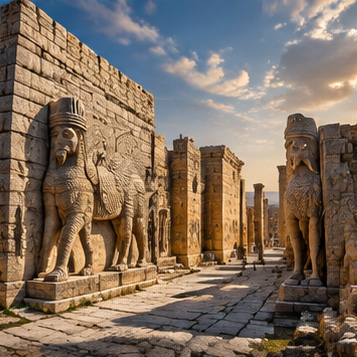
At Kuyunjik, excavators exposed Sennacherib’s “Palace Without Rival,” monumental gateways, colossal protective figures, cuneiform records and miles of carved gypsum wall panels. The palace reliefs portray Assyrian warfare and royal power, including the famous Lachish cycle. The site also yielded the royal library associated with Ashurbanipal, preserving thousands of cuneiform tablets and fragments.
Why the Discovery Matters
Scripture in a Recoverable Landscape
Nineveh is one of the strongest examples in the collection of a biblical imperial capital returning to view through archaeology. The excavated palaces belong to the same Assyrian world named in Kings, Isaiah, Jonah and Nahum. Archaeology does not prove Jonah’s preaching or the repentance narrative; it restores the enormous city, court culture and imperial setting in which Scripture places them.
07Exhibit 07 · Biblical Places UnearthedCaesarea MaritimaMediterranean coast of Israel · Roman Judaea · Herod’s harbor city and Roman administrative capital
Biblical Places Unearthed · Exhibit 07
Caesarea Maritima
Mediterranean coast of Israel · Roman Judaea
Caesarea Maritima is woven through the book of Acts as a Roman coastal capital, military center, port and judicial setting. Philip arrives there, Cornelius lives there, Herod Agrippa I dies there, Paul repeatedly passes through it, and Paul is eventually held and examined there before Roman governors and King Agrippa.
The Scriptural Record
Every Biblical Reference to This Place
This exhibit preserves the complete explicit place-name record used for this location in the KJV. The principal place name is bolded inside each smaller Scripture card so the geographic reference remains immediately visible.
“There was a certain man in Caesarea called Cornelius, a centurion of the band called the Italian band,”King James Version
But Philip was found at Azotus: and passing through he preached in all the cities, till he came to Caesarea.
Which when the brethren knew, they brought him down to Caesarea, and sent him forth to Tarsus.
There was a certain man in Caesarea called Cornelius, a centurion of the band called the Italian band,
And the morrow after they entered into Caesarea. And Cornelius waited for them, and had called together his kinsmen and near friends.
And, behold, immediately there were three men already come unto the house where I was, sent from Caesarea unto me.
And when Herod had sought for him, and found him not, he examined the keepers, and commanded that they should be put to death. And he went down from Judaea to Caesarea, and there abode.
And when he had landed at Caesarea, and gone up, and saluted the church, he went down to Antioch.
And the next day we that were of Paul's company departed, and came unto Caesarea: and we entered into the house of Philip the evangelist, which was one of the seven; and abode with him.
There went with us also certain of the disciples of Caesarea, and brought with them one Mnason of Cyprus, an old disciple, with whom we should lodge.
And he called unto him two centurions, saying, Make ready two hundred soldiers to go to Caesarea, and horsemen threescore and ten, and spearmen two hundred, at the third hour of the night;
Who, when they came to Caesarea, and delivered the epistle to the governor, presented Paul also before him.
Now when Festus was come into the province, after three days he ascended from Caesarea to Jerusalem.
But Festus answered, that Paul should be kept at Caesarea, and that he himself would depart shortly thither.
And when he had tarried among them more than ten days, he went down unto Caesarea; and the next day sitting on the judgment seat commanded Paul to be brought.
And after certain days king Agrippa and Bernice came unto Caesarea to salute Festus.
The Biblical Story
The Place in Scripture
Acts presents Caesarea as a hinge between Jerusalem and the wider Roman world. Cornelius, a centurion at Caesarea, becomes central to the expansion of the Gospel to Gentiles. Later, Paul is escorted under heavy guard to the city, appears before Felix and Festus, and speaks before Agrippa. The repeated place-name is not incidental: Caesarea was the seat of Roman government in Judaea.
Rediscovery and Excavation
The Archaeologists and the Search
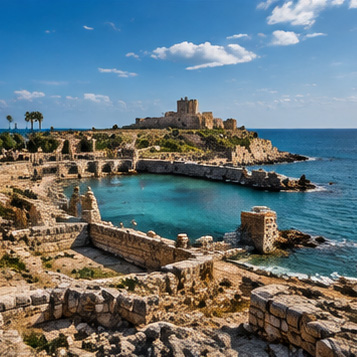
Herod the Great constructed the city and its immense artificial harbor beginning in the late first century BC. Modern archaeological investigation has involved numerous expeditions. A decisive discovery came in 1961 when an Italian mission directed by Antonio Frova excavated the Roman theater. A reused limestone block carried a Latin dedication naming Pontius Pilate and identifying him as prefect of Judaea.
What Archaeologists Uncovered
The Physical City Beneath the Text
Excavation has revealed the theater, hippodrome, harbor installations, aqueducts, streets, bath complexes, warehouses and administrative architecture of the Roman city. The so-called Pilate Stone is especially important because it comes from Caesarea and preserves the name of the Roman governor who appears in the Gospel accounts of Jesus’ trial. Its findspot in the theater also illustrates the later reuse of inscribed building stone.
Why the Discovery Matters
Scripture in a Recoverable Landscape
Caesarea lets visitors stand inside the political geography of Acts. The city’s harbor and administrative buildings explain why travelers, soldiers, governors and prisoners repeatedly pass through it. The Pilate inscription independently anchors a named New Testament official in the archaeological record of the same Roman provincial capital.
08Exhibit 08 · Biblical Places UnearthedCapernaumNorthwestern shore of the Sea of Galilee · A principal center of Jesus’ Galilean ministry
Biblical Places Unearthed · Exhibit 08
Capernaum
Northwestern shore of the Sea of Galilee
Capernaum appears sixteen times by name in the New Testament and becomes one of the most concentrated geographic settings of Jesus’ Galilean ministry. Matthew says Jesus came and dwelt there. The Gospels place teaching in its synagogue, healings in its houses, the centurion’s appeal, the tribute-money episode and repeated returns of Jesus and the disciples within the town.
The Scriptural Record
Every Biblical Reference to This Place
This exhibit preserves the complete explicit place-name record used for this location in the KJV. The principal place name is bolded inside each smaller Scripture card so the geographic reference remains immediately visible.
“And they went into Capernaum; and straightway on the sabbath day he entered into the synagogue, and taught.”King James Version
And leaving Nazareth, he came and dwelt in Capernaum, which is upon the sea coast, in the borders of Zabulon and Nephthalim:
And when Jesus was entered into Capernaum, there came unto him a centurion, beseeching him,
And thou, Capernaum, which art exalted unto heaven, shalt be brought down to hell: for if the mighty works, which have been done in thee, had been done in Sodom, it would have remained until this day.
And when they were come to Capernaum, they that received tribute money came to Peter, and said, Doth not your master pay tribute?
And they went into Capernaum; and straightway on the sabbath day he entered into the synagogue, and taught.
And again he entered into Capernaum after some days; and it was noised that he was in the house.
And he came to Capernaum: and being in the house he asked them, What was it that ye disputed among yourselves by the way?
And he said unto them, Ye will surely say unto me this proverb, Physician, heal thyself: whatsoever we have heard done in Capernaum, do also here in thy country.
And came down to Capernaum, a city of Galilee, and taught them on the sabbath days.
Now when he had ended all his sayings in the audience of the people, he entered into Capernaum.
And thou, Capernaum, which art exalted to heaven, shalt be thrust down to hell.
After this he went down to Capernaum, he, and his mother, and his brethren, and his disciples: and they continued there not many days.
So Jesus came again into Cana of Galilee, where he made the water wine. And there was a certain nobleman, whose son was sick at Capernaum.
And entered into a ship, and went over the sea toward Capernaum. And it was now dark, and Jesus was not come to them.
When the people therefore saw that Jesus was not there, neither his disciples, they also took shipping, and came to Capernaum, seeking for Jesus.
These things said he in the synagogue, as he taught in Capernaum.
The Biblical Story
The Place in Scripture
The New Testament repeatedly moves between the shoreline, houses and synagogue of Capernaum. Mark says that after Jesus returned, “it was noised that he was in the house.” John places the Bread of Life teaching in the synagogue at Capernaum. Yet the city also receives a severe rebuke in Matthew 11 and Luke 10 because mighty works had not produced corresponding repentance.
Rediscovery and Excavation
The Archaeologists and the Search
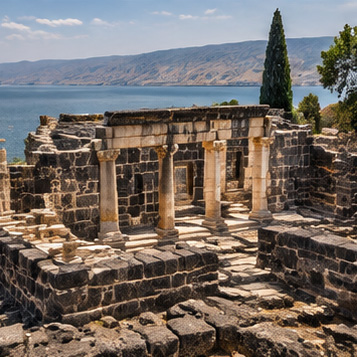
Archaeological attention focused early on the prominent white-limestone synagogue. Excavations began in 1905 and were continued by Gaudenzio Orfali in 1921. In 1968 Virgilio Corbo and Stanislao Loffreda of the Studium Biblicum Franciscanum began a long renewed campaign. From 1968 to 1986 they directed nineteen seasons, with Loffreda returning for additional work from 2000 to 2003.
What Archaeologists Uncovered
The Physical City Beneath the Text
Excavators exposed basalt residential quarters, a monumental late antique synagogue standing over earlier remains, and beneath a Byzantine octagonal church a sequence of domestic structures. Corbo and Loffreda interpreted one house complex as a first-century residence later adapted for Christian gathering and veneration, traditionally associated with Peter. Beneath the later synagogue, earlier basalt structures and pavement demonstrate that the location had a substantial earlier building phase, though the precise dating and identification of those remains continue to be discussed.
Why the Discovery Matters
Scripture in a Recoverable Landscape
Capernaum gives the Gospel narratives an unusually intimate archaeological setting: streets, basalt houses, shoreline economy and a synagogue location can all be examined together. The excavated remains do not identify individual miracles, but they recover the kind of townscape in which the Gospels repeatedly place Jesus.
09Exhibit 09 · Biblical Places UnearthedEphesusWestern Asia Minor · modern Türkiye · Roman metropolis, theater city and one of the seven churches
Biblical Places Unearthed · Exhibit 09
Ephesus
Western Asia Minor · modern Türkiye
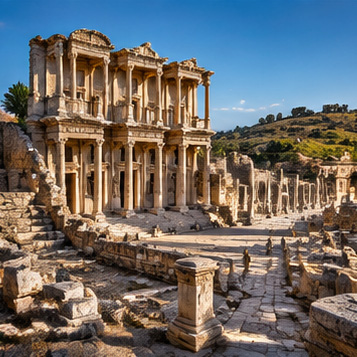
Ephesus was one of the great cities of Roman Asia and became a major center of Paul’s ministry. Acts places Paul, Apollos and the Ephesian church within a city famous for the worship of Artemis. Paul’s preaching disrupted the economy surrounding images of the goddess, and Acts describes an enormous civic disturbance that culminated in the theater.
The Scriptural Record
Every Biblical Reference to This Place
This exhibit preserves the complete explicit place-name record used for this location in the KJV. The principal place name is bolded inside each smaller Scripture card so the geographic reference remains immediately visible.
“Moreover ye see and hear, that not alone at Ephesus, but almost throughout all Asia, this Paul hath persuaded and turned away much people, saying that they be no gods, which are made with hands:”King James Version
And he came to Ephesus, and left them there: but he himself entered into the synagogue, and reasoned with the Jews.
But bade them farewell, saying, I must by all means keep this feast that cometh in Jerusalem: but I will return again unto you, if God will. And he sailed from Ephesus.
And a certain Jew named Apollos, born at Alexandria, an eloquent man, and mighty in the scriptures, came to Ephesus.
And it came to pass, that, while Apollos was at Corinth, Paul having passed through the upper coasts came to Ephesus: and finding certain disciples,
And this was known to all the Jews and Greeks also dwelling at Ephesus; and fear fell on them all, and the name of the Lord Jesus was magnified.
Moreover ye see and hear, that not alone at Ephesus, but almost throughout all Asia, this Paul hath persuaded and turned away much people, saying that they be no gods, which are made with hands:
For Paul had determined to sail by Ephesus, because he would not spend the time in Asia: for he hasted, if it were possible for him, to be at Jerusalem the day of Pentecost.
And from Miletus he sent to Ephesus, and called the elders of the church.
If after the manner of men I have fought with beasts at Ephesus, what advantageth it me, if the dead rise not? let us eat and drink; for to morrow we die.
But I will tarry at Ephesus until Pentecost.
Paul, an apostle of Jesus Christ by the will of God, to the saints which are at Ephesus, and to the faithful in Christ Jesus:
As I besought thee to abide still at Ephesus, when I went into Macedonia, that thou mightest charge some that they teach no other doctrine,
The Lord grant unto him that he may find mercy of the Lord in that day: and in how many things he ministered unto me at Ephesus, thou knowest very well.
And Tychicus have I sent to Ephesus.
Saying, I am Alpha and Omega, the first and the last: and, What thou seest, write in a book, and send it unto the seven churches which are in Asia; unto Ephesus, and unto Smyrna, and unto Pergamos, and unto Thyatira, and unto Sardis, and unto Philadelphia, and unto Laodicea.
Unto the angel of the church of Ephesus write; These things saith he that holdeth the seven stars in his right hand, who walketh in the midst of the seven golden candlesticks;
The Biblical Story
The Place in Scripture
The New Testament record stretches beyond Acts. Paul refers to his experiences at Ephesus in 1 Corinthians, Timothy is instructed to remain there, and Revelation addresses Ephesus first among the seven churches of Asia. The city therefore connects missionary history, church instruction and Revelation within a single recoverable urban landscape.
Rediscovery and Excavation
The Archaeologists and the Search
Archaeological work at Ephesus has been conducted by the Austrian Archaeological Institute since 1895. More than a century of excavation, architectural study and publication has exposed one of the most extensive ancient urban landscapes in the Mediterranean. The long-running Forschungen in Ephesos series has documented monuments and material culture in dozens of scholarly volumes.
What Archaeologists Uncovered
The Physical City Beneath the Text
Visitors can examine the enormous theater, processional and commercial streets, civic buildings, terrace houses, baths, fountains, temples and remains connected with the Artemis sanctuary. Research on the theater shows that it developed through multiple construction phases from the Hellenistic into the Roman imperial period. Acts 19 explicitly places the Ephesian crowd in “the theatre,” making the surviving structure especially evocative even though portions visible today reflect later enlargement.
Why the Discovery Matters
Scripture in a Recoverable Landscape
Ephesus allows the visitor to move from Acts 19 into a monumental Roman city that still preserves the scale necessary to understand the narrative. Its theater, civic center and Artemis tradition illuminate why a dispute over religious images and commerce could become a citywide crisis, while Revelation gives the same city a later place in the history of the early churches.
10Exhibit 10 · Biblical Places UnearthedCorinthIsthmus of Corinth · Achaia, Greece · Roman provincial capital and center of Paul’s ministry
Biblical Places Unearthed · Exhibit 10
Corinth
Isthmus of Corinth · Achaia, Greece
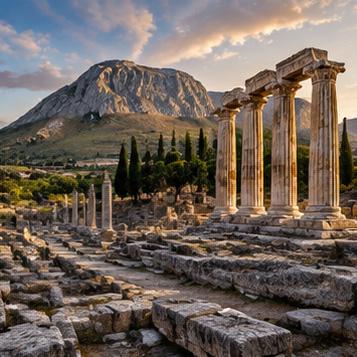
Corinth stood on the narrow land bridge joining mainland Greece to the Peloponnese and commanded routes toward two seas. By Paul’s time it was a prosperous Roman colony and provincial capital. Acts 18 makes the city one of the most important settings of Paul’s missionary work, and the New Testament preserves two major letters addressed to the church at Corinth.
The Scriptural Record
Every Biblical Reference to This Place
This exhibit preserves the complete explicit place-name record used for this location in the KJV. The principal place name is bolded inside each smaller Scripture card so the geographic reference remains immediately visible.
“After these things Paul departed from Athens, and came to Corinth;”King James Version
After these things Paul departed from Athens, and came to Corinth;
And it came to pass, that, while Apollos was at Corinth, Paul having passed through the upper coasts came to Ephesus: and finding certain disciples,
Unto the church of God which is at Corinth, to them that are sanctified in Christ Jesus, called to be saints, with all that in every place call upon the name of Jesus Christ our Lord, both theirs and ours:
Paul, an apostle of Jesus Christ by the will of God, and Timothy our brother, unto the church of God which is at Corinth, with all the saints which are in all Achaia:
Moreover I call God for a record upon my soul, that to spare you I came not as yet unto Corinth.
Erastus abode at Corinth: but Trophimus have I left at Miletum sick.
The Biblical Story
The Place in Scripture
Paul came to Corinth after Athens and worked alongside Aquila and Priscilla. Acts describes his synagogue ministry, the formation of a believing community and his appearance before Gallio at the judgment seat. The letters to the Corinthians then open a window into the life of that church: factionalism, worship, moral disputes, spiritual gifts, love, resurrection and the practical challenges of Christian life in a cosmopolitan Roman city.
Rediscovery and Excavation
The Archaeologists and the Search
The American School of Classical Studies at Athens began excavating Ancient Corinth in 1896, and work has continued with relatively little interruption into the present. More than a century of excavation has documented the city from prehistoric periods through Greek, Roman, Byzantine and later occupation, producing a vast archive of notebooks, photographs, plans and published studies.
What Archaeologists Uncovered
The Physical City Beneath the Text
Excavations exposed the Roman forum, temples, fountains, shops, theater, roads and the prominent rostra or bema in the forum, often discussed in connection with Paul’s appearance before Gallio. East of the theater an inscription records that Erastus paid for paving while serving as a civic official. Scholars have long compared that inscription with the Erastus named in Romans 16:23, while recognizing that identity cannot be established from the name alone.
Why the Discovery Matters
Scripture in a Recoverable Landscape
Corinth is powerful because the excavated Roman city gives physical scale to Acts and to the social world behind the Corinthian correspondence. The forum and bema recover the administrative setting of a Roman colony, while inscriptions, streets and public buildings reveal the civic environment in which the early church lived and argued.